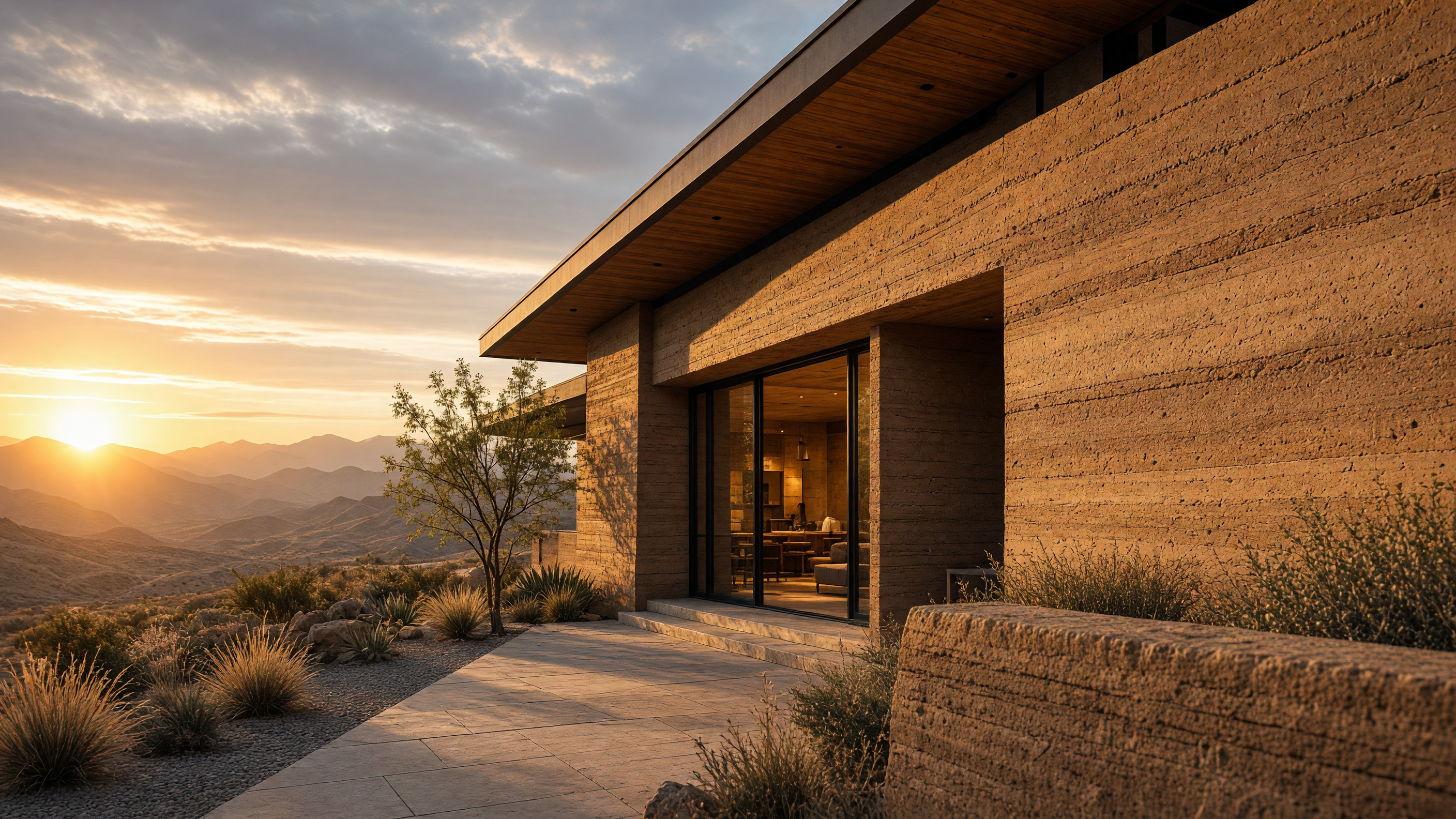
The first thing you feel in a rammed-earth room is not the view. It is the temperature of the unpainted wall against your knuckles: cool in July, faintly warm in January, always slightly mineral, as if the ground had been stood on end.
Rammed earth is soil, a little water, and often a measured dose of cement, packed in lifts inside timber formwork until each layer rings. When the boards come off, the wall keeps the memory of the pit—ochre, then grey, then a rust band where iron oxide ran through the mix. It looks geological because it is. You are living inside a compressed hillside.
That mass is a kind of weather of its own. A wall eighteen inches or two feet thick does not follow the hour. It takes the day's glare and gives it back after dark, flattening the afternoon spike and the drop of night. In a hot-dry valley the rooms stay in the sixties while the gravel outside ticks with heat. In a colder place the same inertia holds the stove, the low winter sun through a deep reveal, the leftover warmth of cooking. You reach for the thermostat less, because the rooms have already decided.
The method is older than our language for energy. Hakka tulou in Fujian rose in rammed rings that held entire clans. In the Dauphiné, pisé farmhouses have stood through two centuries of freeze. Chinese hangtu, French pisé: local dirt, same physics. What we ask now is different—codes, an insulation sandwich, windows that are more glass than puncture. Martin Rauch, working from Schlins in the Vorarlberg, has spent decades making the material precise without sanding away its sedimentary face. His own house reads as a cliff with furniture. At another scale, Herzog & de Meuron's Ricola Kräuterzentrum in Laufen uses Rauch's technique in long, banded façades that look poured from the surrounding ground because, more or less, they were.
In the Sonoran Desert, Casa Caldera by the studio DUST sits low, its walls thick enough that the interior is a cave with a view. Light arrives as a cut. You feel the thickness in the window, which is a short tunnel, and in the acoustics: voices stay put; rain on the roof is someone else's weather.
Along the Margaret River and through the wheatbelt, Australian builders took to rammed earth with a practical affection: iron-red walls, wide eaves, interiors that treat the glare as something to be delayed. You step from the veranda into a sudden dimness. Then the bands of soil come forward, and the heat stays outside a little longer than it should.
People lean on these walls the way they lean on masonry stoves. The surface is not smooth. Raking light catches every lift line. At dusk the wall is still returning the afternoon to the room. After rain a faint clay sweetness comes in under the eaves. If the floor is earth as well, it takes a polish like old leather.