In a factory near the highway, the apartments lie on their sides. Workers walk what will be a ceiling. A window, already glazed, looks at fluorescent tubes instead of a street. By the time the unit stands upright on a city lot, that glass will face a courtyard, a brick wall, or the crown of a plane tree.
The interior smells of adhesive and new gypsum. Edges are true. Joints that will later disappear under paint remain a pencil line. Modular construction for multifamily housing is usually explained as logistics: fewer days of weather, fewer trades on a crowded sidewalk, a crane instead of a year of scaffolding. All of that is real. What I notice first is quieter. The floor does not bounce. The window sits in its opening as if it had always belonged there.
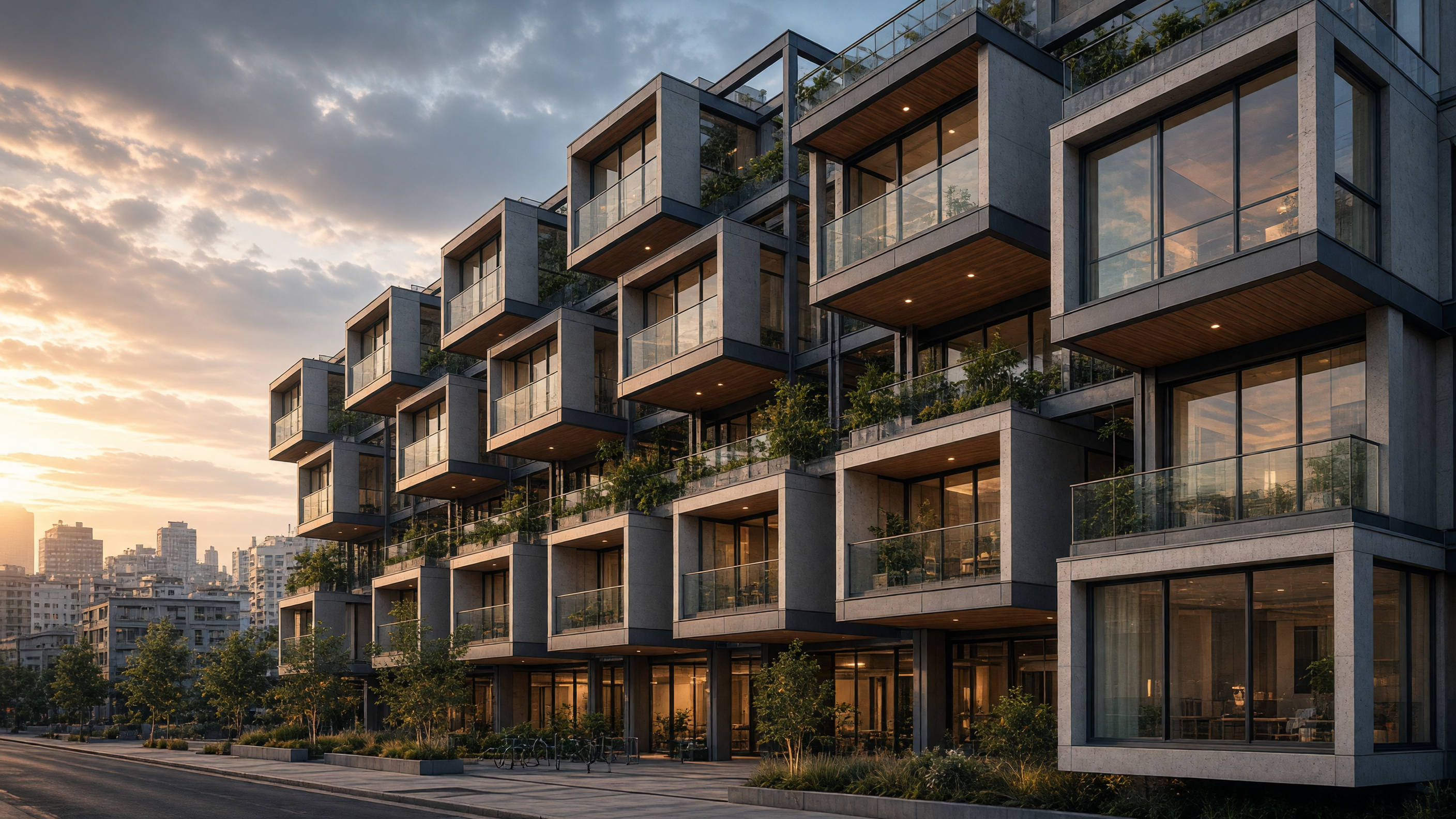
Habitat 67 still occupies the photographs, concrete boxes stacked like a stubborn game. Moshe Safdie wanted gardens in the air. Most work now is less theatrical. nArchitects' Carmel Place in Manhattan arrived as modules and became a thin tower of small rooms, light dropping down a slot of court. In Swedish towns such as Växjö, timber modules rise four and five stories, spruce grain showing at a door frame after rain. Japan has treated the factory house as ordinary for decades; Sekisui delivers rooms without ceremony.
Affordable cities are assembled from land prices, lot widths, parking rules, and the cost of money. A factory can shorten the hours spent in rain. It cannot invent a cheaper parcel beside a train. Time, though, is a kind of money. A building that closes in weeks rather than seasons takes on less water and fewer change orders. Neighbors who dread two years of jackhammers will sometimes accept a week of crane work at dawn, modules wrapped in plastic, swinging over parked cars.
I look for how the pieces meet. A hallway that does not advertise its seam. A party wall thick enough that a laugh comes through muffled, not a television. In cheaper work the joint is a ridge under the paint, a change in the hollow of the floor. In better work you forget, until a repeating window rhythm appears, the ghost of a jig.
Light behaves differently when the wall was built lying down. The sill is level. Morning arrives in a clean rectangle. I have stood in a four-story walk-up where the stair was poured in place and the rooms had traveled. The contrast was almost tender: the stair already scuffed, the apartments still carrying a faint smell of the plant.
Winter is the honest season. A well-sealed module holds heat and holds sound. You hear the street as through thicker glass. In summer the same envelope can feel tight unless someone has insisted on a cross breeze, a balcony, a shared court for laundry and conversation.
The modules weather at their joints first. Paint fails in a hairline. Someone sets a plant on the sill that once faced a factory lamp. In the court below, a bicycle lock clicks. The stair smells of rain and rubber.