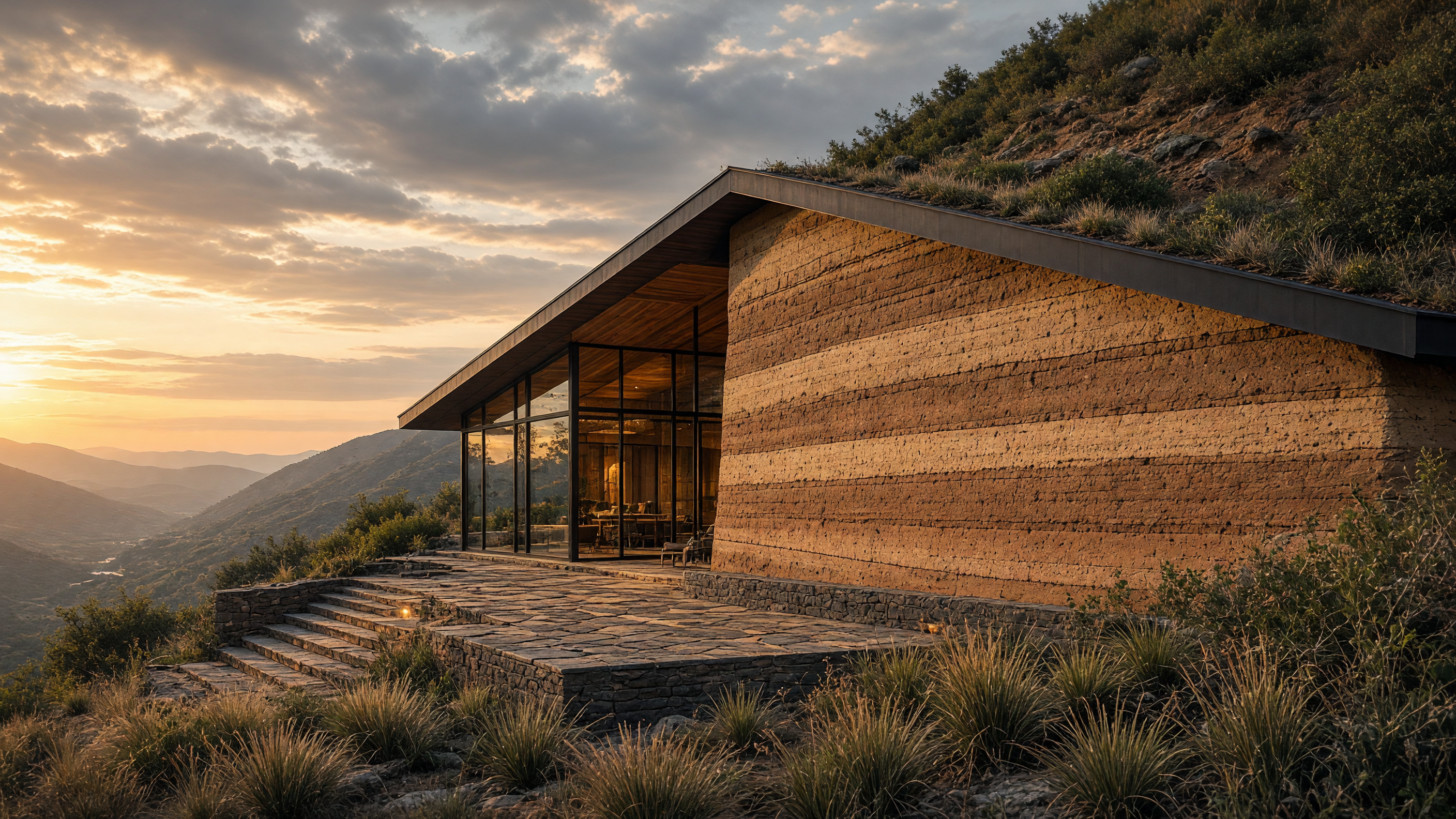
Stand close to a rammed-earth wall and you can read it like a cut bank after rain. Horizontal bands of ochre, grey, and pale rose mark each lift of soil, each afternoon of labor. The surface is neither plaster nor cut stone. It is dirt, densified until it can carry a roof and hold the day’s heat after the sun has gone.
The method is old. The Chinese called it hangtu. The French, pisé de terre. In the High Atlas, kasbahs rose from the same red earth they sat on, their towers returning to it when abandoned. What feels contemporary is the decision, in an age of foam panels and distant steel, to compact local subsoil into load-bearing walls again—not as costume, but as a way of keeping the mass of the site inside the house.
Martin Rauch, working from Schlins in Austria’s Vorarlberg, has spent decades treating the craft with a mason’s patience. His walls are sharp at the edges, almost ceramic, yet they still show the geology of the pit: a gravel line, a darker seam of clay, the faint glitter of mica. At his own house, and later at the Ricola Kräuterzentrum with Herzog & de Meuron, the earth is not a finish applied to a frame. It is the structure. Rooms go quiet. Summer heat arrives late. In winter the walls give back what they stored, slowly, like a stove that never quite goes out.
I once spent an hour in a laterite house in Western Australia, the soil the color of rusted iron. The builder had left the interior unplastered. Light from a high slot window slid down the strata and stopped. The air smelled faintly of dust after rain, though it had not rained. You do not decorate such a wall so much as live beside it, the way you live beside a hillside that happens to have doors.
There are limits, and they are physical rather than fashionable. Rammed earth hates prolonged saturation. Overhangs matter. In wet climates the wall wants a hat and boots—a wide eave, a raised plinth, a drip that actually drips. A small measure of cement is a compromise many builders accept and others refuse; the argument is less moral than hygroscopic. The labor is real: formwork, lifts of perhaps eight inches, the ringing of a pneumatic rammer or, on smaller work, the thud of a hand tool. It is closer to masonry than to pouring a slab, and it refuses to be hurried.
What people who care about extraction often want from these houses is a figure—embodied carbon, thermal lag, the happy coincidence that the soil came from the excavation itself. Those figures can be favorable. The more stubborn fact is sensory. A rammed-earth room has a particular silence and a particular temperature. Hands find the coolness without thinking. Evening light makes the layers recede and then advance, like a shoreline.
At Nk’Mip, the desert cultural centre in Osoyoos, the walls are two feet thick and the color of the surrounding sage country. They do not advertise a way of life. They simply hold the Okanagan day and give it back after closing, dust settling in the strata, the rammed lifts still readable under a thin wash of late sun.