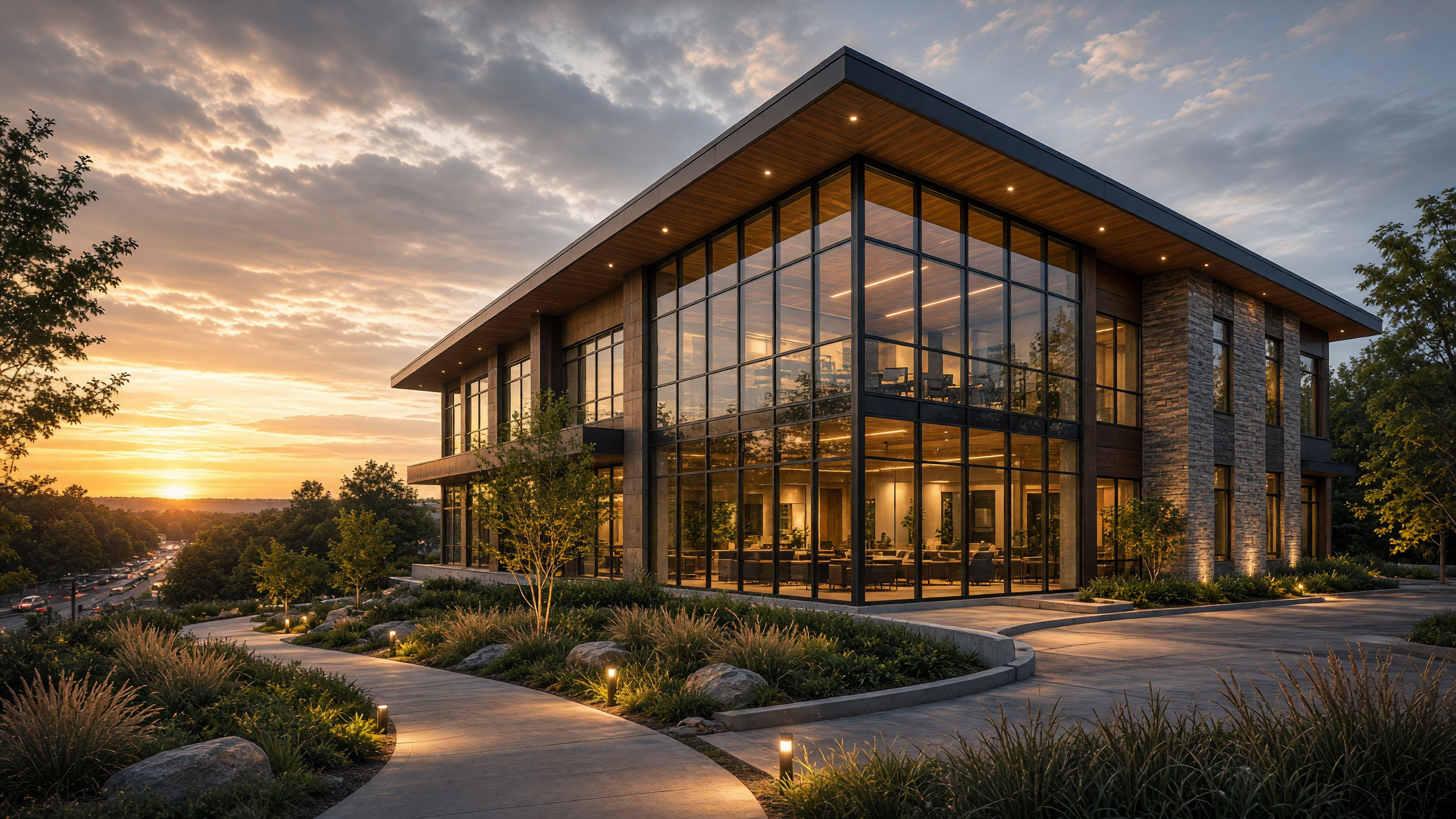
You hear the building before you see it. Not the HVAC roar of a downtown tower, but a milder sound: a heat pump cycling, a glass door that doesn't slam, someone laughing in a kitchen that faces a parking lot still wet from last night's rain.
The suburban satellite office is not a campus and not a spare bedroom. It occupies the landscape Americans already know—the arterial, the former bank, the medical-office park with Bradford pears and a monument sign. Hybrid work did not invent this geography. It asked it to hold a different kind of day.
In the 1980s these parcels filled with speculative office parks, beige and deep, windows tinted against a sun that never reached the interior. Then they emptied. Retail followed, then thinned. What remains is structure, parking, and zoning that still permits work.
The satellite of the hybrid years is smaller and more particular. A firm might keep a few floors downtown for days that need a long table. The rest of the week, people drive twelve minutes instead of forty-five and sit where the light is lower, more lateral, more like a house.
I think of a converted savings-and-loan on a first-ring corner. The drive-through canopy remains, a concrete wing over nothing. Inside, the teller line is a long table. The vault is a phone room. The brick is the cheap blond of 1974, whitewashed now, and afternoon sun hits it the way it hits a garden wall.
Materials matter because the building cannot rely on height. Oak allowed to look like oak. Linoleum that isn't pretending to be stone. Acoustic felt the color of oatmeal. Cork underfoot that gives a little. Windows that open six inches, because the people inside have already rejected the sealed glass box.
There is a social texture, too. You see neighbors—the person three cul-de-sacs over who also needed a door to close. The satellite is closer to a parish hall than a headquarters. People arrive in coats. They leave for school pickup. The copier is quieter than the one downtown, or maybe people are.
Light is the real luxury. Low-rise means the sun still belongs to the room. In winter it slides across a table at 3:30 and makes the whole place feel like late afternoon in a public library. In summer those unloved 1970s soffits finally do a job, throwing a band of shade that lets the glass stay clear.
The danger is familiar: another layer of underused carpet, another monument sign with a missing letter. The better versions treat the satellite as a civic fragment. A courtyard that isn't only for smokers. A path that doesn't end at a dumpster. A café open after five, so the building has a life beyond billed hours.
I have stood in one of these rooms at 9:15 on a Wednesday. Traffic on the arterial is already thinning. Coffee smells like an actual kitchen. Through the glass: a row of cars, a strip of grass, a sky that is just sky, not a reflection of other towers. For a few hours, work has a horizon again.