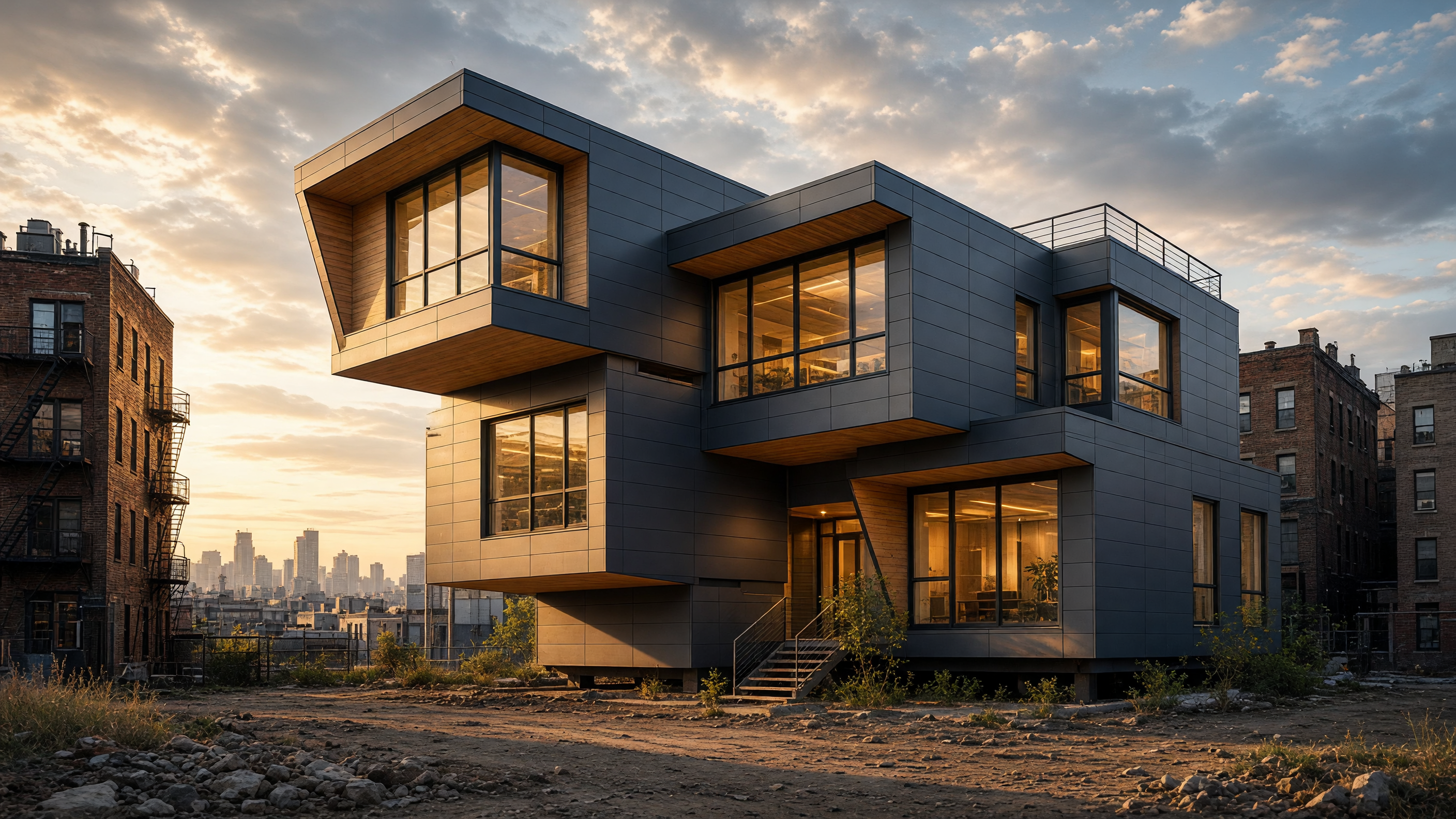
On a Tuesday the lot is still chain-link and standing water. By Thursday a crane has settled at the curb like a visiting relative, and three cream-colored modules hang in the air, turning slowly, looking for the exact coordinates of a house.
This is how infill often arrives now: not as a long argument of scaffolding and weather, but as rooms already finished, kitchens smelling faintly of adhesive and new timber. The neighboring brick does not change. The stoop next door keeps its iron railing. What changes is the gap.
I have always liked the gap. Cities are full of them—the missing tooth in a row of brownstones, the parking scrap behind a warehouse, the odd parallelogram left when two grids refuse to meet. These sites are too small for the usual development machine and too visible to remain empty forever. They ask for something made elsewhere, then lowered in with civic courtesy.
Prefab housing has a longer memory than its brochures admit. Sears sold more than seventy thousand kit houses by rail. Jean Prouvé stamped aluminum walls that could be bolted in the tropics. Most of those dreams preferred the open field. Urban infill is a stricter guest. It must nod to the cornice line. It must share a party wall without insulting the plaster on the other side. It must arrive without taking down the maple someone planted in 1987.
The best modules do not pretend to be site-built. You can read the seams. A shadow line runs where two boxes meet, a thin dark joint like the space between piano keys. Inside, the ceiling sits a little lower than the old apartment next door, and windows are punched with factory regularity. Light arrives as rectangles, not as the irregular wash of a bay framed by a carpenter who liked to improvise. You feel the precision of the jig, a floor screwed down on a slab two hundred miles away while rain fell on this lot. At dusk the new metal flashing picks up a colder light than the old brick.
Carmel Place in Manhattan stacked micro-units on a leftover midblock site, rooms finished upstate and driven in at night. GLUCK+’s The Stack rose on West 28th Street in weeks, modules already holding bathrooms, tile, even the slight scuff of a factory worker’s boot. The street barely noticed until the crane left and the façade was finally itself.
Walking past, what matters is not speed. Speed is a contractor’s metric. What matters is whether the new wall holds a conversation with the old ones: brick against metal panel, cedar against painted brownstone, a window that aligns, almost, with the neighbor’s parlor. The almost is important. Perfect alignment would be a kind of lie. Cities are accumulations of near-misses.
A module does not creak into place the way timber framing does. It lands with a dull, satisfied thud, then crews torque the connections and the building becomes continuous. Someone will cook in that kitchen. Steam will fog a window glazed in a warehouse. The lot that held rain will hold a table.