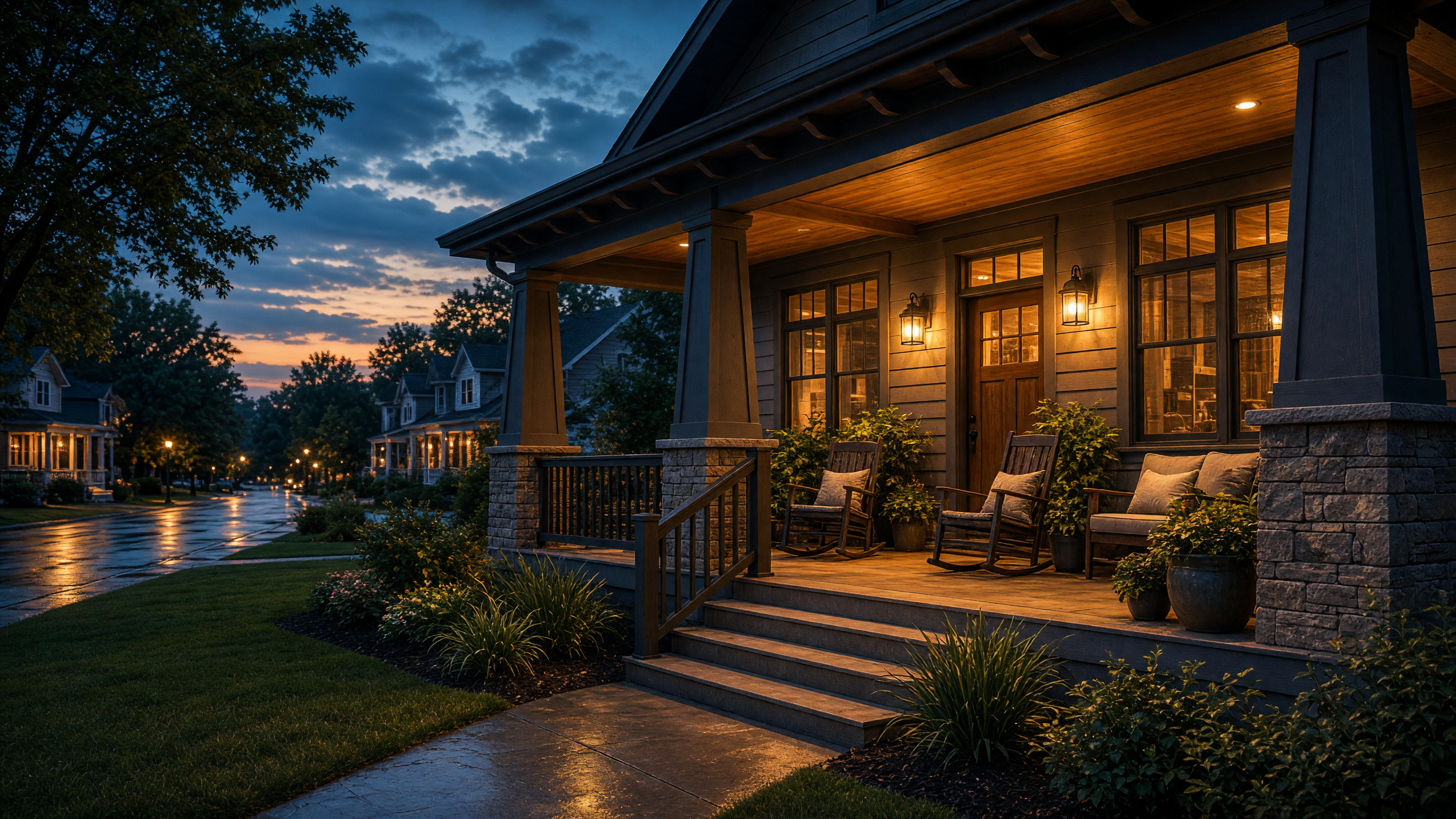
The first thing you notice is the ceiling. In older Southern houses it is often painted a pale, watery blue, a color meant to confuse wasps and to hold a little of the sky after the sun has gone. Sit there at six in the evening and the boards still keep the day’s heat. A moth ticks against the bulb. Two doors down someone is watering tomatoes, and you hear the hose without leaving the chair.
For half a century the American suburb turned its face from this kind of room. The front became a garage door, a strip of unused lawn, a walk that led only to the car. Air-conditioning and television finished the work. Neighbors became people you waved at through windshields. The house no longer offered a place that was neither fully private nor fully public: a place where you could be seen without being visited, and could visit without being asked inside.
That in-between is what the porch does. It is architecture as a pause. You sit with a book and remain available. A child on a bicycle slows. A dog pulls toward the steps. Talk happens at the volume of the street, not the living room. You do not patrol the block. You occupy the threshold, and the street becomes faintly inhabited again.
Craftsman bungalows understood the dimensions. Their porches were deep, low, honest about wood: thick posts, exposed rafters, a floor that sloped just enough to shed rain. In Charleston the piazza runs the length of the house, turned sideways to catch the breeze and to keep conversation slightly off the sidewalk—a courtesy and a claim at once. Later pattern-book towns, from Seaside to the rebuilt streetcar edges of Portland, put the porch back into the lot. Some of it was nostalgia. Some of it worked because the setback was close enough for a greeting and deep enough that a stranger did not feel they had entered your rooms.
Materials matter more than style. Pressure-treated lumber and simple railings will still function if the space is deep and furnished. A handsome porch that is too shallow becomes a hat the house wears and never uses. The ones that last have a ceiling fan, a place to set a glass, and a view that includes other people, not only other lawns. Brick piers that meet the ground with some weight. Steps wide enough for two people to pass groceries and a few sentences.
I watched a new porch change a 1970s ranch block north of Atlanta. The owners kept the brick, added a hipped roof, and set two rocking chairs slightly off-center, as if someone had just stood up. Within a month the chairs were rarely empty at dusk. A neighbor of twelve years learned the name of the woman next door. Nothing dramatic. Only the slow return of a civic habit that the garage-front house had almost designed out of existence.
The sound of a screen door is particular: a slap, then the spring’s long complaint. It announces arrival without a knock. In winter the porch is less used but still present, a snow-dusted room waiting. In rain it becomes a shelter you share with whoever is already sitting there, the house, for a while, no longer a sealed box.