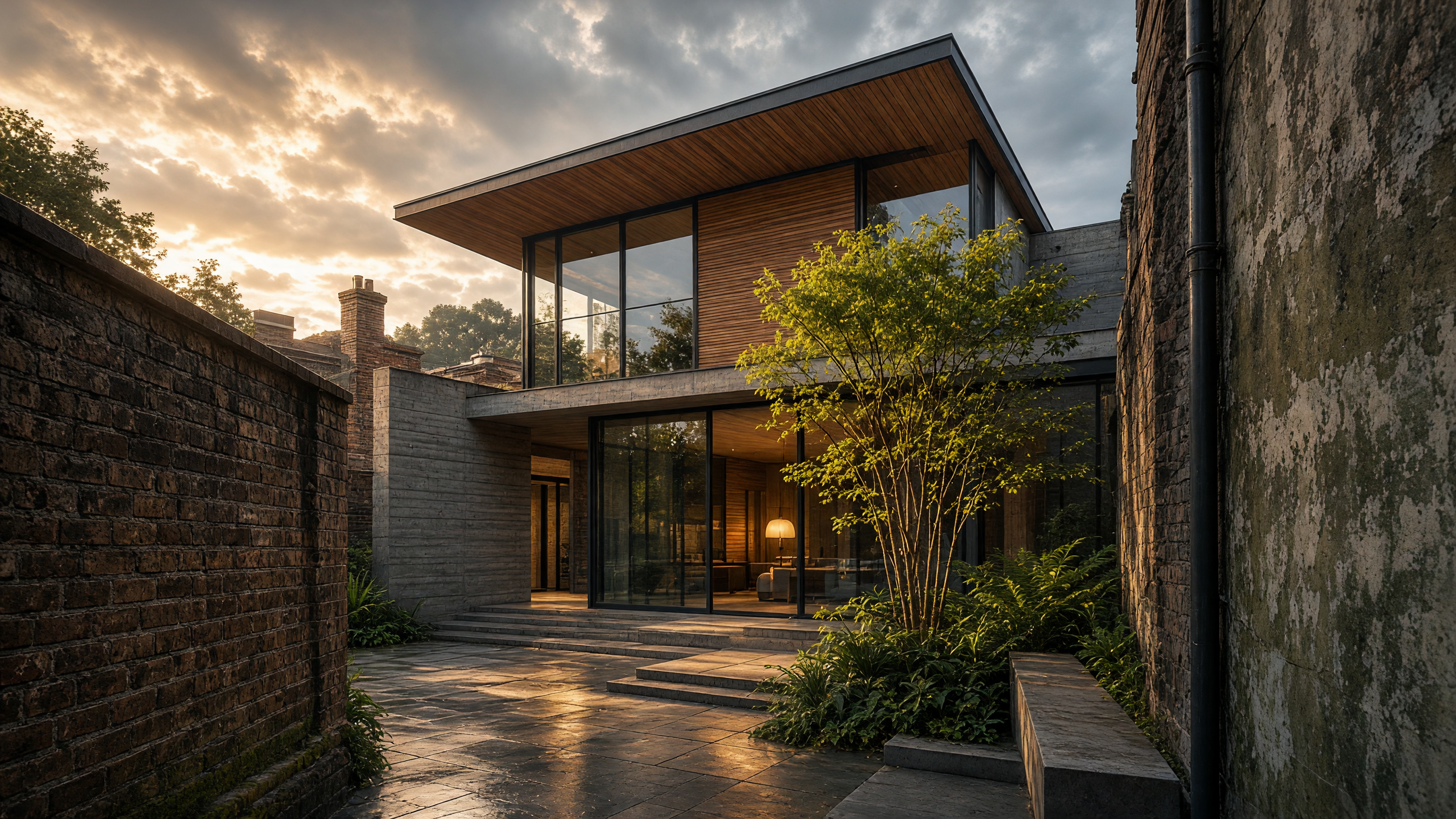
The street offers a door, a stoop, a window looking into other windows. In a neighborhood of attached houses it rarely offers a place to stand in actual weather without being watched. That older work belongs to the courtyard: not a garden for display, but a room the house withholds from the city.
I understood this first in a riad in Fez, where the street was a corridor of plaster and the life of the house gathered around a tiled square of sky. I understood it again, more severely, in Tadao Ando’s Azuma House in Osaka. The house is a concrete slot between neighbors. Living rooms are split by an open court. To go from kitchen to sleeping room you cross rain and winter. Ando did not soften the crossing. The court is the only sky the house owns, and it is enough because it is owned.
American and northern European blocks still default to the rear yard—a leftover strip overlooked by three other kitchens, a place for bins and a struggling tree. The courtyard is a different geometry. Rooms pull around an interior square, a slot, a narrow garden court, so that glass faces inward. Neighbors meet a nearly blank wall. Light arrives from above and from the court itself, sliding down plaster or board-formed concrete, changing by the hour.
Materials are close here. You smell wet brick. You hear water if there is a basin, or the dry tick of bamboo if there is none. Stucco takes shadow the way cloth does. A single tree—fig, olive, Japanese maple—becomes a column of time. In a hot month the court is a chimney of cooler air. In winter it is a well of pale light that a north-facing street façade, tight to the sidewalk, cannot give.
This is not a revival of the Chinese siheyuan or the Roman atrium, which assumed other climates and other households. What remains useful is the inversion. The public face can stay urban, even hard. The life of the house gathers around an open interior. On a twenty-foot infill lot the court may be only twelve feet across. It is still a room. Children can be in it without entering the street. Conversation stays inside the walls. The city remains audible—a bus, a shout—but it no longer occupies the air you sit in.
The courtyard costs floor area. You give up a room to keep weather. That economy is why so many dense houses refuse it, and why the ones that accept it feel larger than their plans. The successful courts are slightly austere. They admit rain. They have a floor you can sweep—stone, brick, concrete with a drain. They do not pretend to be landscape. They are architecture without a ceiling.
I have stood in courts that failed: dark wells, glazed on four sides, humid and overplanted. The ones that work let the day pass across a wall and leave a trace. At dusk the plaster holds a last band of warmth. A door opens. Dust, leaves, yesterday’s rain move into the kitchen. The street, for a moment, is only sound.