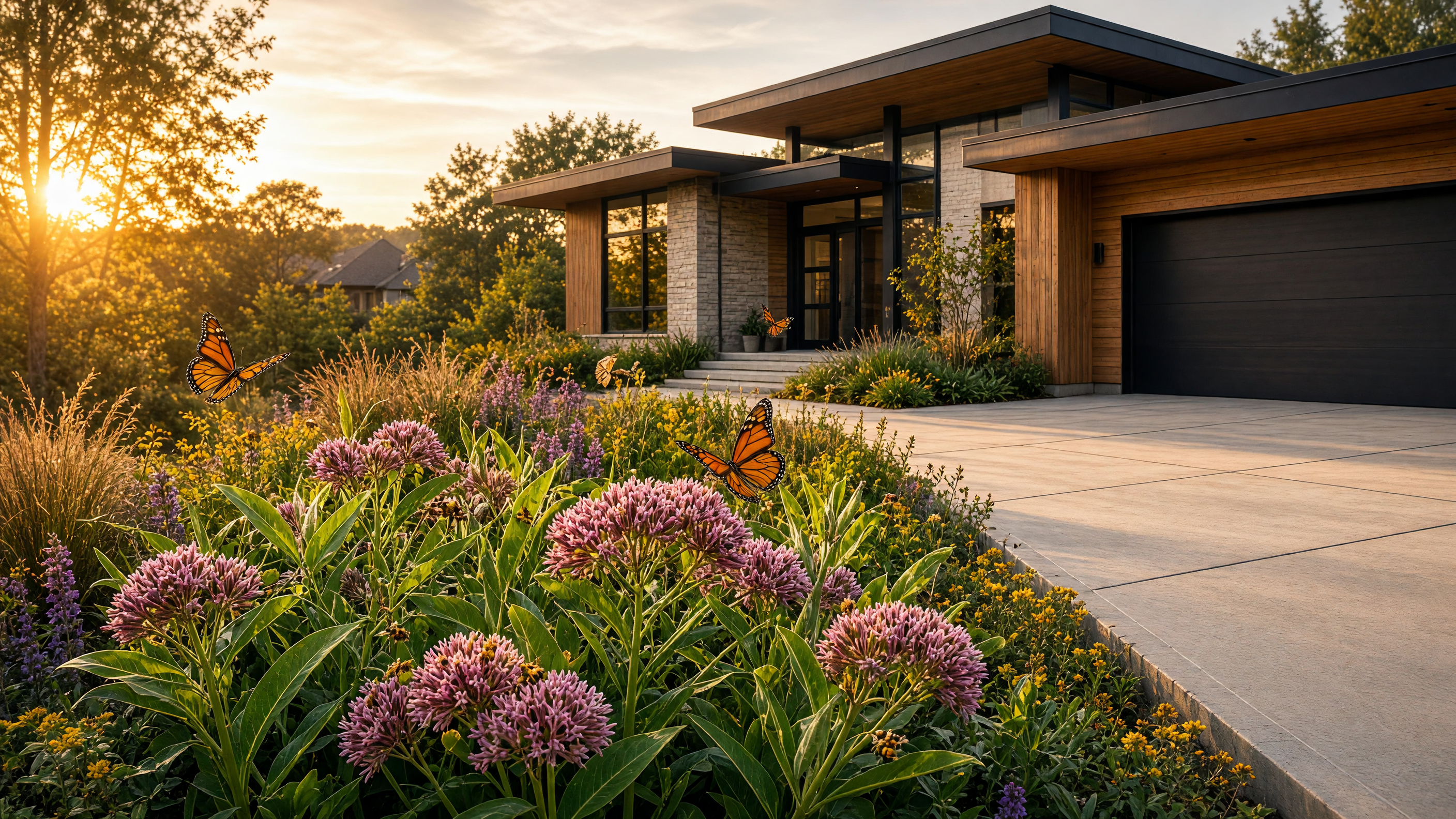
The first thing you notice is not color but motion. A swallowtail, low over what used to be lawn, tracing a path no site plan ever drew. The ranch house behind it still presents its garage as a face. The driveway still tilts toward the street. The ground, though, has begun to argue.
Postwar suburbs were written in turf. A continuous green plane, chemically kept, meant order and civic belonging, a kind of visual quiet. What it also meant was hunger. For decades the typical front yard offered almost nothing a native bee could eat, nothing a monarch larva could chew, nothing for the moths that work after dark. The houses remained; the ecology around them was a desert wearing a green coat.
I have walked streets in Pasadena, in Ann Arbor, in a cul-de-sac outside Raleigh, where that coat is being unpicked, not all at once. A homeowner lets the parkway strip go to yarrow and California poppy. Another replaces the foundation planting—those sad, sheared orbs of boxwood—with salvia, penstemon, a thicket of milkweed that leans toward the concrete like a guest who has decided to stay. The houses do not become cottages. They remain suburban objects. The gardens simply refuse the old pact between lawn and façade.
Light behaves differently once the turf recedes. Low sun catches the dusty gold of goldenrod, the pale architecture of dried seed heads in November. You hear these yards before you fully see them: a density of hum that grass never produced. On a still afternoon the air above a patch of mountain mint is busy in a way that feels almost industrial, a small factory of pollination running at the scale of a doormat. Crush a leaf of thyme underfoot and the smell follows you to the porch.
There is an architectural argument here, quiet but real. The suburban lot was always a designed landscape, even when it pretended to be nature’s default. Setbacks, sight lines, the civic performance of the front yard—these were codes as much as aesthetics. Pollinator gardens rewrite those codes without filing a variance. They thicken the edge between private house and public sidewalk. A child walking home now passes through bees and the faint sweetness of alyssum. The mailbox stands in a drift of asters.
Some municipalities have begun to notice. Reduced mowing of rights-of-way. Seed mixes specified for medians. A few HOAs, after years of citations for “weeds,” have rewritten covenants to allow native plantings of a certain height. The fights are small and local and often ugly. A neighbor still sees mess where another sees habitat. Meanwhile the plants keep arriving: swamp milkweed in a rain garden that also takes the downspout; blazing star against a vinyl fence; a single oak, if anyone is patient enough, for the hundreds of insect species that need it.
I keep thinking of a corner lot from last year, a 1954 split-level whose owners had given the entire south yard to prairie. Little bluestem in wind. Coneflower gone to seed. The house looked suddenly older and more specific, as if the land had been allowed to speak in its own grammar. A monarch hung on a leaf. The garage door was still closed. Traffic moved on the collector road.