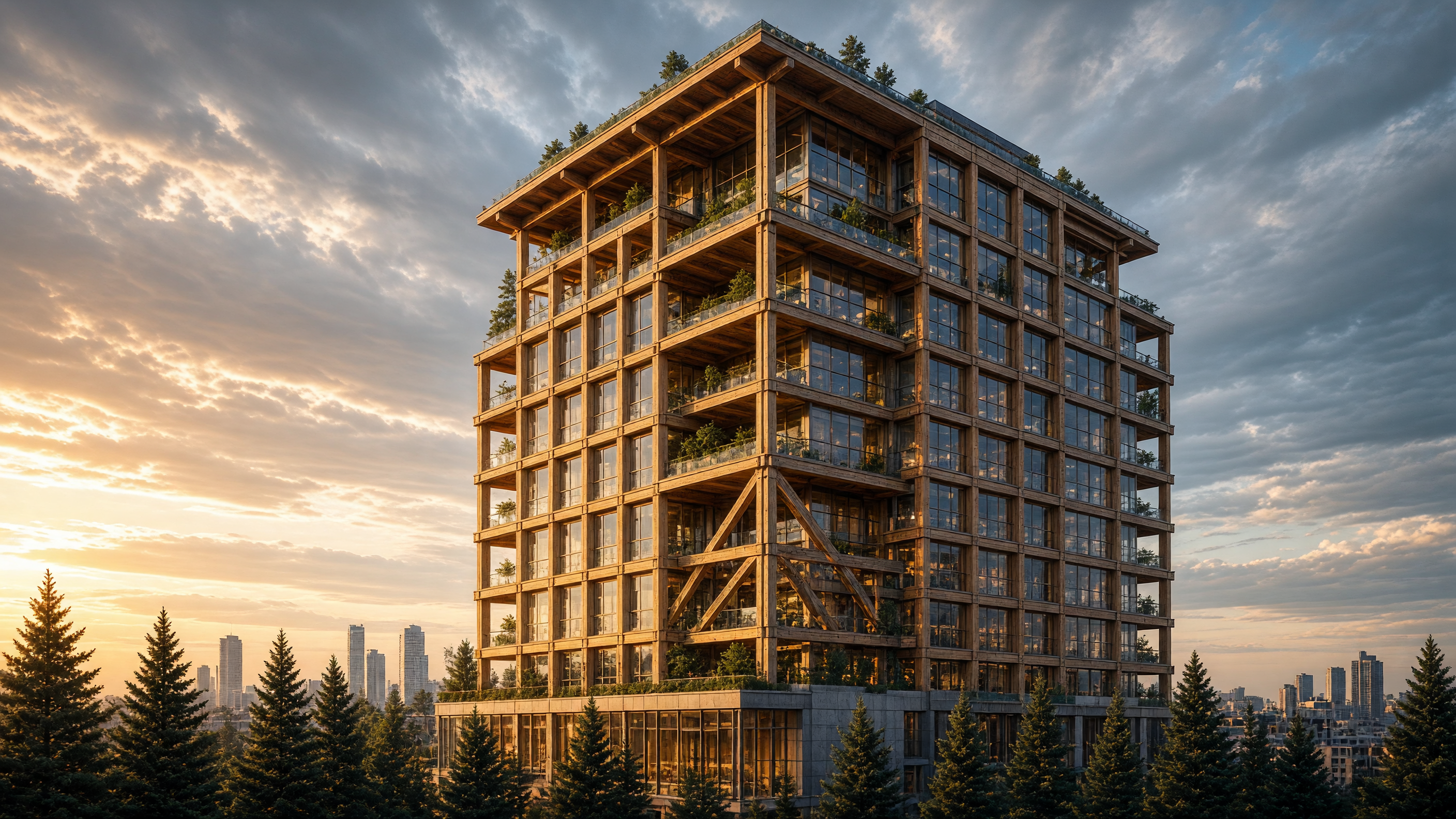
For two centuries after the great fires, cities taught wood to stay close to the ground. Brick and iron, then concrete and steel, became the grammar of height. Timber was furniture, not skeleton. That grammar is loosening.
In Brumunddal, Mjøstårnet stands beside Lake Mjøsa like a pale cliff. Voll Arkitekter stacked glued laminated spruce into eighteen storeys—offices, apartments, a hotel, a restaurant that looks out over water. You can put a palm on a column and feel a slight warmth that steel never offers. The grain is not decoration; it is load path made visible.
Mass timber—cross-laminated timber, glulam, laminated veneer lumber—is wood reconstituted into panels and beams large enough to behave like masonry, only lighter. A CLT wall is a sandwich of boards, each layer turned ninety degrees, pressed with adhesive until it becomes a plate. Prefabricated in a mill that smells of sawdust, trucked to a site, craned into place in days rather than months. The city hears less hammering. Neighbours keep their windows open.
Carbon is the quiet argument. Trees lock carbon as they grow; when that wood becomes a beam, the carbon stays locked for the life of the building, and often longer if the timber is reused. Concrete and steel spend carbon in furnaces and kilns before a single floor exists. A mass-timber tower is not carbon-neutral by magic—foundations are still concrete, cores often hybrid, transport still diesel—but the ledger shifts. Each cubic metre of spruce is a postponement of emissions, stacked into a skyline.
Fire, the old urban fear, is met with thickness. Mass timber chars on the outside and protects the core; engineers calculate the sacrificial layer the way they once calculated rebar cover. Sprinklers, gypsum, and compartmentation do the rest. In Milwaukee, Ascent rises twenty-five storeys with a concrete podium and a timber frame above, the tallest of its kind in the United States. Residents walk corridors where the ceiling is wood, not a dropped grid. Light lands differently on grain than on painted gypsum. Evenings feel quieter. Footsteps soften.
Vienna’s HoHo Wien is a hybrid: timber columns and slabs around a concrete core, seventy-five metres of mixed uses. You see the joints—steel knives into wood, bolts in neat ranks—the honesty of a barn translated into a tower. In Vancouver, Brock Commons housed students in eighteen timber storeys wrapped in cladding that made the wood almost secret. Inside, the secret was the opposite of secret: rooms that smelled faintly of forest after rain.
There are limits. Moisture movement, acoustic flanking, the need for dry storage on site, the still-young codes that treat height as exception. Forests must be managed, not mined. A tower of illegally logged tropical hardwood would be a carbon story told backwards. The northern spruce and pine that feed these mills are a different ecology—slow, cold, already in the industrial forest.
Stand in one of these buildings at dusk. The windows hold the city; the walls hold a former hillside. You hear less echo than in concrete. Your hand, if you let it rest on a glulam beam, finds a temperature close to your own.