In 2005, the San Francisco collective Rebar fed a downtown parking meter, unrolled a strip of sod, and set out a bench and a potted tree. Two hours of metered time. The sod went home in a truck. The image did not: a green room the size of a car, traffic sliding past its edges. Parklets began there, as a joke with staying power.
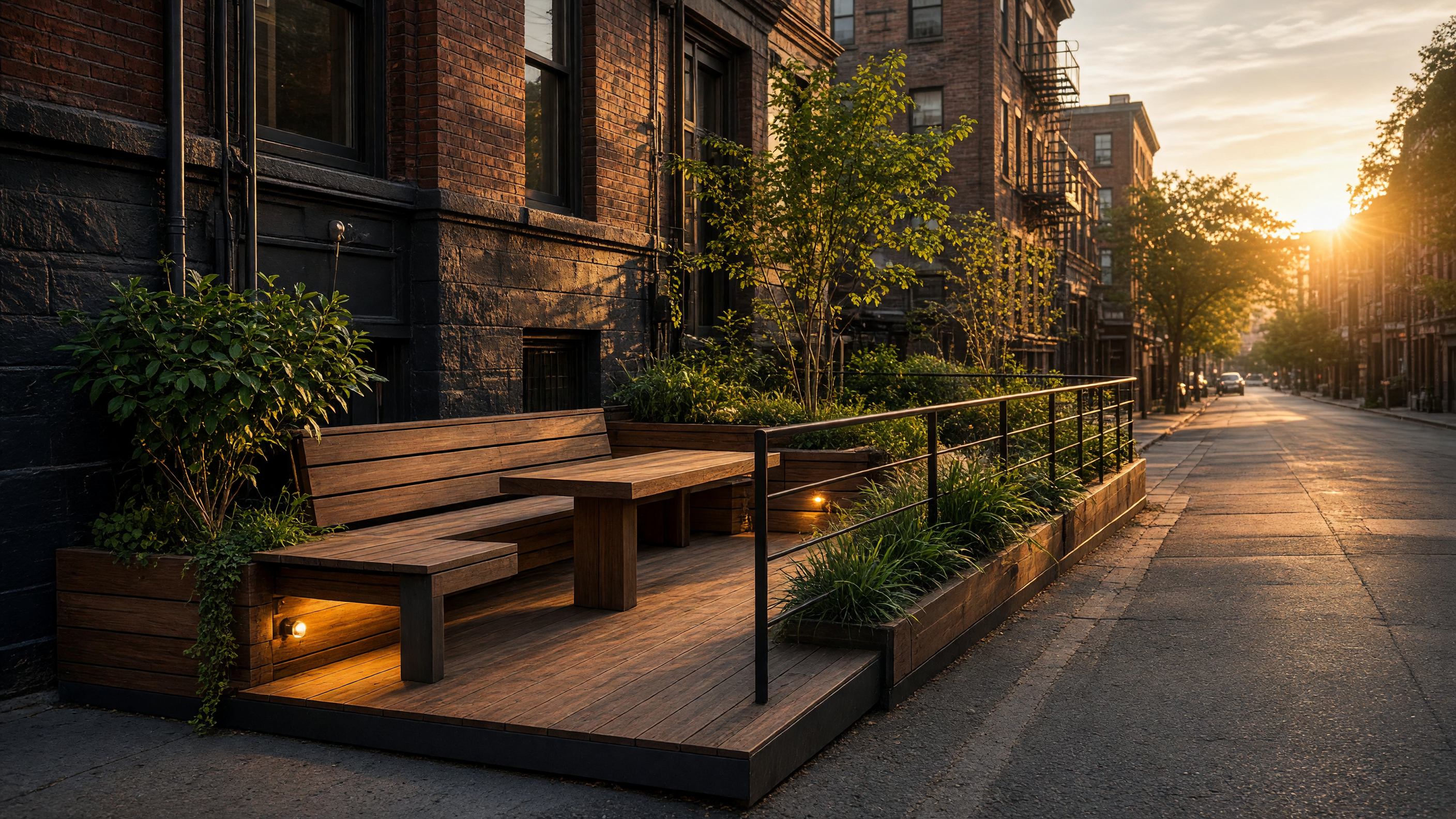
They occupy the most stubborn American module, the parking stall—eight feet by twenty, sometimes doubled. A steel frame lifts a deck to sidewalk height so the curb ceases to be a barrier. You step out and you are already in. Pine boards, or ipe if the budget allows, silvering after a season of rain. Planters of Corten or powder-coated aluminum. A railing low enough for a forearm, high enough to keep a child from the lane. Nothing heroic. The materials expect scuffs, a clipped corner, a winter that does not care about civic experiments.
Sit on Valencia Street at four o'clock. The deck holds the day's heat. A bus passes close enough that the air moves your sleeve. Talk falls and rises with the signal: green, and engines take the sound; red, and a sentence can finish. Rosemary in the planter gives off its oil when a hand brushes it. A paperback lies open on the bench, pages lifting in the draft. The café that paid for the permit wipes the tables, and the tables are public, more or less. Regulars know which chairs belong to espresso. Visitors do not, and sit anyway.
Light works hard in a space this thin. Morning sun, low between the Mission's facades, rakes the grain of the boards and throws the railing's shadow in stripes. Late day, the western light is warmer, almost interior. At dusk the string lights—inexpensive, a little theatrical—suggest a ceiling where there is none. You are in the weather and also held, a condition closer to a porch than a plaza. The street does not recede. You hear the tick of a bicycle freewheel, the hiss of a bus kneeling at the stop, a horn that is not meant for you and arrives anyway.
Not every city keeps them year-round. In Minneapolis they come up before the plows. In San Francisco many have gone from temporary to habitual, wood gone gray, plants thick enough to look as if they chose the spot. A parklet on Division Street in Portland uses a cedar screen; traffic becomes vertical bands of color and chrome. In Santa Monica one is all white steel and succulents, sharp against stucco, a small desert at the curb. New York's larger pedestrian plazas are cousins, not twins. The parklet's power is its tightness, the fact that a sedan could still fit if someone insisted.
The curb used to be a drainage detail and a painted limit. Now it is a place you can occupy with a coffee and an hour. Two cars fewer, a handful of bodies more. You sit facing the shopfronts or facing the traffic. Either way the street has acquired a room—narrow, a little loud, slightly precarious—and someone is already in it.