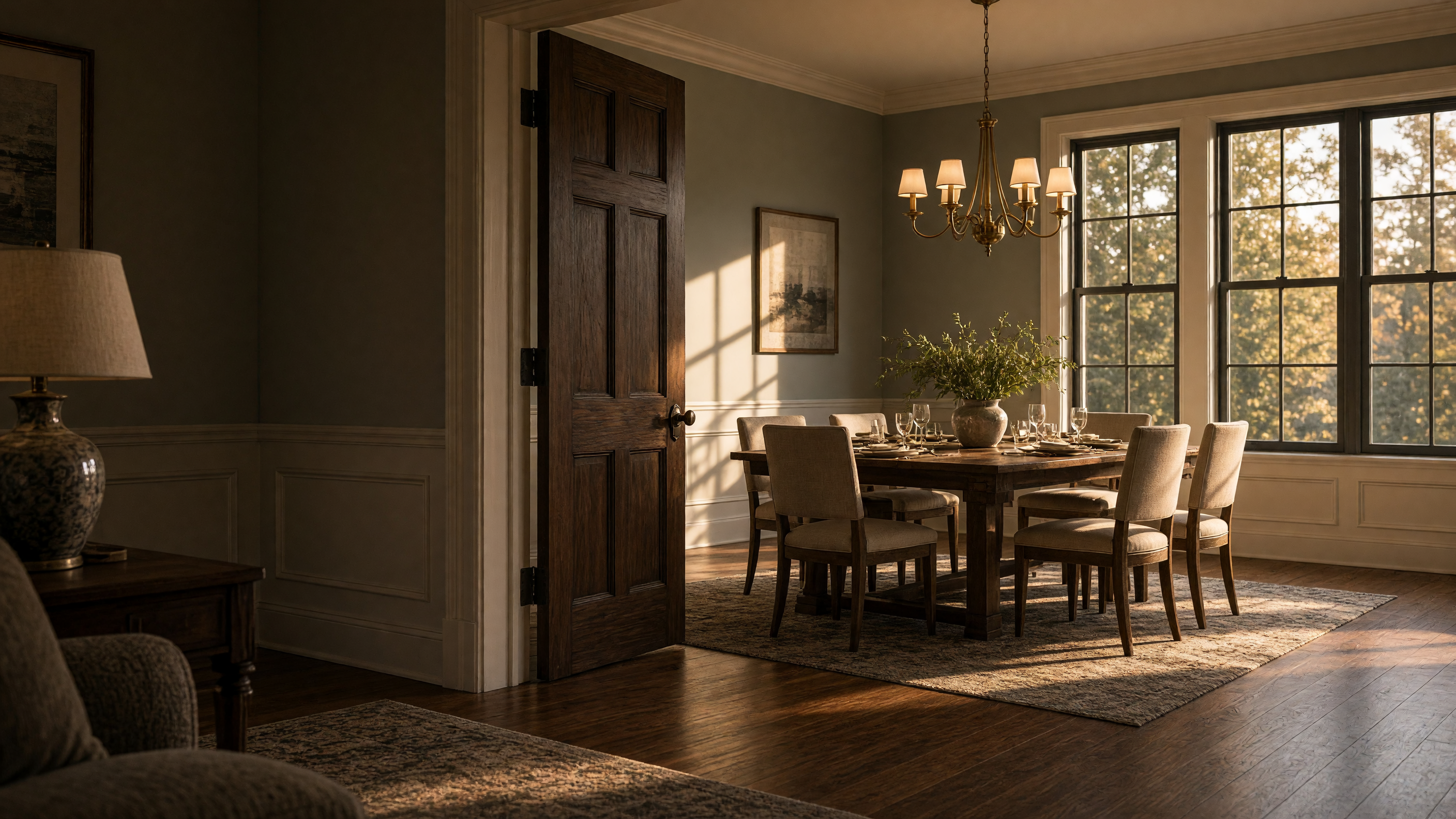
For thirty years the American house treated the dining room as leftover ceremony. Builders folded it into the great room. Architects praised the unbroken line from stove to sofa as honesty. The table, if it survived, sat in a draft of kitchen noise, under a fixture meant for chopping onions.
I have been in houses lately where the door has returned. Not a pocket of mahogany, not a swinging relic, but a simple leaf of painted wood that clicks shut. Behind it sits a table that is not also a desk. The light is lower. Someone has hung a shade that throws a warm circle on oak or walnut, and the corners of the room recede into a kind of dusk even at six.
What returns is not formality so much as duration. In an open plan, meals coincide with other events. A child works at one end. A laptop glows at the other. The television, even muted, keeps a weather in the room. The dining room, when it works, asks for a different clock. You sit. You stay. The plates wait in a stack until the talk has run out.
I think of dining rooms in older Midwestern houses I measured as a young architect. Plaster held the cool of morning. A bay faced west so that winter sun arrived at four o'clock on the tablecloth, a slow gold that made the silver look older than it was. The rug was often too large, a little worn where the chairs traveled. Sound behaved differently there. Voices did not have to climb over the refrigerator.
The unused formal room of the 1990s suburban house was another kind of failure: furniture too shiny, air a little stale, a space kept for holidays and then avoided. What is coming back is not that museum. It is a room used on a Tuesday, with a jacket over a chair and a mark on the wood from a hot dish.
Contemporary versions are quieter in their references. A plaster cove, a single pendant, a table long enough for eight and used by four. In a house outside Portland last autumn, the dining room was twelve by fourteen, with a window onto a small orchard and a door to the kitchen that the owners close without apology. They eat at seven. The kitchen, they said, is for the making. This room is for the sitting.
Tile and stainless want a different light than linen and wood. The kitchen is a workshop: bright, wipeable, a little loud. The dining room can afford a softer edge. Limewash that takes the lamp. A chair with a back you can lean into. A floor that does not ring when a fork drops.
I am not arguing for Sunday china. The rooms I like have mismatched glasses and a bowl of fruit that is actually eaten. What they have, and what the great room could not provide, is a threshold. You cross it. The day changes register.
Evening, in those rooms, has a surface again. The wood takes the lamp. Someone pours water. A chair scrapes, then settles. The kitchen, on the other side of the door, can wait.