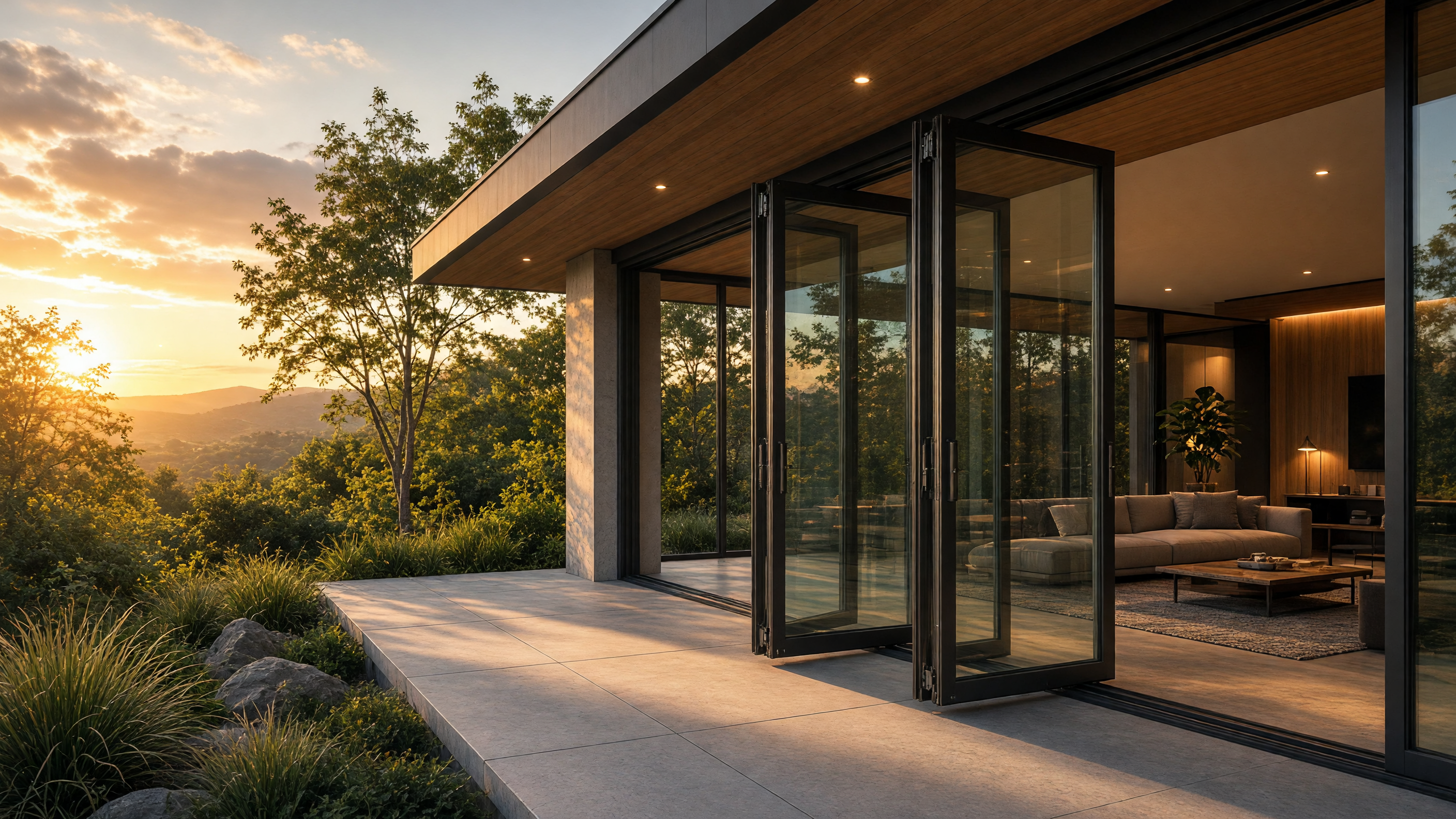
There is a particular sound a folding glass wall makes when it first gives way—not a slam, not a long industrial slide, but a sequence of small metallic permissions. One latch, then another. The panels lean, travel, and gather. In a few seconds the living room has a new climate and a new acoustics. Birds arrive. The floor, if the architect has been honest, continues without a lip.
I first noticed this properly in a house near the Carmel coast, where the west wall was a concertina of tempered glass in slender aluminum frames. Closed, it was a kind of quiet aquarium: the Pacific reduced to a painting, the wind a rumor against the seals. Open, the room became a porch that happened to have a sofa. The stacked panels formed a thick, glittering column at one end, like a book shut too quickly, pages still catching light.
The idea is older than the hardware. Japanese houses have long treated walls as movable planes—fusuma sliding on grooves, amado storm shutters stacked at night against rain and wind. What folding glass adds is not the principle but the transparency and the weather. You keep the view while you change the air. You keep the garden while you keep the rain out, provided the sill is detailed without vanity and the gaskets have not been treated as an afterthought.
Vanity is the usual failure. A track that catches sand. A handle that looks like jewelry and works like a riddle. A threshold so proud it trips the child and the dog. The best folding walls are almost boring in their mechanics and lavish only in what they admit: light at ankle height, the smell of wet stone after a storm, a conversation that can migrate from kitchen to terrace without anyone announcing the move.
Indoor-outdoor living, as a phrase, has been worn thin by brochures. The actual experience is more specific. It is the moment the interior loses its echo. It is the way a tablecloth lifts at one corner. It is the insect that must now be negotiated, and the decision—screens or none—that tells you more about a household than any furniture. In cooler climates the fold is seasonal, a summer instrument, like canvas awnings. In Los Angeles or Lisbon or Brisbane it can be daily, a habit of opening the house the way one opens a shirt at the collar.
Mies dreamed of a universal space bounded by glass. The folding wall is less metaphysical. It admits that climate is not universal, that a room wants sometimes to be a room. The panels remember they are a wall. They can return. That return matters. A house that cannot close is not liberated; it is merely unfinished. The pleasure lives in the choice, in the thickness of the stack against the jamb, in the last panel clicking home against a magnetic catch you cannot see.
On those stacked edges the light becomes its own small architecture—a vertical of reflections, six or eight planes of the same garden, slightly offset, lawn and sky repeating like a still life that has not quite decided to be still.