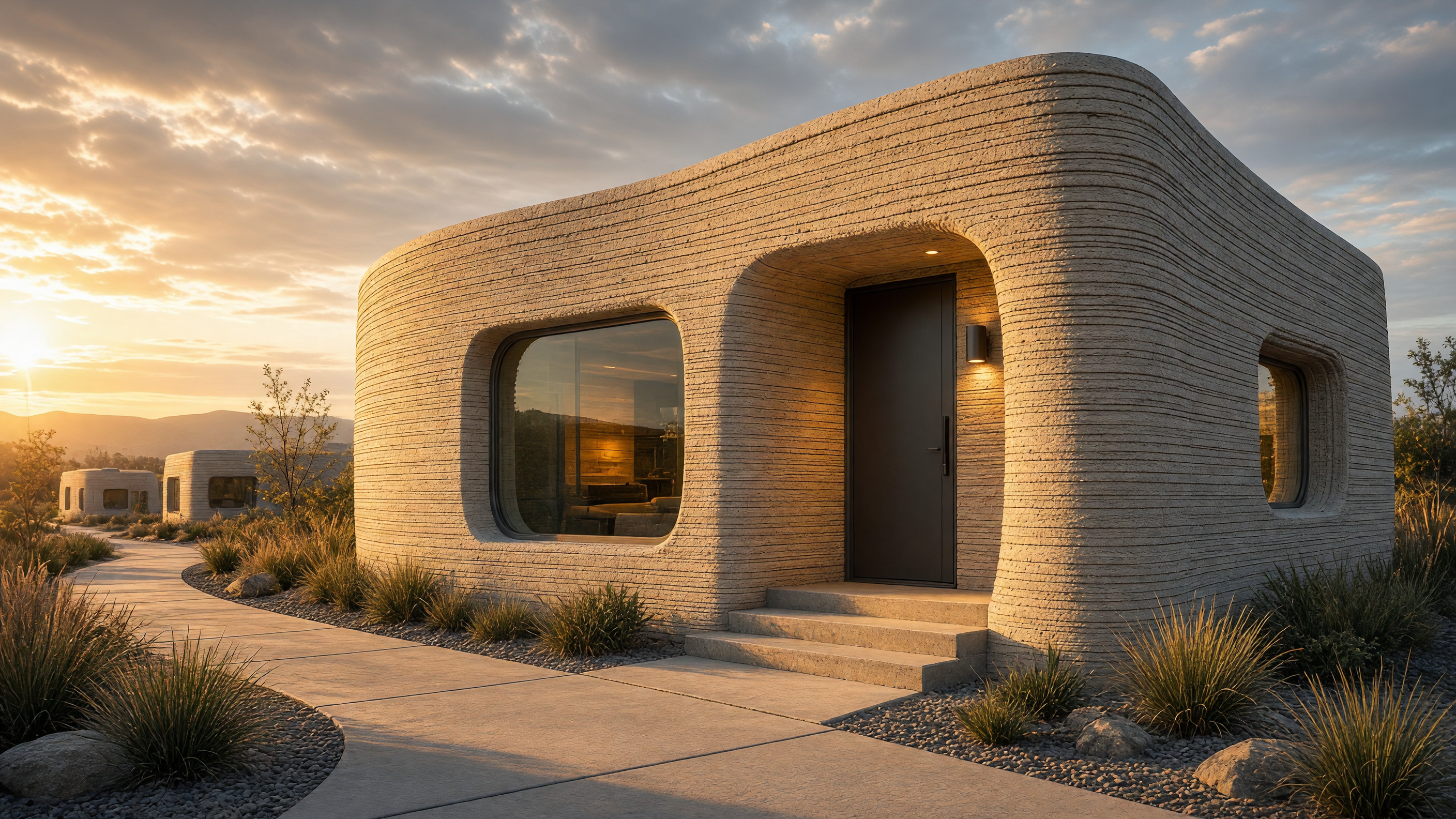
In a field east of Austin, before the sun clears the live oaks, the printer is already at work. A gantry moves with the patience of a loom. From its nozzle comes a gray bead, thick as a man's wrist, that coils upon itself until a wall stands where there was only caliche and weeds.
The layers do not hide. They read like growth rings, or like the coils of a pot thrown too large for any kiln. You can run a hand along them and feel the slight slump of each pass, the moment when gravity almost won. The concrete is still warm. It smells of wet stone and plasticizer.
ICON built a handful of these houses with Habitat for Humanity on the city's edge. One family left a trailer for a printed shell of four hundred square feet. The interior still carried the scent of curing cement. Ordinary windows sat in printed openings; the ridges caught morning light like corduroy. A ceiling fan turned. Someone had already hung a calendar.
There is a temptation to speak of futures. I notice instead the old problem of speed. After a hurricane, after a fire, after rents climb past wages, the question is not whether a machine can draw a wall. It is whether the wall, once drawn, can hold a life without looking like a temporary measure.
In Tabasco, Mexico, New Story and ICON printed a neighborhood of some fifty houses. The mix used local sand. The plans were modest: two rooms, a kitchen, a roof against the rain. Children played in the dirt while the printer laid the next course. From a distance the houses look poured. Up close they are striated, almost geological.
WASP's TECLA house, near Ravenna, used clay dug from the site. Two robotic arms printed in a slow dance, a double-curved shell closer to pottery than to a culvert. One smells of earth; the other of Portland cement. Both are sincere.
The aesthetic of the layer is not yet resolved. Some want the ridges sanded away, as if the machine should leave no trace. Others leave them, the way board-formed concrete once advertised the lumber that shaped it. I prefer the ridges. They record time. They catch dust, rain, and the low winter sun. A shadow moves across them hour by hour, a sundial no one designed.
Cost is the argument everyone brings. A printed wall can rise in a day or two. Labor shrinks, though it does not vanish; someone still mixes, watches, sets the windows, frames the roof. Affordable housing has always been more a problem of land, finance, and politics than of how we stack material. The printer does not dissolve those. It only changes the tempo of the wall.
In Malawi, 14Trees printed schools and dwellings with local aggregates. The walls are thick. They hold the day's heat and give it back after dark. Inside, the light is cooler. Rain sounds different against a continuous surface than against corrugated metal.
I keep returning to the threshold. In a printed house the door is a pause in the coil, a gap left by the machine and finished by a person. That joint—nozzle then hand—is where the building becomes a house, or remains a demonstration.