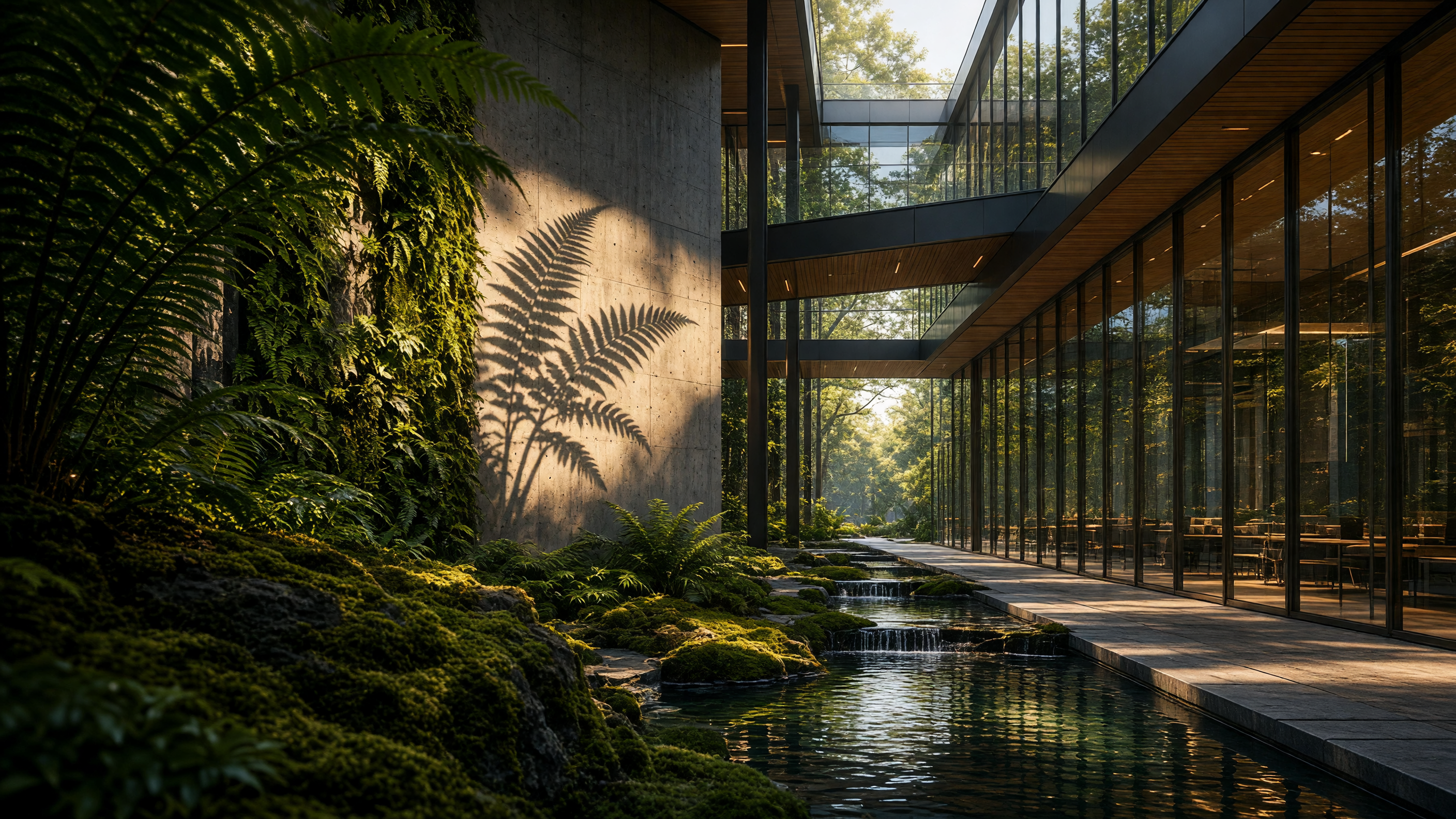
The first thing you notice is not the plants. It is a thin sheet of water falling over black granite, just beyond reception, a sound so slight it takes a moment to name. Then the air: cooler, faintly mineral, as if a garden had been left open overnight.
Most workplaces still arrive as sealed boxes. Recycled air, even light, carpet that never quite dries. Biophilic design, named after E.O. Wilson’s old argument that we are drawn to living systems, is often reduced to a ficus in a corner and a photograph of pines. The better rooms do something quieter. They restore a relationship with weather, distance, and living matter without turning the office into a greenhouse.
At Second Home in Holland Park, desks sit among more than a thousand plants. Light arrives filtered, green at the edges. You hear leaves before you hear keyboards. COOKFOX’s office in a former bank on the Bowery keeps a living wall of ferns and mosses that hold humidity the way old stone holds coolness. People linger there not because a wellness poster told them to, but because the air is different: damp, faintly earthy, a relief from the dry hiss of mechanical ventilation.
In Tokyo, Pasona threads rice paddies and tomato vines through meeting floors. The gesture is almost theatrical, yet the effect is ordinary and physical. Employees walk past ripening fruit on the way to a conference. The workday acquires a season, a smell of wet soil after watering, a green that changes from week to week.
Nordic offices have long treated timber as more than cladding. A spruce ceiling in Oslo still smells faintly of resin in July. Operable windows admit rain and the low noise of a street. Circadian lighting, when it is done well, does not mimic a sunrise with colored LEDs so much as it refuses to flatten the day into one white temperature. Morning remains cooler, bluer; afternoon warms. The body notices even when the mind does not.
Biophilia is also pattern. The fractal edge of a leaf, the grain of oak, the irregularity of handmade brick. Eyes tire less on these surfaces than on painted drywall. A courtyard in Barcelona, planted with orange trees, turns a corridor into a pause. You see sky, then work, then sky again. Water, even a shallow runnel, slows the pace of a conversation without anyone naming the reason.
Amazon’s Spheres in Seattle remain the loudest image of this impulse: glass globes filled with cloud-forest plants, a public spectacle of nature under climate control. They are beautiful and slightly anxious, like a conservatory that has forgotten the street. The more convincing rooms are smaller. A window that actually opens. A stair washed in north light. A table of solid walnut that warms under the hand. Moss that darkens after rain, even if the rain is only the building’s own misting system.
On a Monday in Amsterdam, a woman leans toward the glass because the sun has moved, and a fern on the sill throws a shadow across her keyboard. She does not think of biophilia. She notices the leaf, then the work, then the leaf again.