On certain streets in Boston, the triple-decker still does the work of a neighborhood. Three stacked porches, three families, one clapboard volume that reads from the sidewalk almost as a tall house. Afternoon light hits the top porch first, then the middle, then the stoop. You hear a radio, a kettle, a bicycle chain. Nothing about it is monumental. That is the point.
The missing middle was never missing in the buildings. It went missing in the rules. For much of the twentieth century, zoning treated the detached house as the only respectable dwelling on an ordinary lot. Duplexes, fourplexes, Chicago two-flats, and bungalow courts became illegal on streets that had been built of them. Cities were left with two extremes: the single house and its unused lawn, and the large apartment block with a lobby that belongs to no one.
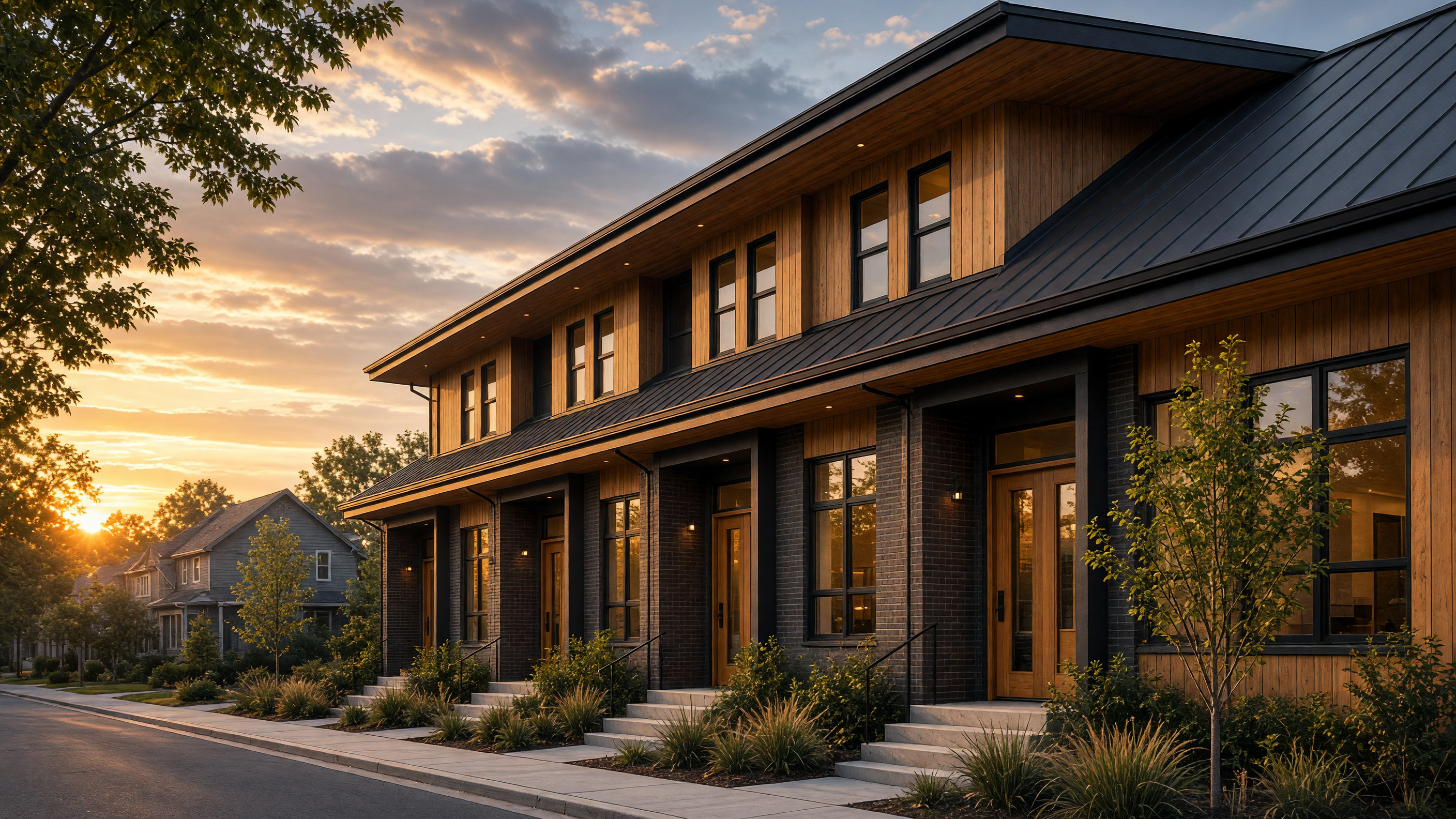
House-scale apartments restore a grain cities already knew how to make. A fourplex can keep the roof pitch of its neighbors, the same window rhythm, the same eave and setback. From across the street it is still a house—only a house that holds more than one household. Inside, rooms keep domestic proportions: a kitchen window over a small yard, a bedroom that takes morning light on one wall, a stair that turns once and lands at a door with a name beside it.
I keep returning to the bungalow courts of Southern California. Small dwellings arranged in a U around a garden, each with its own door to a shared path. You leave the sidewalk through a gap in the hedge and the noise falls away. Gravel, or brick, or a strip of lawn. Stucco the color of dried clay holds the afternoon. A chair has been left out. These apartments still grant the dignity of an individual entrance, the small ceremony of a threshold that is yours.
Materials carry the house into the apartment. Painted clapboard. Brick pointed by hand. A newel post worn smooth. In a well-made fourplex the shared hall is not a fluorescent corridor but a room with a window, where coats hang and light arrives in a rectangle on the floor. You smell cooking from more than one kitchen. You learn the cadence of other people's doors. Between units the walls still have the thickness of a house. You hear a laugh, not an entire evening of someone else's television.
Contemporary versions fail when they pretend to be mansions or mini-towers. The better ones accept the lot. They put cars where they do not devour the garden. They sit close enough to the street that a conversation from the porch does not require a raised voice. The roof is still a roof. The front door still faces the sidewalk.
Last spring, in a courtyard in Pasadena, a woman watered geraniums while a neighbor carried groceries up a short flight of exterior stairs. The concrete was worn. The flowers were ordinary. Between them the air held that late-day warmth of stucco and leaves. No one was performing density. They were living at a scale the street could still recognize as home.