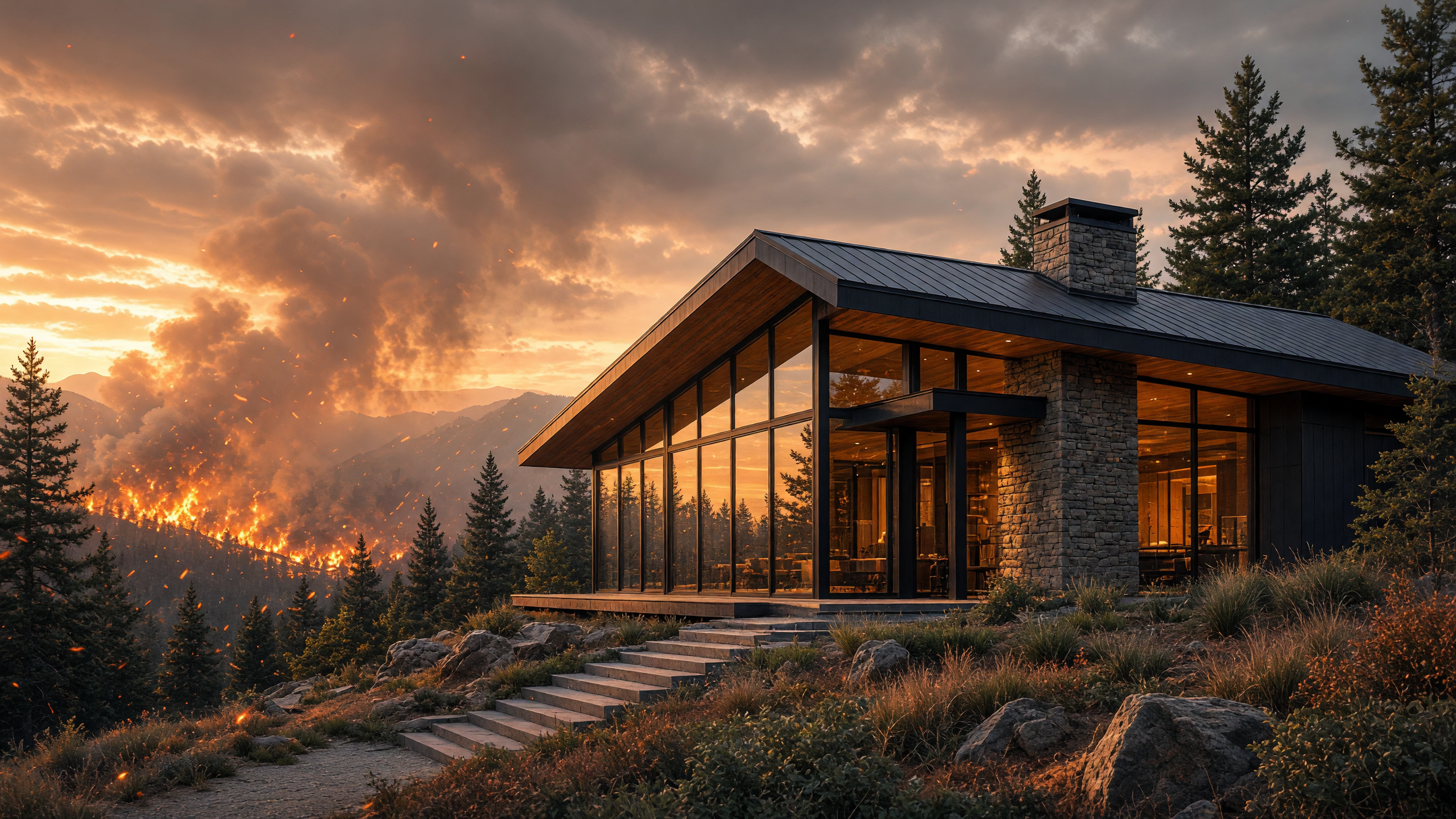
Fire at the wildland-urban interface does not usually arrive as a roaring front. It arrives as weather. A wind that smells of dust and resin. A sky gone the color of tarnished brass. Then the small, almost delicate rain of embers, each one a seed looking for a gutter, a vent, a cedar shake.
I have walked those edges in the California foothills and in the dry ranges outside Melbourne, the morning after a red-flag night, when the air still held a metallic taste and the hills were a pale, unreadable green. The houses that remained were not heroic. They were quiet. Their walls were stucco or fiber-cement, their roofs standing-seam metal or concrete tile, the color of dry grass or weathered clay. Eaves boxed tight. Vents screened to a mesh you could barely see. Glass that had been tempered, dual-paned, set in frames that would not melt into an opening.
The ones that failed often failed at the edges. A wooden deck that had collected years of oak leaves. A plastic skylight. A juniper planted against the wall, as if the plant and the house had been having a long, unwise conversation. In Paradise, in 2018, whole streets of ordinary timber homes vanished in hours; here and there a concrete-tile roof and a cleared five-foot perimeter of gravel remained, blackened but standing, like a sentence that had refused to finish.
What we ask of a house at this interface is not invulnerability. It is a kind of patience. The building must wait out the wind without offering the ember a place to rest. That patience is material and geometric. Class A roofing. Noncombustible siding that can still be detailed with a shadow line, a reveal, a sense of weight. Ember-resistant vents. A five-foot zone of stone or irrigated ground against the foundation, then a wider, tended landscape that does not pretend the chaparral is a lawn.
There is a sensory life to these houses that the codes do not mention. The cool of a plaster wall in late afternoon. The particular rattle of a metal roof when a gust comes down the canyon. The way light, on a smoky day, enters a room as a thick gold, almost liquid, and makes the interior feel both sheltered and slightly underwater. People who live here know the smell of sage after rain and the other smell, the one that means pack the photographs and the dog.
I think of a house in the Santa Monica Mountains, low and pale, its courtyard planted with succulents and decomposed granite, its windows looking toward a slope of ceanothus. The architect had boxed the eaves, used fiber-cement that read as board-and-batten, and set the garage as a buffer to the prevailing wind. Nothing about it announced itself as a bunker. It still wanted to be a house: a place for coffee, for the view, for the sound of quail in the brush.
On red-flag days the owner closes the windows and waits. The metal roof ticks in the heat. Somewhere downslope, a siren starts and then stops. Ember weather, and the house holding still.