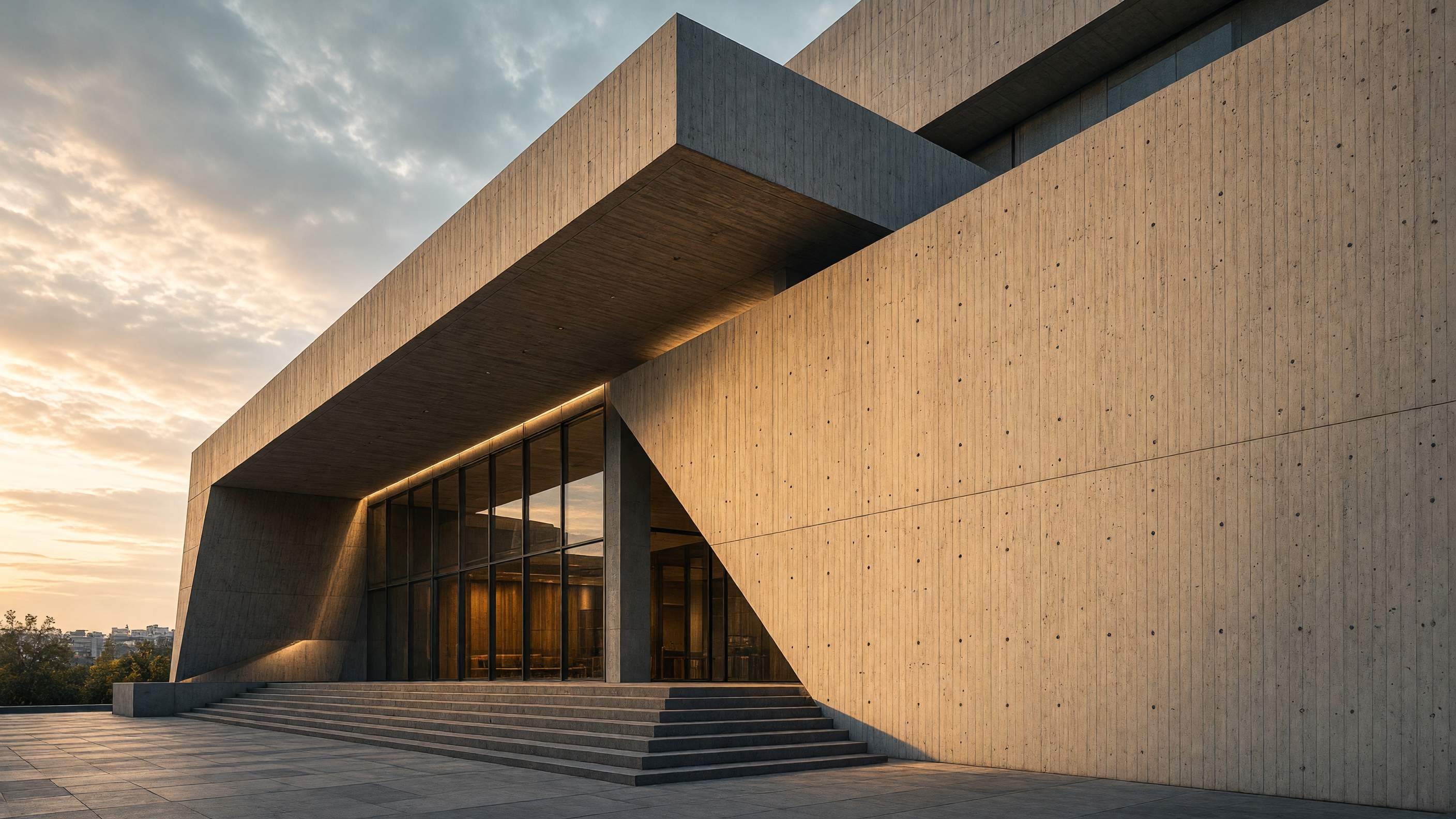
On a wet Tuesday outside Grafton Architects’ Town House in Kingston, people wait under a deep soffit and rest their bags against concrete that still shows the timber that held it. The wall is not polished. Rain darkens the ridges. Later the sun will catch them like a faint map. The building is a university, but it behaves like a civic hall: stairs wide enough for lingering, rooms that do not hurry you toward a desk.
Brutalism never really asked to be loved. Alison and Peter Smithson wanted an ethic—materials left as found, joints admitted, weight not disguised as lightness. Civic clients in the 1960s took the ethic and poured it into city halls, libraries, courts. Then the weather stained the façades, the maintenance budgets vanished, and the word itself became an insult. For a generation, public architecture preferred glass, frit, and the promise of transparency.
What has returned is not nostalgia for bunker walls. It is a hunger for mass that can be touched, for rooms that hold sound instead of scattering it, for a public building that does not look leased. In London, Grafton’s Marshall Building at the LSE stacks heavy concrete floors around a sequence of halls. Light falls through coffers. Coffers gather the light the way a nave does, without the piety. You hear footsteps before you see the person. The material is cool in July, slightly dusty, honest about its pour.
Caruso St John’s Nottingham Contemporary, a decade earlier, already understood the mood. Precast panels take a lace pattern from the city’s industrial past, but the weight is brutalist in spirit: a gallery that sits on the street like a piece of infrastructure, not a shopfront. In Milton Keynes, 6a’s MK Gallery speaks in the language of the new town around it—in-situ concrete, big thresholds, a café that opens onto a public lawn without theatricality.
The sensory life of these buildings is slow. You notice the temperature of a handrail. Even the smell is particular: mineral, a little damp after rain, never of new carpet. You notice how a board-marked wall takes afternoon light the way a cliff takes it, not the way a curtain wall does. Acoustic privacy arrives without carpets or slogans about wellbeing. People sit on plinths because the plinths were poured thick enough to sit on.
There is a cultural weather behind the revival. After years of atriums that overheat and cladding that failed in the rain, cities have grown suspicious of lightness as a civic virtue. Concrete, used with care, reads as a promise of duration. It also reads as labour: someone built the formwork, someone struck it, the grain remains. In an age of screens and renderings, that residue of work feels almost intimate.
At four o’clock the Kingston soffit is a long shadow. A cyclist locks a bike to the railing. Two people argue quietly on the stair, which is wide enough to hold the argument without making it a scene. The concrete does not comment. It simply remains, marked by the boards that once contained it, open to whoever arrives next.