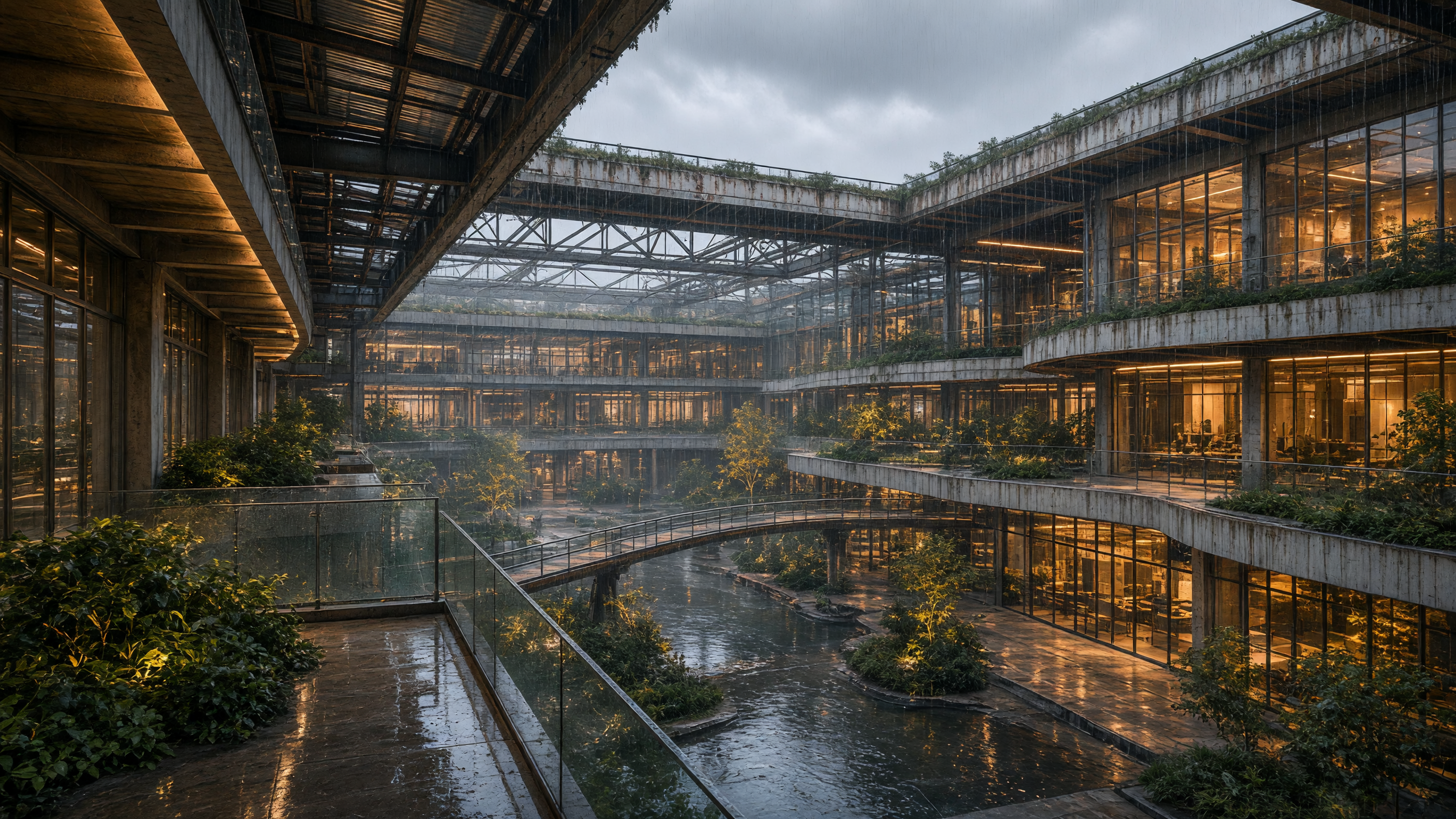
Victor Gruen imagined the American shopping street pulled indoors, climate-proofed against Minnesota winter. Southdale opened in 1956 with a garden court, a fishpond, and the hope that civic life could happen under glass. What followed, across a thousand suburbs, was not a civic room but a sealed tube of terrazzo, fluorescent wash, and Muzak that outlived the merchandise.
Walk a dying mall now and the building confesses. Skylights still throw a pale, even light onto empty planters. Escalators run for nobody. You hear your own shoes on the composite stone. The air has that particular recycled coolness, independent of the season outside. At the corridor ends, the department-store boxes sit like tombs, their loading docks more honest than their display windows.
The interesting work is not nostalgia for those interiors. It is the conversion of their sites into places that can take weather.
Mashpee Commons on Cape Cod did it early, and without much sentiment. In the 1980s a conventional strip was taken apart and restitched as streets, apartments over shops, a post office, a small library. Brick and clapboard replaced the blank rear walls that malls always turned toward the parking. You can get wet there. That is partly the point.
Belmar, on the former Villa Italia Mall in Lakewood, Colorado, went further. The enclosed mall was demolished. In its place came a grid, housing, a cinema, offices, a main street that meets other streets. The old parking sea—always the true architecture of the American mall—became the land bank for blocks. What had been one climate, one landlord, one closing time became many.
Horton Plaza in San Diego, Jon Jerde's carnival of stairs and pastel stucco, is coming down in pieces for housing and offices. Jerde had tried to make the mall feel like a hill town. The hill town works better when it is not locked at nine.
The Arcade in Providence is older, 1828, a glass-roofed passage that later went quiet. Apartments now occupy the upper floors. You walk the granite pavement and look up through iron and glass at actual sky, or rain, or the kind of dusk fluorescent tubes never learned. The mixed-use here is not a diagram. It is a nineteenth-century section: commerce below, rooms above, light shared.
What these places share is a reversal of the mall's original bet. The mall privatized the street and called the interior public. The better conversions give the street back, and they put dwellings where the dummy façades were. A former J.C. Penney footprint can hold a clinic, a grocer, and three floors of windows that open. Children wait for buses where a fountain once recirculated the same water.
Light is the first material that changes. In the old court it was always noon. On a new block it slides, catches brick, fails in rain, returns. You smell asphalt after a storm instead of cinnamon from the pretzel stand. The parking lot, poured as one gesture, has to become streets someone might cross at night, on foot.
Service alleys, where trucks once backed in, are often the best streets on the site. Keep them. Open the rest.