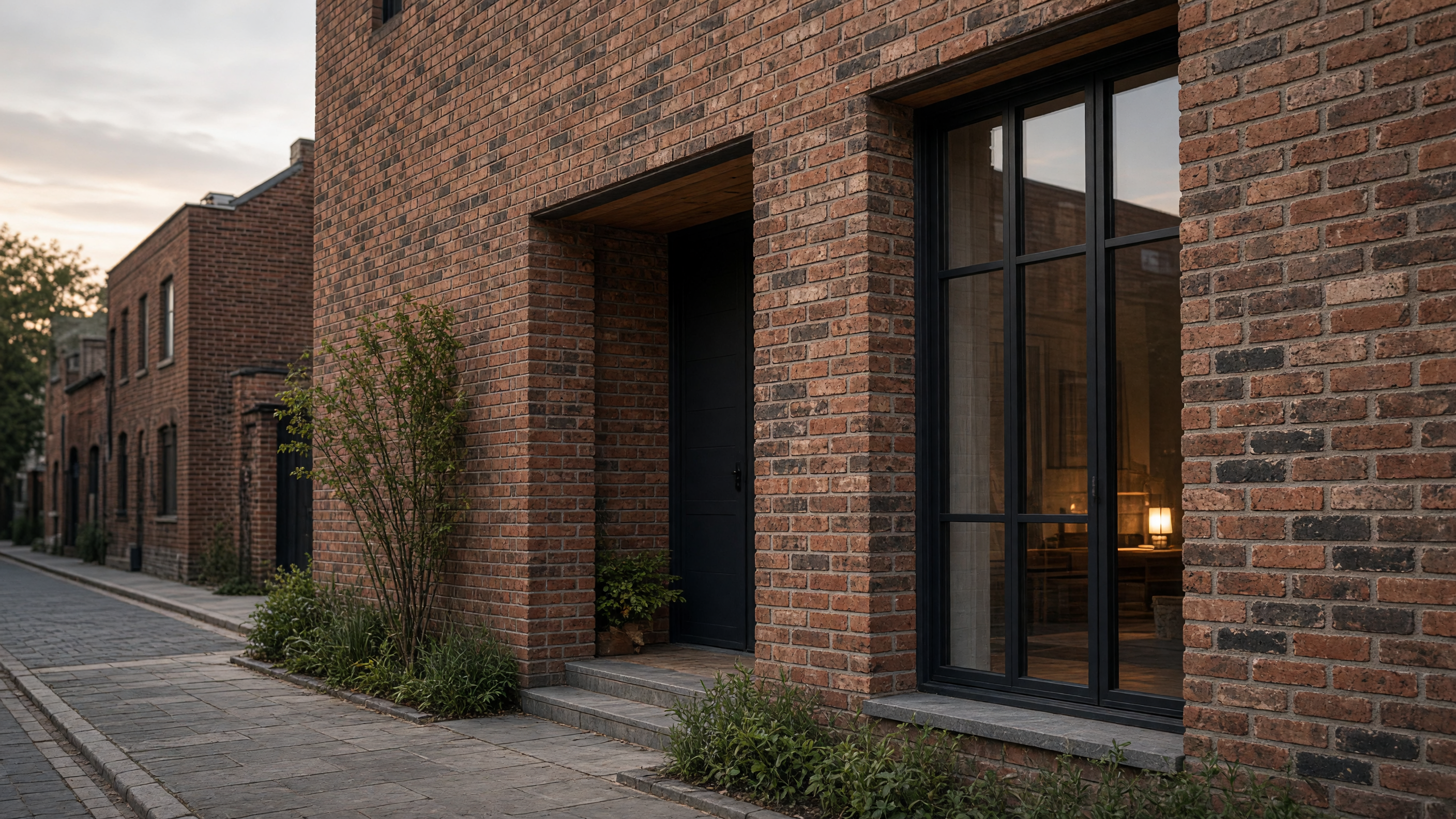
The masons began by sorting the salvaged brick into three stacks: whole, half, and chipped. They laid the whole bricks first, setting each one on a thin bed of lime mortar so the joints stayed narrow and the wall read as a single plane. Where the old brick had spalled, they turned the damaged face inward so the weather side stayed sound. The wall rose in the original running bond, but every sixth course received a stainless-steel angle that projects into the cavity behind, tying the brickwork to the new wood framing without visible fasteners.
Behind the brick, two inches of mineral wool fill the space between the steel ledger and the sheathing. The wool stays dry because the lime mortar lets vapor pass; no vapor barrier traps moisture against the inner face. In summer the brick surface absorbs heat during the day and radiates it outward after sunset, lowering the load on the air conditioner. In winter the same mass stores heat from the low sun and releases it through the night, trimming the hours the boiler runs.
The owner kept the original window openings and simply deepened the jambs so the new insulated glass sits flush with the inner face of the brick. Light therefore falls across the same width of floor as it always did, yet the glass now carries a low-e coating that reduces heat loss. At the base of each opening a narrow stone sill projects an inch beyond the brick, throwing rainwater clear of the wall and preventing dark stains at the corners.
On the rear elevation the brick meets a new one-story addition. The addition roof is low and flat, its edge tucked behind the last course of brick so the parapet reads continuous. Inside the addition, the ceiling is left exposed; the brick of the old party wall continues down to the new concrete floor, giving the smaller room the same thermal mass as the rooms above. A single radiator set against that wall supplies most of the heat, because the brick surface stays warm long after the boiler shuts off.
During the workday the family rarely touches a thermostat. Morning light on the south brick face raises the surface temperature enough that the kitchen feels comfortable by the time breakfast is finished. In late afternoon the children sit on the window seat, their backs against the warmed masonry, while the alley side of the house stays cooler because the low porch roof shades the lower courses. The brick does not announce these effects; it simply holds and releases heat according to its own weight and color.