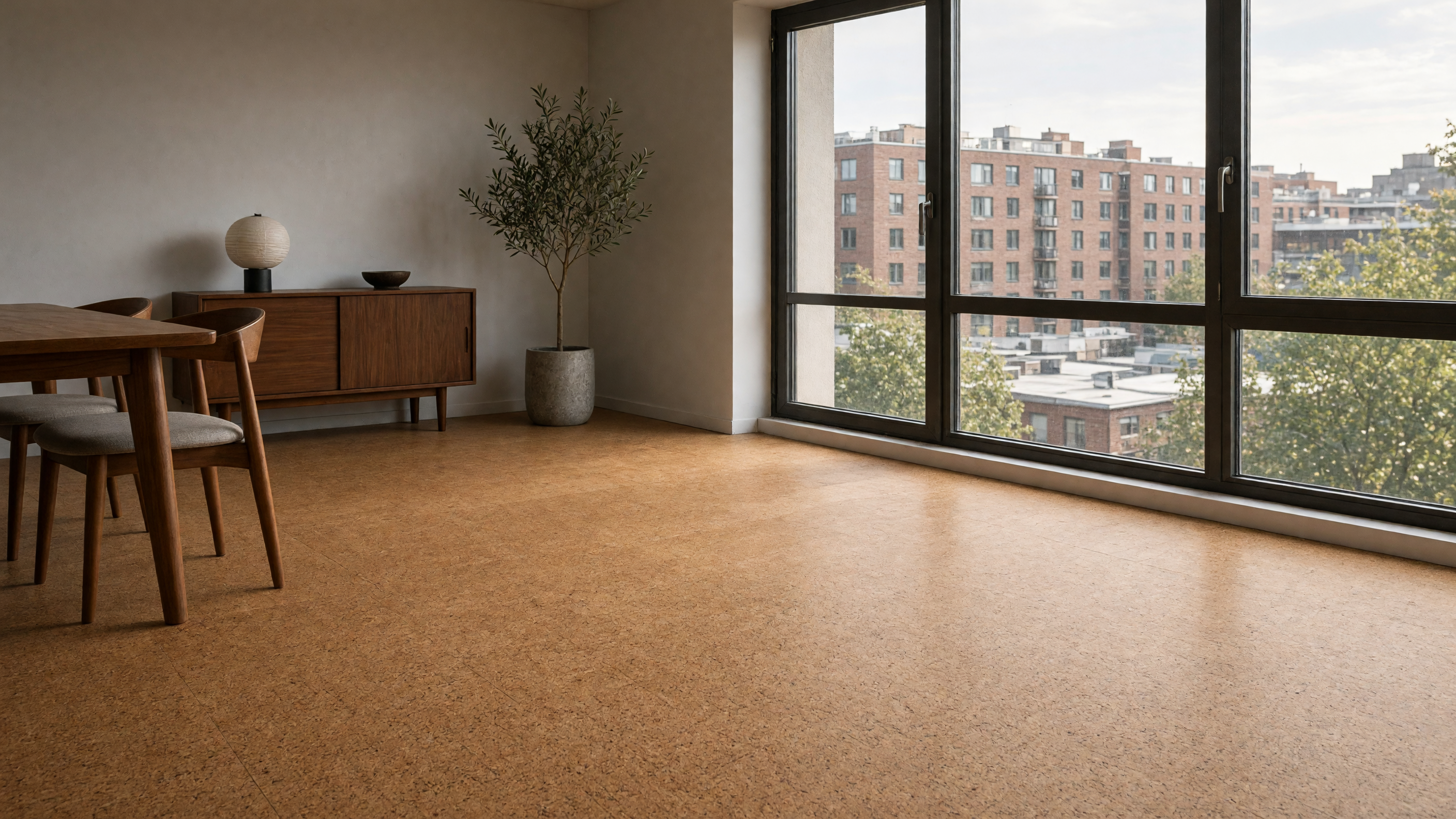
The floor in the apartment below mine is cork, laid in a simple running bond without border or pattern. At night the sound of a dropped spoon travels only as a soft click, not the sharp report that hardwood would send through the joists. The material gives underfoot just enough to shorten the impact, and the air trapped in its cells turns that small movement into heat instead of noise. Over a year the surface has darkened where the afternoon light hits it longest, the change visible only from one angle in the late day.
Cork is harvested from the bark of the cork oak without felling the tree, so the floor carries the rhythm of a living stand rather than a single cut. The sheets arrive compressed and are sanded flat on site; the joints are butted and glued to a plywood underlayment that already carries the building’s heating pipes. Because the material is dimensionally stable in moderate humidity swings, no expansion gap is needed against the baseboard, which keeps the edge detail to a single line of quarter-round.
Light in these rooms arrives low from the west. Cork reflects that light softly because its surface is neither glossy nor matte; the small cells scatter the rays instead of mirroring them. On an overcast morning the floor reads as a single warm plane that meets the white walls without a hard line, so the eye travels farther into the room than the actual dimensions suggest. In summer the same surface stays cool under bare feet, and the difference is noticeable after the hallway, which is still tiled.
A tenant who works nights keeps the blinds drawn until late afternoon. When the room is dark the cork does not reflect the small LED on the charger or the streetlight that slips past the curtain edge; it absorbs those points of light and leaves the corners quiet. The same absorption reduces the need for heavy rugs. A single wool runner now lies only where the desk chair rolls, and the rest of the floor is left bare so that the air can move across it and carry away the small amount of moisture that cooking releases.
The underlayment is three-quarter-inch plywood screwed to the existing joists at twelve-inch centers. The cork itself is four millimeters thick and arrives in tiles that weigh little enough for one person to carry a stack up the stairs without strain. No radiant-heat system was altered during installation; the pipes remain at their original depth, and the cork’s modest thermal resistance does not change the time it takes the room to reach temperature on a cold morning.
Because the material is harvested on a nine-year cycle and can be sanded once before replacement, the floor carries a clear limit on its service life. When the surface finally wears, the tiles can be lifted without disturbing the underlayment, and new cork can be glued in their place. The process leaves the room usable the same day and produces a waste stream small enough to fit in the back of a station wagon. The choice therefore sits between the daily quiet it provides and the straightforward way it can be renewed when the time comes.