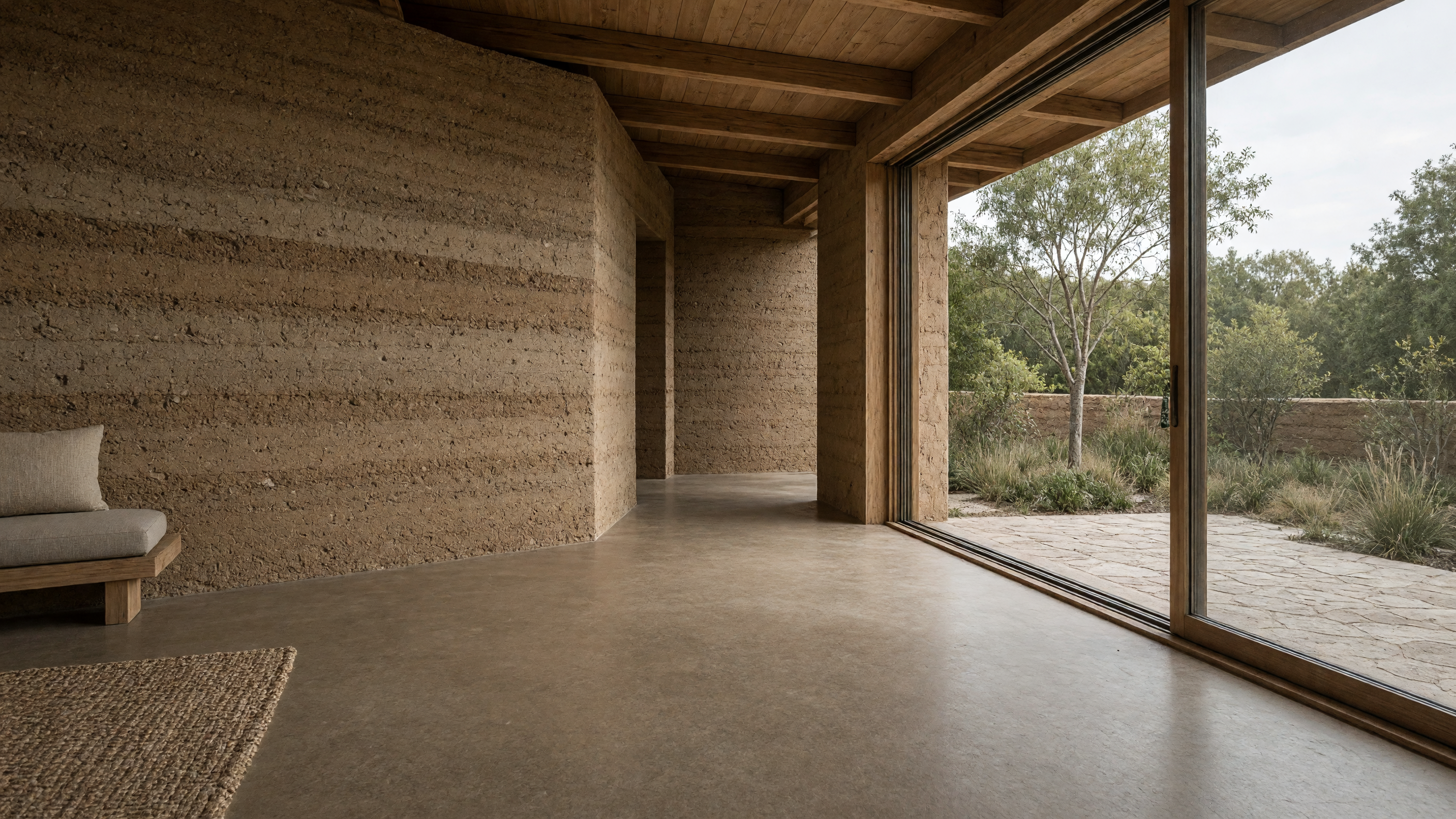
In a house in central New Mexico, the living room floor is a single poured slab of rammed earth, finished only with a thin coat of linseed oil. On summer afternoons the surface stays cooler than the air above it by several degrees, enough that a person sitting on a low chair feels the difference through the soles of their shoes. The slab rests directly on compacted gravel and a vapor barrier, so the mass stays in contact with the ground temperature rather than with the fluctuating air inside the room.
That contact matters more than the material itself. Rammed earth stores heat slowly and releases it slowly, but its real advantage here is the steady draw of coolness from the soil beneath. The floor does not need ducts or fans; it works by staying where it is. In winter the same mass receives heat from low winter sun through south-facing glass and gives some of it back at night, trimming the swing between day and night temperatures inside.
The surface is not sealed the way concrete is. It remains slightly porous, so a spill darkens the earth for a few hours and then fades. Owners learn to keep a small broom near the door and to accept that the floor will carry the marks of daily life. Those marks are part of the thermal performance: a thin layer of dust or a woven rug changes how the surface exchanges heat with the air, and occupants adjust them by season without thinking much about it.
Construction is straightforward once the crew has the right soil. The mix is mostly local subsoil with a small addition of sand and a little lime for stability. It is compacted in lifts of about four inches inside temporary forms, then left to cure for several weeks before the oil finish. No reinforcing steel is required because the slab is not expected to span; it simply sits on the prepared base. The joints between pours are left visible as faint lines that run across the room like the grain in a plank floor.
Because the material comes from the site or a nearby borrow pit, transport energy is low. The floor also avoids the high embodied carbon of Portland cement. Once in place it needs almost no maintenance beyond occasional re-oiling, and at the end of the building’s life the earth can be returned to the ground or reused. These facts are rarely discussed by the occupants; what they notice is that the room feels even in temperature without mechanical help.
In practice the floor is used exactly like any other hard surface. Chairs, tables, and rugs move across it without special protection. Children play on it in summer because it is cooler than the deck outside. In the evening the same surface holds a little warmth from the day and makes the room feel less abrupt when the sun drops. The effect is quiet and constant, the result of a simple decision about what the floor is allowed to touch.