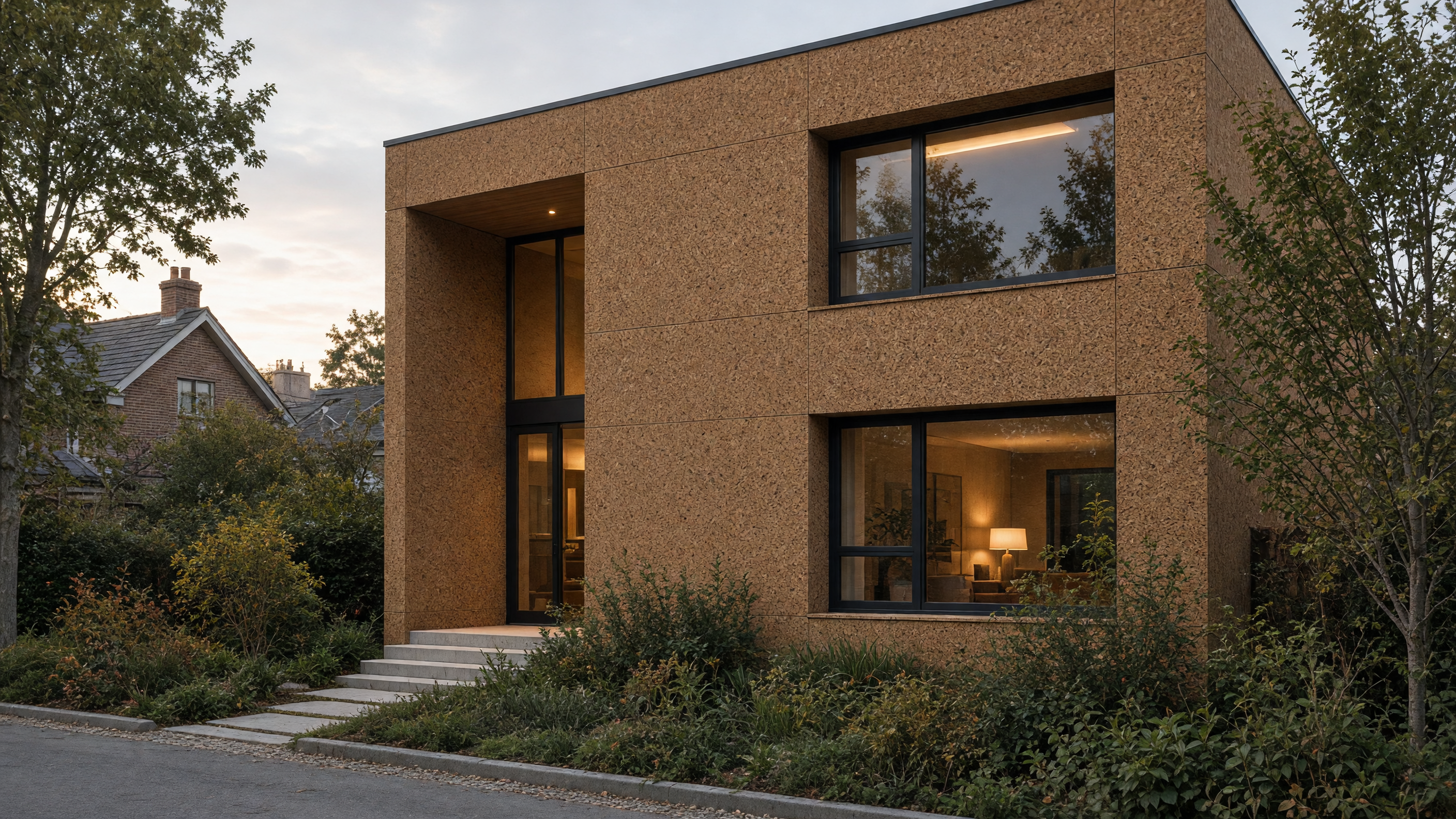
The first house I measured had cork on the south wall only, a single course of 40-millimeter blocks glued to a cement board and then sealed with a lime wash that had already started to flake. The owner said the surface stayed cool to the hand even when the air outside reached 92 degrees. Inside, the bedroom that shared that wall needed the window unit less often than the identical room on the north side.
Cork works here because the material itself slows heat flow. Its cells are mostly air, trapped in a matrix of suberin, and that combination resists both conduction and the daily swing of temperature. In a one-story ranch built in the 1960s, the wall is only a stud cavity with fiberglass and a layer of drywall. Adding the cork on the outside moves the thermal mass outward, so the interior mass stays closer to the overnight low for longer into the next afternoon.
The joint between sheets is simple: a 3-millimeter gap filled with an acrylic caulk that matches the lime wash. No rainscreen, no ventilated cavity. The installer said the cork can take a little moisture and still dry because the material breathes. In practice the south wall shows faint tide marks after heavy rain, yet the marks disappear within a day. The north and east walls, still clad in the original vinyl, show mildew along the baseboard every spring.
The owner keeps the blinds half-drawn on that south room until late afternoon. Because the surface does not radiate heat inward the way a dark brick wall would, the room does not feel warmer even when direct sun falls across the floor. On weekends he opens the sliding door and lets the cooler air from the shaded porch move through. The difference is small, maybe two degrees on the thermostat, but the compressor on the heat pump cycles less often during the shoulder months.
The cork came from Portugal in 4-by-8-foot sheets, harvested on a ten-year cycle from the same stands that supply wine stoppers. The builder cut the panels on site with a standard circular saw and a fine-tooth blade, then bedded them in a thin-set mortar mixed with a little acrylic additive. The only special tool was a long-handled roller used to press each sheet flat before the mortar set. No scaffold was required; two ladders and a plank were enough.
Over two summers the surface has taken on a pale gray where the lime wash has worn away, and the cork beneath shows its natural brown. The change is uneven, darker where the morning sun hits first. The owner says he will re-coat the wall next year, not to restore color but to keep the surface from checking along the exposed edges. The cork itself shows no rot or insect damage so far.