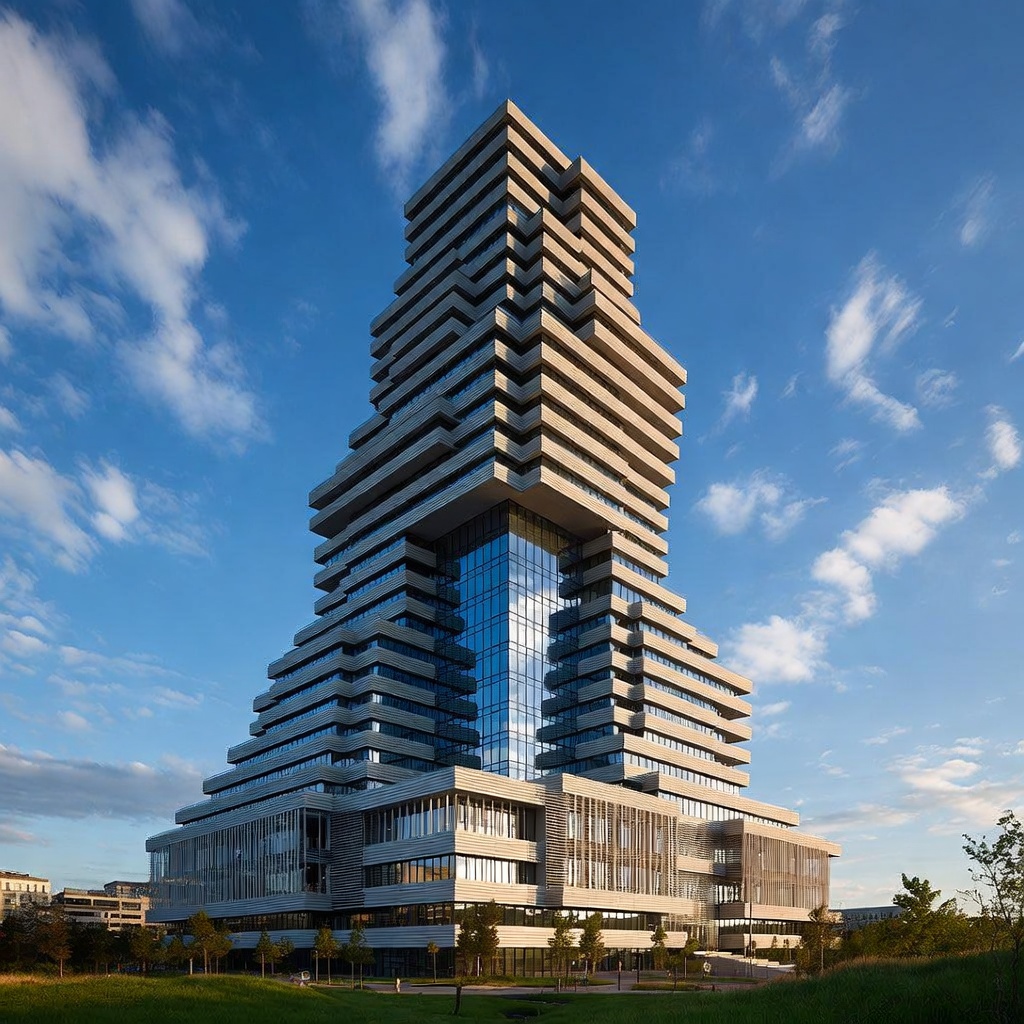
Imagine stacking skyscrapers like oversized Lego bricks, snapping them together in weeks instead of years, all while slashing costs and environmental impact. Welcome to the world of modular skyscrapers, where construction’s old-school headaches—endless delays, skyrocketing budgets, and mountains of waste—are getting a high-tech overhaul. This isn’t sci-fi; it’s happening now, transforming city skylines from Shanghai to New York.
At its core, modular construction breaks a building into prefabricated modules—think self-contained rooms or floors—built in factories under controlled conditions. These steel-framed pods, complete with wiring, plumbing, insulation, and finishes, are trucked to the site and craned into place like giant puzzle pieces. It’s assembly-line efficiency meets vertical ambition. Pioneered in the mid-20th century for quick housing post-WWII, the tech has evolved with robotics, 3D printing, and BIM (Building Information Modeling) software, ensuring precision down to millimeters.
Why the buzz? Speed is king. Traditional skyscrapers can take 5-7 years; modular ones? Often half that. Take Singapore’s 40-story Marina Bay Court, completed in 2017 using 90% prefabricated modules—erected in just 15 days on-site after factory prep. Or New York’s 32-story Via 57 West, a striking pyramid-shaped tower where modules arrived ready-to-stack, dodging the city’s brutal winters. Cost savings hit 20-50%, thanks to factory efficiencies: no weather delays, fewer on-site workers (reducing labor costs by up to 30%), and minimal material waste—recycling rates soar past 90%.
Environmentally, it’s a game-changer. Factories use energy-efficient processes, cutting CO2 emissions by 45% compared to stick-built methods, per a McKinsey report. Modules incorporate green tech like solar panels, rainwater harvesting, and superior insulation, earning LEED certifications effortlessly. In dense urban zones, this means less disruption—no noisy cranes for months—and safer builds, with 80-90% of work done off-site, slashing accident rates.
Challenges persist, of course. Transporting 20-ton modules demands wide-load permits and beefy infrastructure; oversized loads can’t just zip through city streets. Regulations lag too—many codes weren’t written for factory-forged giants, requiring custom approvals. And earthquakes? Engineers counter with flexible joints and dampers, as proven in Japan’s modular high-rises that withstood the 2011 Tohoku quake.
The future? Sky’s the limit—literally. Firms like Skanska and Laing O’Rourke are scaling up to 100+ stories, with 3D-printed modules and drone deliveries on the horizon. In housing-crisis cities like London and Toronto, modular towers promise affordable units at warp speed. Broad Group in China even built a 57-story hotel in 19 days, modules stacking like a time-lapse video.
Modular skyscrapers aren’t just taller buildings; they’re smarter, greener cities. As urbanization explodes—two-thirds of humanity urban by 2050—they’re the stackable solution to our vertical future. Next time you gaze at a gleaming tower, ponder: was it pieced together in a factory? The revolution is stacking up, one module at a time.
Comments are closed