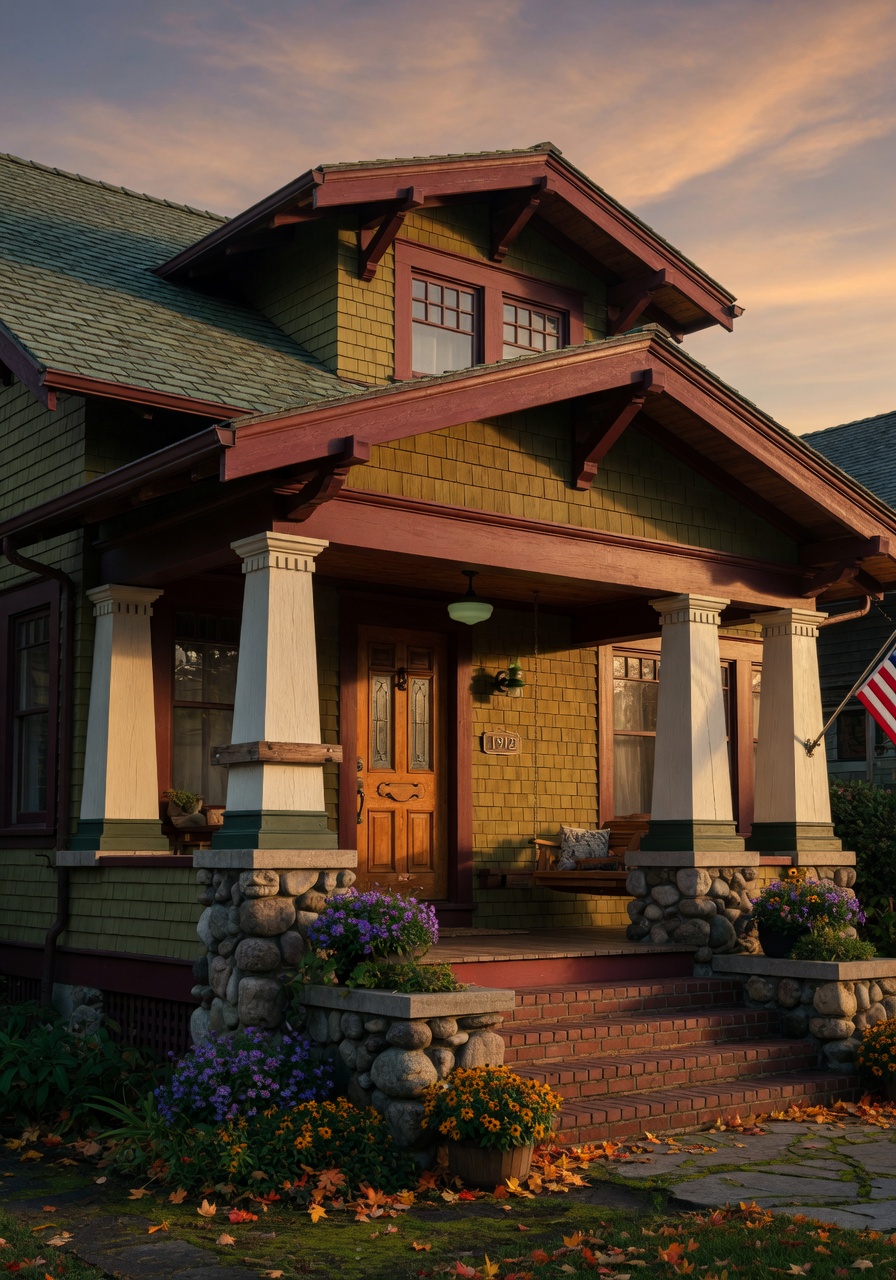
Long before sleek minimalism or sprawling McMansions took over, the Craftsman bungalow carved out its place with a grounded honesty that still resonates. Born in the early 1900s during America’s rapid industrial growth, this style pushed back against Victorian fussiness by embracing straightforward materials and practical design. Low-pitched roofs with deep overhangs and broad front porches became signatures, turning everyday spaces into spots meant for lingering rather than just passing through.
Those porches often rest on tapered columns anchored by solid stone or brick piers, creating a sturdy welcome that feels built to last. Inside, the emphasis shifts to visible structure—exposed beams and rafters that highlight the woodwork—alongside built-in storage like window seats, bookcases, and fireplaces that blend into the walls. Exteriors typically feature wood shingles or horizontal siding, while interiors stick to oak or fir trim finished to let the natural grain show. Double-hung or casement windows with divided panes bring in plenty of daylight and turn ordinary views into framed moments. Even the smaller kitchens and baths from that era hold their own with compact, workable layouts, original tile work, and simple brass hardware.
The style grew out of the broader Arts and Crafts movement, influenced by thinkers like Gustav Stickley and architects such as Charles and Henry Greene in California. Pattern books and mail-order kits from companies like Sears made these homes accessible to middle-class families, spreading them across cities from Pasadena to Chicago and Seattle. Iconic examples include the Gamble House, with its precise joinery and custom art glass, showing how the approach celebrated handmade quality over factory uniformity during a time of fast urban change.
Modern updates keep the spirit alive through thoughtful renovations and new constructions that weave in energy-saving elements like solar arrays tucked beneath classic gables. Neighborhoods such as Pasadena’s Bungalow Heaven see owners preserving original details while swapping in efficient windows that match the old divided-light look. What sets these homes apart today is their human scale: front porches naturally draw people outside for conversation, smaller footprints cut down on excess, and features like those overhanging eaves provide shade without needing extra systems. They quietly practiced sustainability long before it became a priority, relying on local woods and passive design.
The pull remains in the details—the feel of hand-finished surfaces, the solid click of a well-made door, the way light catches on textured glass. Whether restoring one or simply appreciating the form, Craftsman bungalows connect people to a time when buildings reflected real skill and daily rhythms. In neighborhoods everywhere, they continue to offer an alternative to trend-driven construction, proving that lasting appeal comes from proportion, texture, and spaces designed for actual living.
Comments are closed