Manhattan’s most striking skyscrapers didn’t reach their full height by accident. The tapered crowns and needle-like tops that still catch the light today grew out of a specific collision between new zoning rules, post-war optimism, and the streamlined glamour of the 1920s and 1930s.
After the 1916 setback ordinance forced architects to step back each upper floor to protect street-level light, developers turned the restriction into an opportunity. Instead of blunt towers, they began stacking diminishing tiers that narrowed into slender spires, often sheathed in reflective metal or colorful terra-cotta. The 1925 Paris exposition had already introduced the vocabulary—sunbursts, chevrons, and crisp geometric lines—and New York builders ran with it.
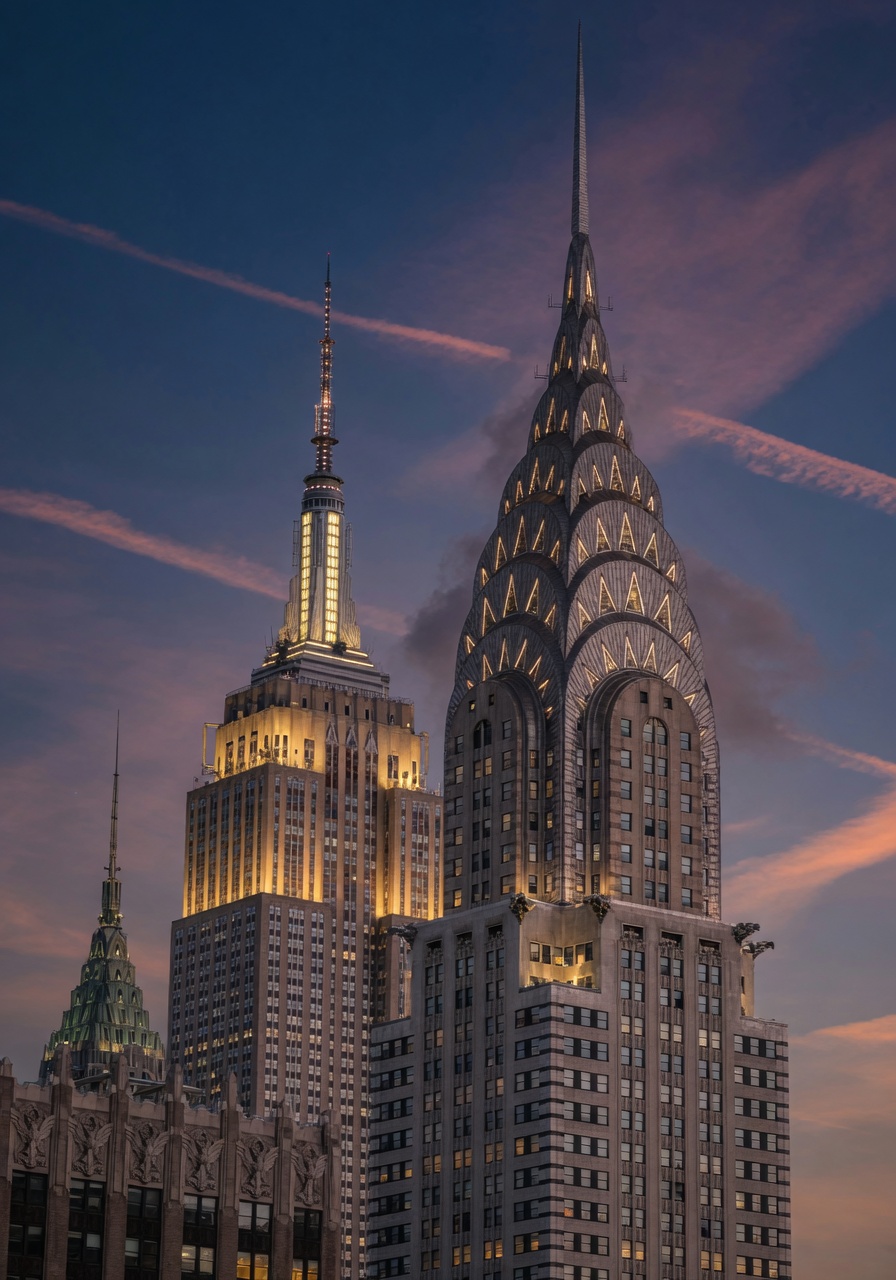
William Van Alen’s Chrysler Building, finished in 1930, remains the clearest expression of that moment. Its 1,046-foot vertex flares outward in seven concentric arches before terminating in a stainless-steel spire. The radiating pattern was meant to suggest a hubcap, a deliberate nod to Walter Chrysler’s automotive empire. The metal chosen, Nirosta steel, was selected specifically because it would resist the city’s corrosive atmosphere while keeping its mirror finish for decades.
A year later the Empire State Building topped out at 1,250 feet, its mooring mast originally intended for airships. The aluminum cladding and floodlit accents gave the shaft a luminous quality that earned it the nickname “the world’s tallest lighthouse.” Both buildings used the same basic formula: vertical emphasis, precise repetition of motifs, and materials that signaled modernity rather than historical ornament.
Smaller examples followed the same logic. The Daily News Building’s 1929 obelisk carries incised lines that mimic newsprint, while 30 Rockefeller Plaza ends in a clean, tapering mast that reads as both functional and decorative. Even the McGraw-Hill Building’s stepped massing shows how the style adapted to different budgets and sites.
Those same spires continue to shape current practice. One Vanderbilt’s illuminated crown, completed in 2024, borrows the Chrysler’s faceted geometry but pairs it with LED systems that cut energy use. Restoration work on the Chrysler’s interior in 2007 and its listing on the National Register have kept the buildings in active use rather than turning them into static monuments. In a city that keeps adding glass boxes, these earlier towers still prove that height and personality can coexist, and that the skyline can carry forward a century-old sense of ambition without looking dated.
Comments are closed