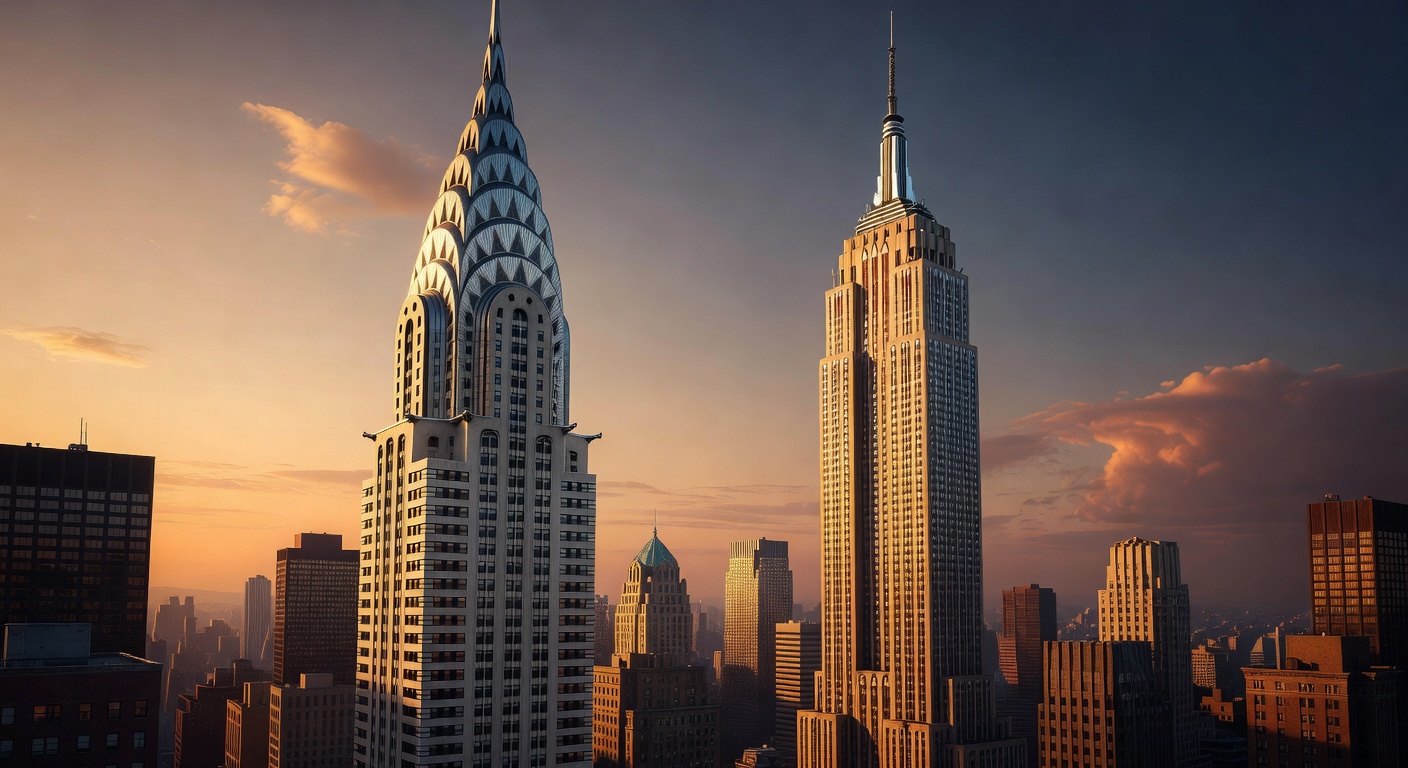
Perched atop Manhattan’s skyline like crystalline spears piercing the clouds, New York’s Art Deco spires stand as defiant monuments to a roaring era. These slender pinnacles, crowning icons like the Chrysler Building and the Empire State Building, aren’t just architectural flourishes—they’re engineered marvels that blend ziggurat-inspired setbacks with gleaming metal sheaths, capturing the exuberance of the 1920s and 1930s.
Art Deco’s golden age dawned amid post-World War I prosperity, fueled by the 1925 Paris Exposition Internationale des Arts Décoratifs, where the style’s luxurious motifs—sunbursts, chevrons, and stylized flora—first dazzled the world. In New York, zoning laws enacted in 1916 mandated tapered building forms to preserve light and air at street level, birthing the iconic “wedding cake” silhouette. Developers seized the opportunity, commissioning spires that ascended in rhythmic tiers, often clad in stainless steel or terra-cotta. The Chrysler Building’s 1930 crown, with its radiant hub-and-spoke vertices and layered arches, exemplifies this: William Van Alen’s 1,046-foot vertex gleams like a frozen fountain, its seven silvered bands evoking automotive hubcaps—a nod to founder Walter P. Chrysler’s passion for cars. Similarly, the Empire State Building’s 1931 mooring mast, a 102-story spire originally designed for dirigibles, soars 1,250 feet, its Art Deco filigree of aluminum and floodlit accents making it the “world’s tallest lighthouse.”
Key features define these spires’ allure: verticality through stacked, diminishing forms; ornate detailing with geometric precision; and materials like Nirosta steel, resistant to New York’s corrosive skies. The Daily News Building’s 1929 spire, a slender obelisk etched with news ticker motifs, or 30 Rockefeller Plaza’s needle-like top, add to the chorus. Even lesser-known gems, like the McGraw-Hill Building’s setbacks, showcase Deco’s machine-age elegance.
Today, these spires pulse with modern relevance. Amid climate crises and urban density debates, they inspire sustainable high-rises—One Vanderbilt’s 2024 crown echoes Chrysler’s with LED-lit facets, proving Deco’s timeless adaptability. Preservation efforts, like the Chrysler’s 2007 interior restoration, underscore their cultural heft: listed on the National Register, they draw millions, fueling tourism and identity. In a flattened digital age, these spires remind us of human audacity—vertical aspirations that weathered the Depression, wars, and 9/11. They matter because they encode optimism: in an era of glass-box anonymity, New York’s Deco spires affirm that architecture can thrill, unite, and endure, spiking the heavens with unyielding grace.
(Word count: 428)
Comments are closed