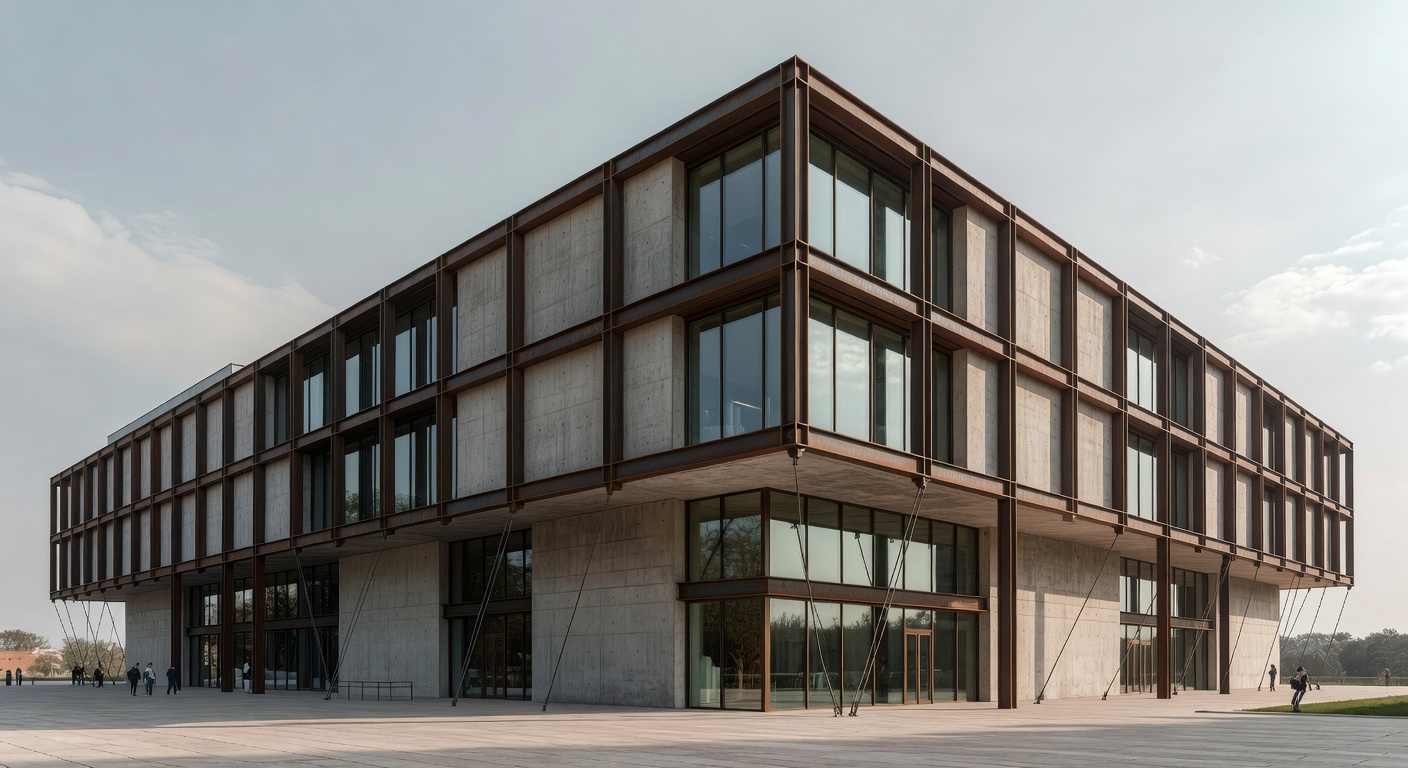
Renzo Piano doesn’t just build structures—he crafts conversations between materials and light. The Italian architect, famed for the Centre Pompidou in Paris, embodies “material honesty,” a principle where every beam, panel, and surface declares its true nature without disguise. No faux finishes or deceptive veneers here; Piano lets steel be steel, glass be glass, and concrete confess its heft. This approach strips architecture to its essence, turning buildings into legible narratives of engineering and craft.
At its core, material honesty in Piano’s work means exposing the skeleton. Take the Pompidou Center, co-designed with Richard Rogers in 1977. Its exoskeleton of colorful ducts and pipes bursts outward like a child’s erector set writ large. Steel struts and ventilation tubes aren’t hidden behind walls—they’re celebrated on the facade, color-coded for function (blue for air, green for fluids, yellow for electrics). This High-Tech manifesto shocked Paris at the time, dubbed a “cultural Hoover factory” by critics. Yet it democratized architecture: visitors grasp how the building breathes and pulses, fostering curiosity over intimidation.
Piano refined this ethos through decades. The Kansai International Airport in Osaka (1994) deploys massive steel trusses that arch like a bird’s wing, their rivets and welds unadorned. Glass walls flood the terminal with light, revealing the structure’s inner workings. Or consider the Whitney Museum in New York (2015), where weathered concrete terraces stack like geological layers, honest in their raw texture and load-bearing might. Terra cotta screens on the California Academy of Sciences in San Francisco (2008) mimic natural cladding, breathable and site-specific, nodding to sustainability without gimmicks.
Historically, material honesty traces to Modernists like Louis Kahn, who insisted materials “speak” their truth, and Louis Sullivan’s organic forms. Piano inherits this while softening its austerity—his Mediterranean roots infuse warmth, as in the shard-like glass towers of The Shard in London (2012), where diagrid steel frames gleam transparently against the sky.
Why does this matter today? In an era of greenwashing and simulated smart skins, Piano’s honesty combats fakery. It promotes durability: exposed elements invite maintenance, extending lifespans. Environmentally, it aligns with circular design—recyclable steel and glass reduce embodied carbon. Psychologically, it builds trust; users intuitively understand a building’s safety and intent, vital in public spaces amid climate anxiety and urban density. As Piano ages—nearing 87—his influence urges architects to prioritize authenticity over spectacle. In a world of digital renders and fleeting trends, material honesty grounds us, reminding that great architecture endures by being unapologetically itself.
(Word count: 428)
Comments are closed