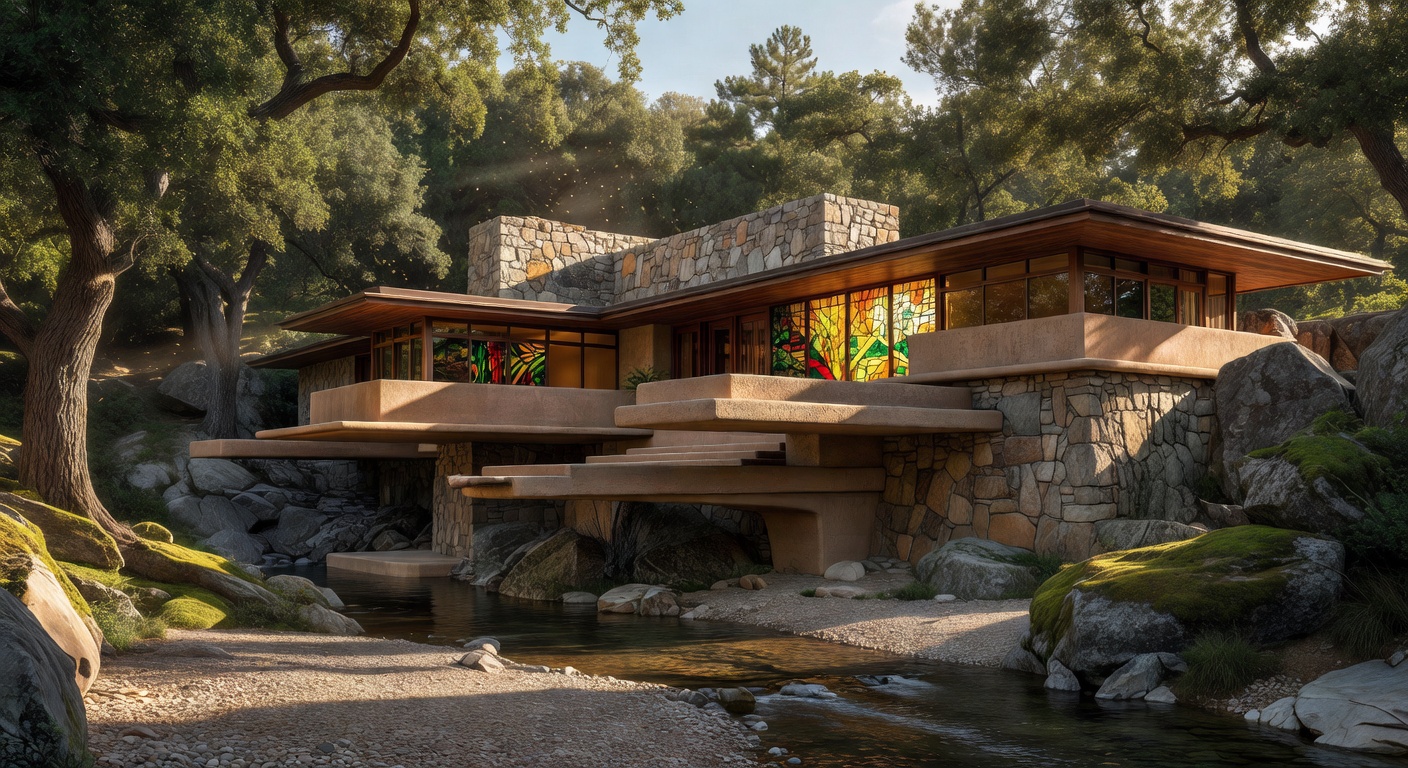
Frank Lloyd Wright didn’t just design buildings; he sculpted living landscapes that breathed with their surroundings. Born in 1867 amid America’s Gilded Age, Wright pioneered organic architecture, a philosophy where structures emerge from their environment like natural extensions of the earth. Rejecting the rigid geometries of European modernism, he sought harmony between human habitation and the natural world—a radical idea when factories belched smoke and cities sprawled chaotically.
At its core, organic architecture embodies several key features. First, unity with site: Wright famously declared, “No house should ever be on any hill or on anything. It should be of the hill, belonging to it.” His designs hug contours, using local materials like Wisconsin limestone or Arizona desert stone to blend seamlessly. Second, the elimination of ornamentation in favor of inherent beauty—forms follow function, but with poetic flow. Cantilevered roofs, open floor plans, and expansive windows dissolve barriers between indoors and out, fostering a sense of expansiveness. Third, the “organic ornament,” inspired by nature’s patterns: think intricate brickwork mimicking river courses or stained glass evoking prairie grasses.
Historically, Wright’s breakthrough came with the Prairie School in the early 1900s. Homes like the Robie House in Chicago (1909) featured low, horizontal lines echoing Midwestern plains, with roofs overhanging like protective wings. But his magnum opus, Fallingwater (1935) in Pennsylvania, epitomizes the ethos. Perched over a waterfall, its concrete cantilevers cascade like the water itself, turning a private residence into a symphony of sound and stone. Commissioned by the Kaufmann family, it cost overruns and engineering feats but proved architecture could enhance, not conquer, nature.
Wright’s influence rippled globally. Post-WWII, his Guggenheim Museum in New York (1959) spiraled upward like a nautilus shell, challenging verticality with organic curves. Today, modern architects channel his spirit. Norman Foster’s Hearst Tower in Manhattan incorporates “triangulated” bracing that reduces material use, echoing Wright’s efficiency. In sustainable design, firms like Studio Gang draw from organic principles for net-zero buildings, such as the Nature Boardwalk at Lincoln Park Zoo, which weaves paths through ecosystems without disruption. Even 3D-printed homes in Texas mimic Wright’s site-specificity, using local soils for eco-friendly shells.
Why does this matter now? In an era of climate crisis and urban homogenization, Wright’s lessons combat alienation. His architecture promotes biophilia—our innate connection to nature—reducing stress and boosting well-being, as studies from the Human Spaces report affirm. It demands sustainability: local sourcing cuts carbon footprints, while integrated designs minimize energy needs. Amid cookie-cutter suburbs and glass skyscrapers, organic architecture reminds us that buildings shape lives. Wright quipped, “The mother art is architecture,” and by rooting homes in their genius loci, we reclaim that maternal bond with the planet. As we face rising seas and resource scarcity, his vision isn’t nostalgia—it’s a blueprint for resilient, soulful living. Dive into a Wright-inspired space, and you’ll feel it: architecture alive, whispering secrets of the earth.
Comments are closed