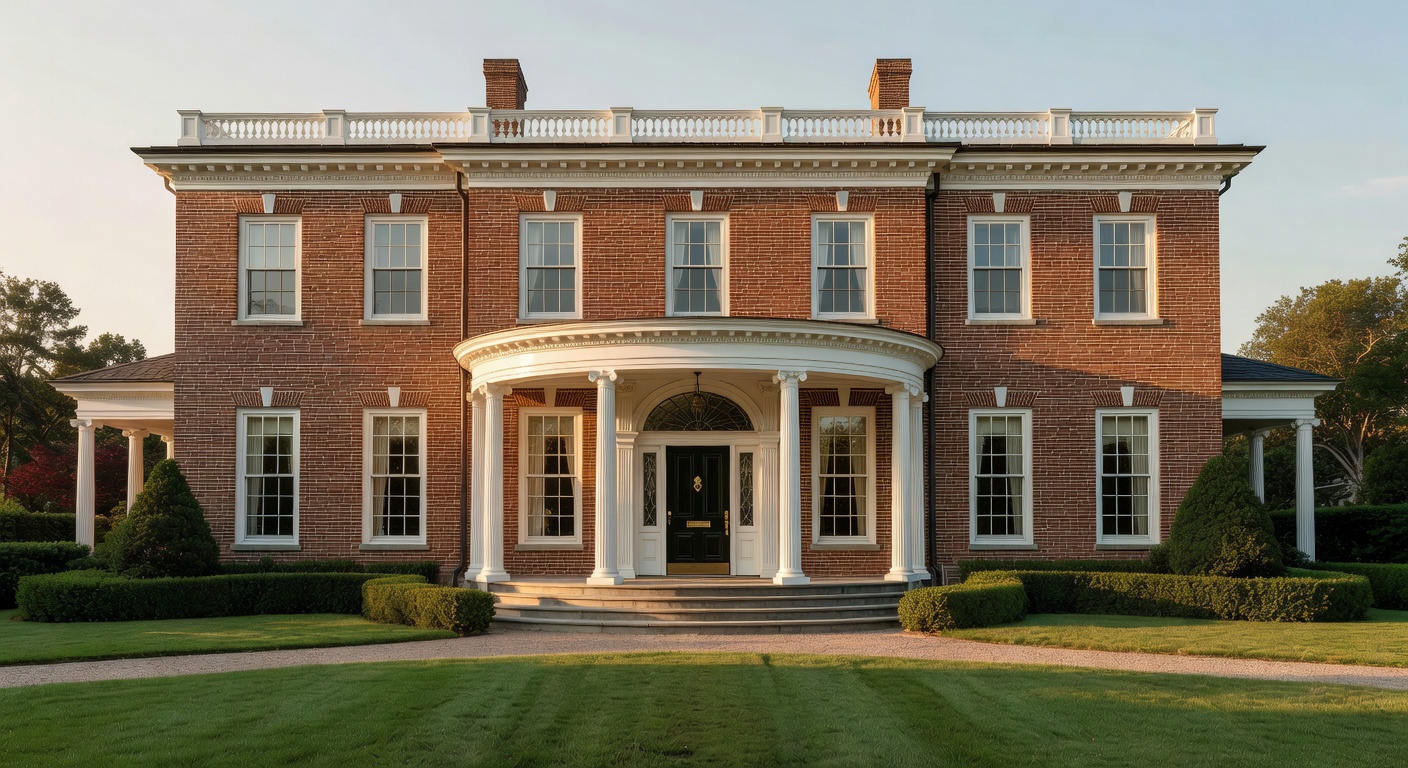
Federal style architecture stands as a testament to early America’s quest for sophistication, blending neoclassical grandeur with a distinctly republican restraint. Emerging in the late 18th century, this style marked a pivotal shift from the ornate excesses of Georgian designs toward something purer, more enlightened. Named after the newly formed federal government, it embodied the ideals of the young republic: order, symmetry, and intellectual poise.
At its core, Federal style delights in understated elegance. Think crisp, white-painted brick facades with gently arched entrances framed by slender pilasters or fanlights—those delicate semicircular transoms that scatter light like whispered secrets. Windows are generously proportioned, often paired in rhythmic sequences, topped with thin lintels rather than heavy cornices. Elliptical arches and oval motifs recur inside, softening the geometry with organic grace. Interiors shine with Adamesque details: delicate plasterwork, swags of carved laurel, and bellflowers climbing chair rails. Colors remain subdued—pale yellows, soft blues, creamy whites—evoking a sense of calm authority rather than royal pomp.
Historically, this style arrived via architects like Charles Bulfinch and Asher Benjamin, who drew from English architect Robert Adam and ancient Roman precedents. After the Revolutionary War, America’s elite sought to distance themselves from British Baroque while signaling cultural maturity. The U.S. Capitol’s early designs and Boston’s Park Street Church exemplify this: monumental yet approachable, they projected a nation confident in its democratic roots. By the 1820s, as the style peaked before yielding to Greek Revival exuberance, it had dotted cities like Philadelphia and New York with gems such as the Nicholas Low House, its facade a masterclass in proportional harmony.
Today, Federal style endures not as museum relic but as a blueprint for timeless living. Modern revivals appear in high-end urban townhouses and suburban estates, like those in Charleston’s historic districts or new builds in Georgetown. Designers like Thomas Jayne incorporate Federal motifs—swag drapery, inlaid floors—into contemporary spaces, proving its adaptability. Why does it matter now? In an era of chaotic maximalism and fleeting trends, Federal elegance offers ballast: a reminder that true luxury lies in restraint. It fosters serene environments that enhance focus and conversation, countering digital overload. Sustainability-wise, its durable materials and efficient layouts align with eco-conscious builds.
Moreover, it democratizes sophistication. Affordable reproductions of Federal mantels or hardware make this polish accessible, bridging past and present. As we grapple with identity in a polarized age, Federal style whispers a unifying truth: elegance unites, from Mount Vernon’s portico—George Washington’s own Federal masterpiece—to your next renovation. It invites us to build not just homes, but legacies of quiet power. In rediscovering it, we reclaim a heritage that’s as relevant as ever—polished, poised, and profoundly American.
Comments are closed