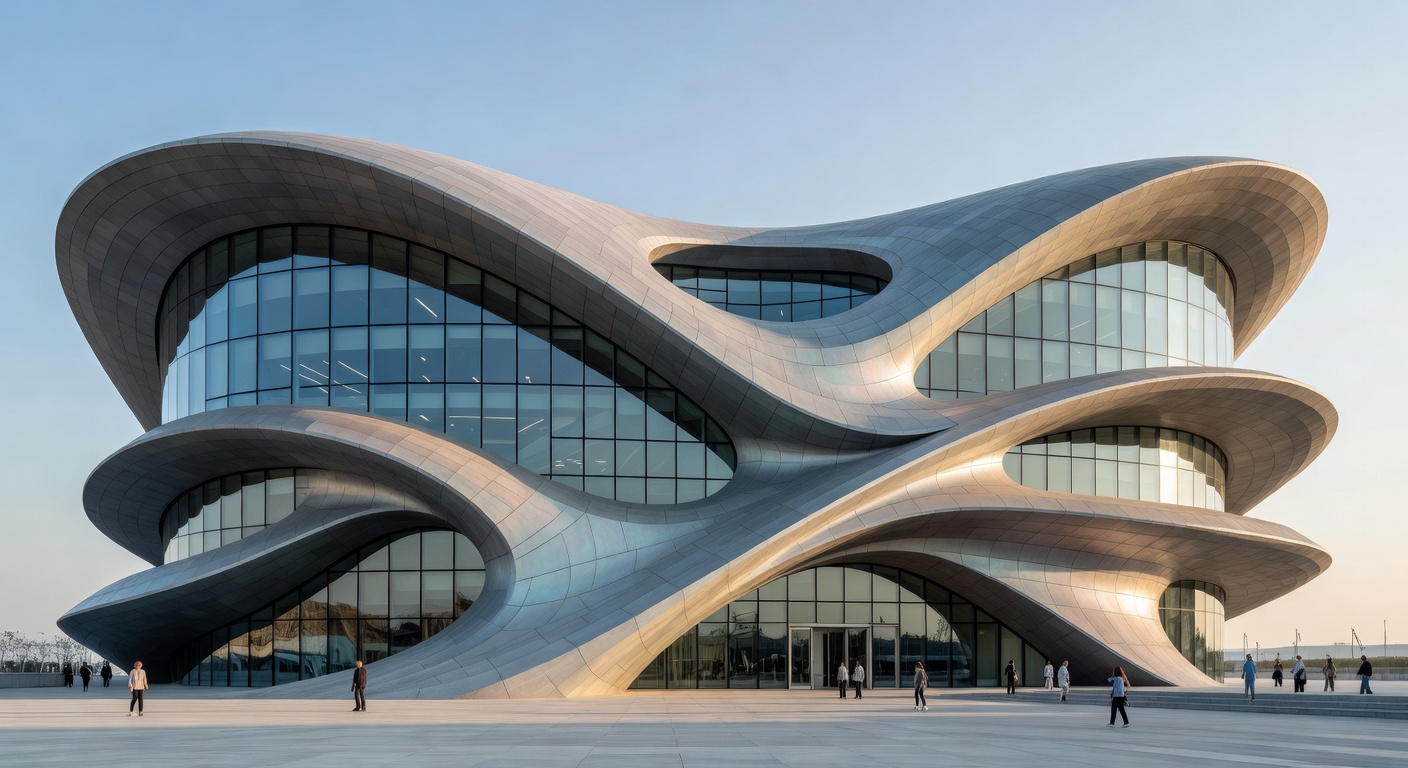
Parametric curves aren’t just lines on a blueprint—they’re the DNA of Zaha Hadid’s architectural legacy, twisting buildings into fluid, almost alive forms that challenge our sense of space. Hadid, the Iraqi-British starchitect who passed in 2016, pioneered this approach, using algorithms to generate complex geometries that traditional drafting couldn’t touch. Her work turned static structures into dynamic sculptures, blending art, engineering, and computation in ways that still ripple through modern design.
At the heart of Hadid’s parametricism lies a mathematical backbone. Parametric design employs equations where variables—like time, angle, or force—drive the shape. Instead of drawing curves by hand, designers input parameters into software like Rhino or Grasshopper, letting algorithms iterate thousands of variations. Hadid’s team mastered this in the 1990s, evolving from her early painted visions—those explosive, jagged sketches that won her the 1983 competition for The Peak in Hong Kong (though unbuilt). By the 2000s, digital tools unlocked her visions: think of the sinuous steel roof of the Heydar Aliyev Center in Baku, Azerbaijan (2012), where parametric curves create a seamless 57,500-square-meter wave without visible supports, mimicking dunes in motion.
Historically, Hadid built on precedents like Antoni Gaudí’s organic forms in Barcelona’s Sagrada Família, computed via inverted catenary chains, or Frei Otto’s tensile structures. But she supercharged it with computation. In the parametric turn of the late 1990s—coined by Patrik Schumacher, her long-time partner—Hadid rejected orthogonal boxes for “a new architectural paradigm.” The Vitra Fire Station (1993) marked her shift: fragmented forms hinted at fluidity, but later masterpieces like the MAXXI Museum in Rome (2009) unleashed full parametric glory. Its interlocking ribbons, optimized for light and flow, were born from scripts simulating pedestrian movement and structural loads.
Today, Hadid’s influence pulses in icons like the Beijing Daxing International Airport (2019, completed posthumously), its colossal starfish form generated parametrically for efficiency—handling 100 million passengers yearly with minimal columns. Or the Opus in Dubai, twin towers fused by a parametric void that evokes melting ice. These aren’t gimmicks; parametric curves optimize everything from wind resistance to material use, slashing construction waste in an era of sustainability mandates.
Why does it matter now? Parametricism democratizes complexity. Tools once elite are accessible via free software, empowering architects worldwide to tackle climate challenges—curved facades that harvest solar energy or self-shading skins. Amid urbanization’s crush, Hadid’s curves foster experiential spaces: fluid interiors that blur indoors and out, promoting mental well-being. Critics once called her work “deconstructivist” chaos, but data proves otherwise—her buildings endure earthquakes, cut energy costs, and draw millions.
Hadid’s parametric legacy isn’t frozen in her 950+ projects; it’s a living code, urging us to design not for today, but for fluid tomorrows. In a world of straight lines, her curves remind us: architecture can dance.
Comments are closed