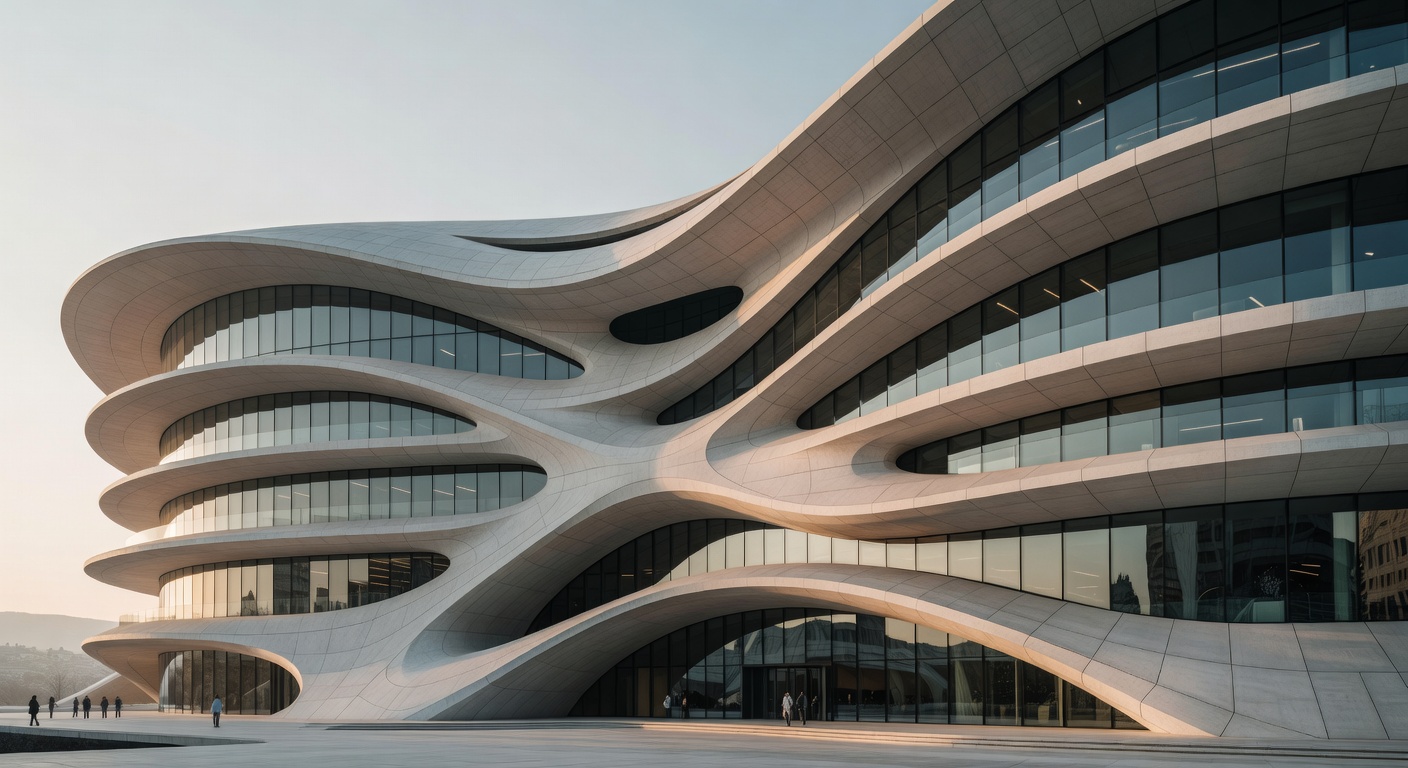
Parametric curves aren’t just lines on a blueprint—they’re the DNA of Zaha Hadid’s architectural legacy, twisting buildings into organic, gravity-defying forms that challenge our perception of space. Born in Baghdad in 1950, Hadid pioneered this approach in the late 1980s, blending mathematics, computation, and artistry to redefine urban landscapes. Her work turned static structures into dynamic entities, proving that architecture could flow like a river or soar like a bird in flight.
At the heart of Hadid’s parametricism lie algorithms that generate complex geometries from simple parameters. Unlike traditional drafting, where architects draw curves by hand, parametric design uses software like Rhino and Grasshopper to define shapes through equations. A single variable—like curvature radius or tension force—can ripple across an entire facade, creating seamless, non-repetitive patterns. Key features include continuity (smooth transitions without sharp breaks), adaptability (forms that respond to site conditions or environmental data), and scalability (from a chair to a stadium). Hadid’s mastery lay in her “paintings” phase—early 2D sketches resembling explosive abstractions—that she later realized in 3D through these tools. The result? Buildings that appear to morph in motion, defying Euclidean rigidity.
Historically, Hadid’s parametric curves emerged amid the digital revolution. Winning the 1983 competition for The Peak Club in Hong Kong (unbuilt but iconic), her jagged, fragmented designs hinted at parametric potential. By the 1990s, as CAD evolved, she founded her London studio, embracing computation to materialize visions once dismissed as “unbuildable.” The 2000s marked breakthroughs: the Vitra Fire Station in Germany (1993) with its sharp angles foreshadowed fluidity, while the MAXXI Museum in Rome (2009) exemplified full parametric glory—sweeping concrete ribbons weaving through space, optimized for light and circulation via algorithmic modeling.
Modern examples amplify her influence. Beijing’s Galaxy Soho (2012), with its looping parametric bands, fosters interconnected public realms amid dense urbanity. The Heydar Aliyev Center in Baku (2012)—Hadid’s fluid masterpiece—rises like a wave, its surface undulating without joints, achieved through parametric control of 1,574 unique panels. Today, firms like Patrik Schumacher’s (Hadid’s successor) and others push parametricism further, integrating AI for climate-responsive designs, as in Dubai’s Opus skyscraper with its toroidal voids.
Why does this matter now? In an era of climate crisis and megacities, parametric curves enable hyper-efficient structures: lighter materials, better airflow, and adaptive facades that harvest energy. They democratize complexity—once elite, now accessible via open-source tools—sparking innovation from Shenzhen skyscrapers to parametric pavilions at global expos. Hadid’s curves remind us architecture isn’t about boxes; it’s about possibility. As cities densify and sustainability demands ingenuity, her legacy pulses through every sinuous skyline, urging us to curve toward a bolder built world.
Comments are closed