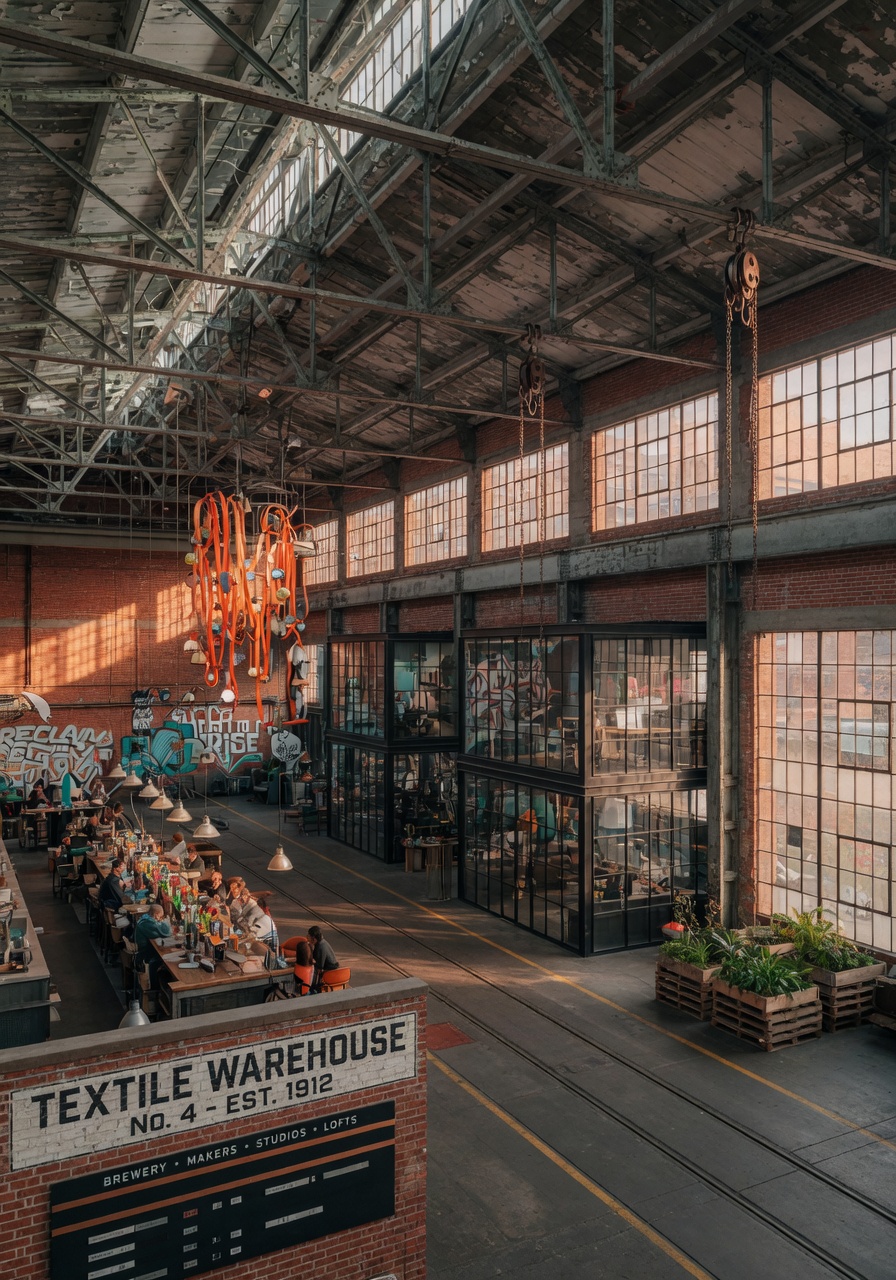
Warehouses once built to swallow railcars and stack pallets now anchor some of the liveliest districts in post-industrial cities. Their thick masonry shells, wide plank floors, and steel-framed windows—features engineered for heavy freight rather than comfort—have become unexpected assets for a new generation of uses. The same open volumes that once moved goods now host everything from vertical farms and performance venues to shared offices and micro-breweries, all without the need for new structural skeletons.
These buildings owe their staying power to straightforward industrial logic. Load-bearing exteriors left interiors column-free, so floor plates can be subdivided or opened up at will. High ceilings and original clerestory windows deliver daylight that modern offices chase with expensive glazing. Loading docks, originally sized for forklifts, convert easily into sheltered plazas or bike entries. Even the patina of soot and rust adds character that new construction rarely matches without expensive finishes.
The story stretches back to the rapid trade expansion of the 1800s, when warehouses clustered beside ports and rail yards to buffer the flow of grain, textiles, and machinery. When manufacturing moved offshore after World War II, many of these structures stood empty, their hulking forms read as symbols of economic retreat in places such as Detroit or Manchester. Preservation advocates in the 1970s began proving that the buildings could be stabilized rather than razed, and the approach has since scaled. London’s Battersea Power Station now mixes residences with retail inside its turbine halls. Brooklyn’s Industry City layers food halls, tech offices, and maker spaces across former shipping sheds. Chicago’s Merchandise Mart shifted from wholesale storage to a permanent design marketplace.
The shift carries measurable weight today. Keeping an existing structure typically cuts embodied carbon by half or more compared with demolition and new build. It also concentrates activity inside already serviced urban blocks, reducing pressure to pave farmland at the edges. Construction crews, baristas, coders, and artists all find work inside the same addresses, while the visible layers of brick and timber keep a neighborhood’s industrial memory intact. In an age of housing pressure and climate targets, these conversions show that the most durable urban growth often starts with what is already standing.
Comments are closed