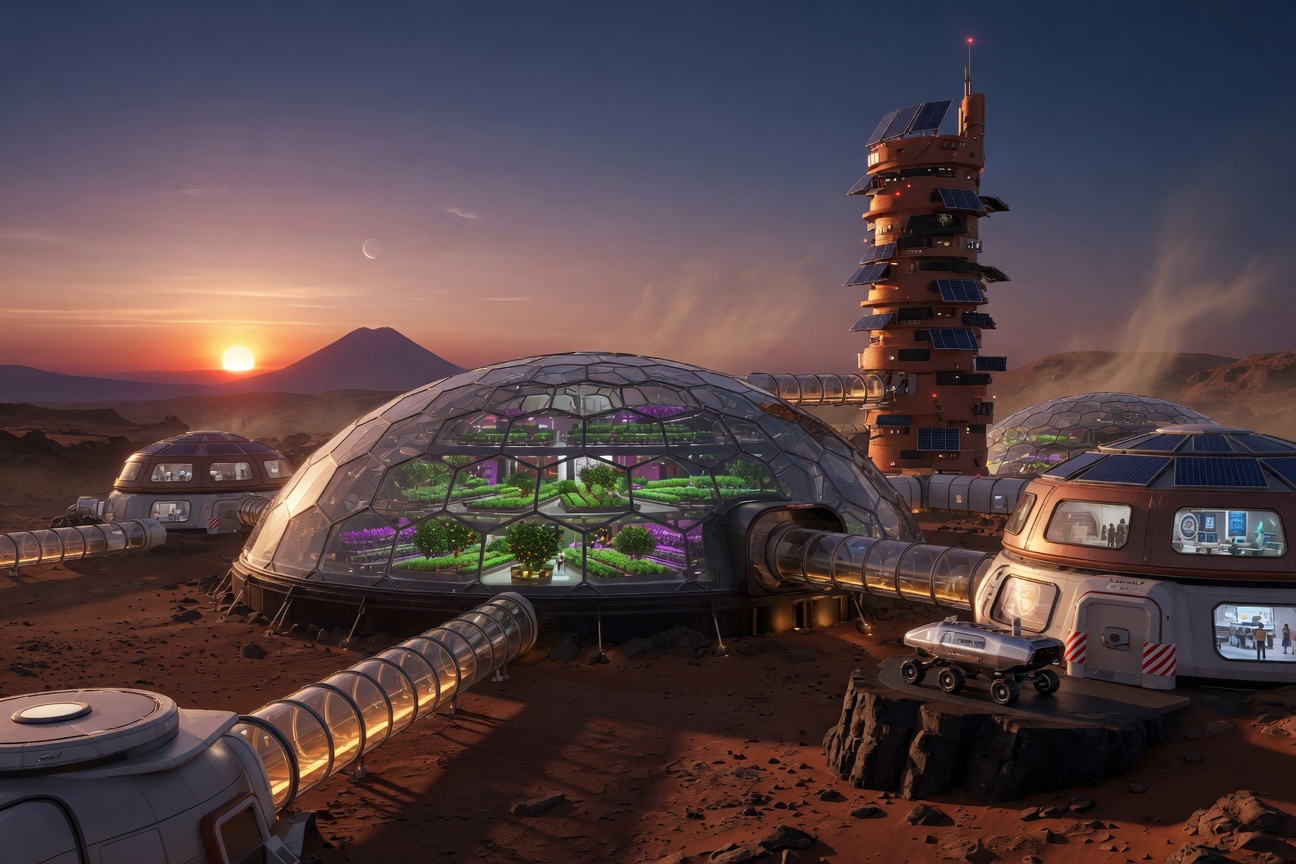
Humanity’s architectural journey has always mirrored its environments, from the mud-brick ziggurats of Mesopotamia to the steel skyscrapers of today, and now it faces its greatest test on the barren plains of Mars. The planet’s thin atmosphere, intense radiation, and temperature swings demand structures that do more than shelter—they must actively sustain life while drawing resources from the hostile landscape itself.
Early designs favor 3D-printed habitats made from Martian regolith, the loose soil covering the surface. Rovers equipped with printers mix this dust with binding agents to extrude walls layer by layer, creating thick barriers that shield against cosmic rays without importing heavy materials from Earth. These printed forms often take domed or cylindrical shapes, their curved surfaces distributing internal pressure evenly in an environment where the air outside exerts almost no force.
Lava tubes offer another foundation, natural caves formed by ancient volcanic flows that provide ready-made radiation protection and stable temperatures. Colonists could seal entrances with inflatable membranes or regolith bricks, transforming these voids into multi-level living spaces complete with hydroponic farms along the walls. Such hybrid approaches reduce construction time dramatically compared to surface builds, which must contend with frequent dust storms that could erode exposed exteriors over months.
Integrated systems turn architecture into a life-support machine. Greenhouses embedded in habitat clusters recycle water and oxygen through plant growth, while thermal mass walls store daytime heat for nighttime release. Low gravity influences everything from ramp slopes to furniture anchoring, preventing residents from floating during routine tasks. Modular connectors allow expansion, linking new pods as populations grow without redesigning entire complexes.
Challenges persist in material testing and dust mitigation, yet prototypes on Earth and the International Space Station validate core concepts like regolith sintering for airtight seals. These innovations promise not isolated outposts but thriving settlements where every wall contributes to survival, echoing how past civilizations turned local clay and stone into enduring civilizations.
Comments are closed