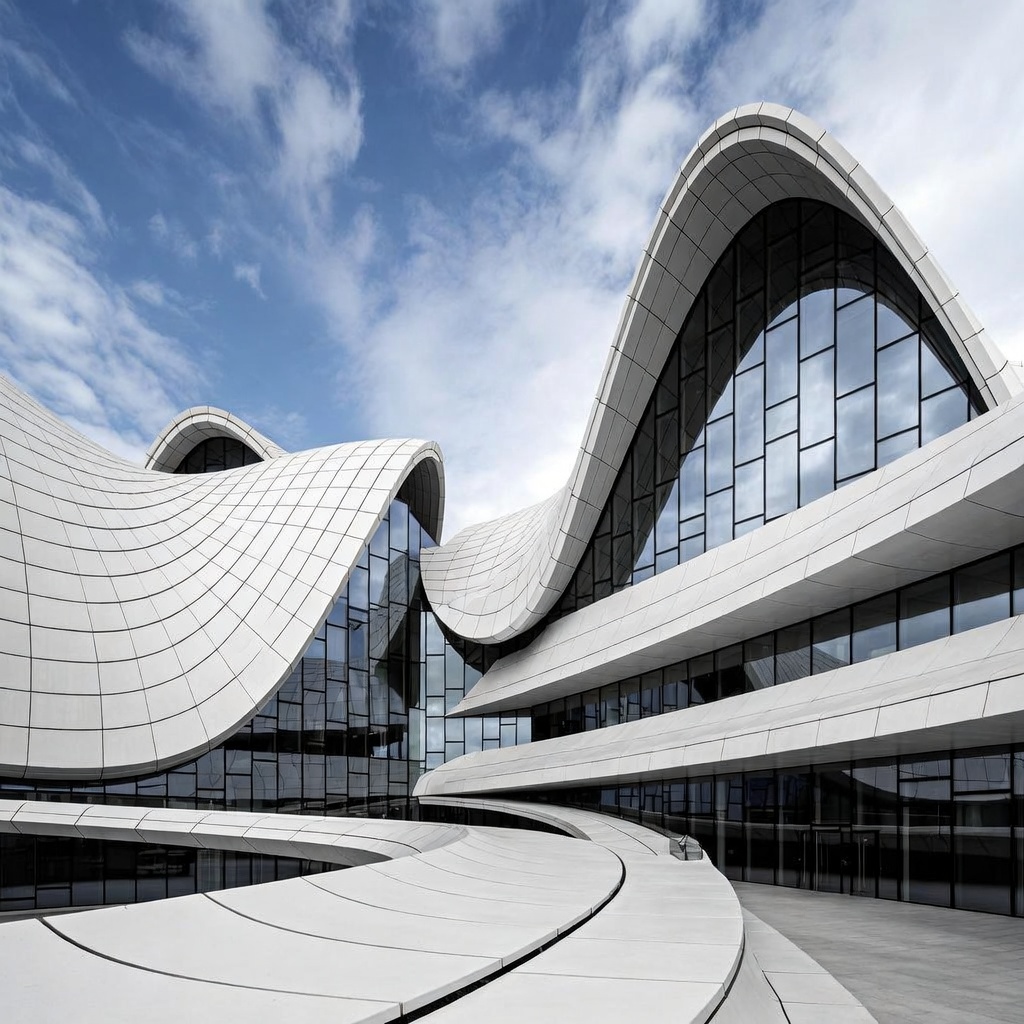
Parametric curves slither through Zaha Hadid’s designs like liquid metal, defying the rigid geometry of traditional buildings. These mathematical expressions—think splines, NURBS (non-uniform rational B-spline curves), and algorithmic loops—allow architects to sculpt forms that flow, twist, and respond dynamically to their environment. Hadid, the Iraqi-British starchitect who died in 2016, mastered this technique, turning equations into iconic structures that feel alive.
Born in Baghdad in 1950, Hadid studied mathematics at the American University before diving into architecture at London’s Architectural Association in the late 1970s. There, she encountered parametricism, a movement pioneered by figures like Patrik Schumacher, her long-time collaborator. Parametric design emerged from computational advances in the 1980s and ’90s, fueled by CAD software like Rhino and Grasshopper. Unlike orthogonal modernism’s straight lines, parametric curves use parameters—variables like height, curvature, or wind load—to generate complex, organic shapes. Hadid’s early paintings, such as “The Peak” (1983), hinted at this with jagged, frozen-motion landscapes, but her real breakthrough came when digital tools made fabrication feasible.
Key features of Hadid’s parametric curves include their adaptability and efficiency. Curves aren’t arbitrary; they’re optimized. In the Heydar Aliyev Center in Baku, Azerbaijan (2012), sweeping parametric surfaces create a seamless 57,500-square-meter envelope without visible joints, achieved through doubly curved panels milled via parametric scripts. The building’s form responds to site topography, blending base, plaza, and roof into a continuous wave. Similarly, the Guangzhou Opera House (2010) employs parametric modeling to carve pebble-like auditoriums from a 70,000-square-meter mass, with curves that diffuse sound and light naturally. These designs minimize material waste—curves distribute loads better than boxes—and integrate engineering feats like double-skin facades for climate control.
Historically, parametricism echoes Antoni Gaudí’s handmade catenaries and Frei Otto’s soap-bubble experiments, but Hadid digitized it. Her MAXXI Museum in Rome (2009) marked a turning point, its interlocking parametric loops challenging Mussolini-era rationalism with fluid aggression. Today, her legacy thrives in projects like the Beijing Daxing International Airport (2019, completed posthumously), where parametric curves form a starfish-like roof spanning 700,000 square meters, optimizing passenger flow via algorithmic simulations.
Why does this matter now? In an era of climate crisis and urbanization, parametric curves enable responsive architecture. They allow buildings to harvest energy (curved solar shades), adapt to rising seas (morphing facades), and personalize spaces via AI-driven parameters. Post-Hadid, firms like BIG and Foster + Partners build on her playbook, but her fearless futurism—blending deconstructivism with blobitecture—pushes boundaries. Parametric design democratizes complexity; open-source tools let anyone iterate like Hadid. It’s not just pretty—it’s a toolkit for resilient cities, proving math can make monuments that move with us. As urban populations swell to 68% by 2050, her curves remind us: architecture must evolve, or calcify.
Comments are closed