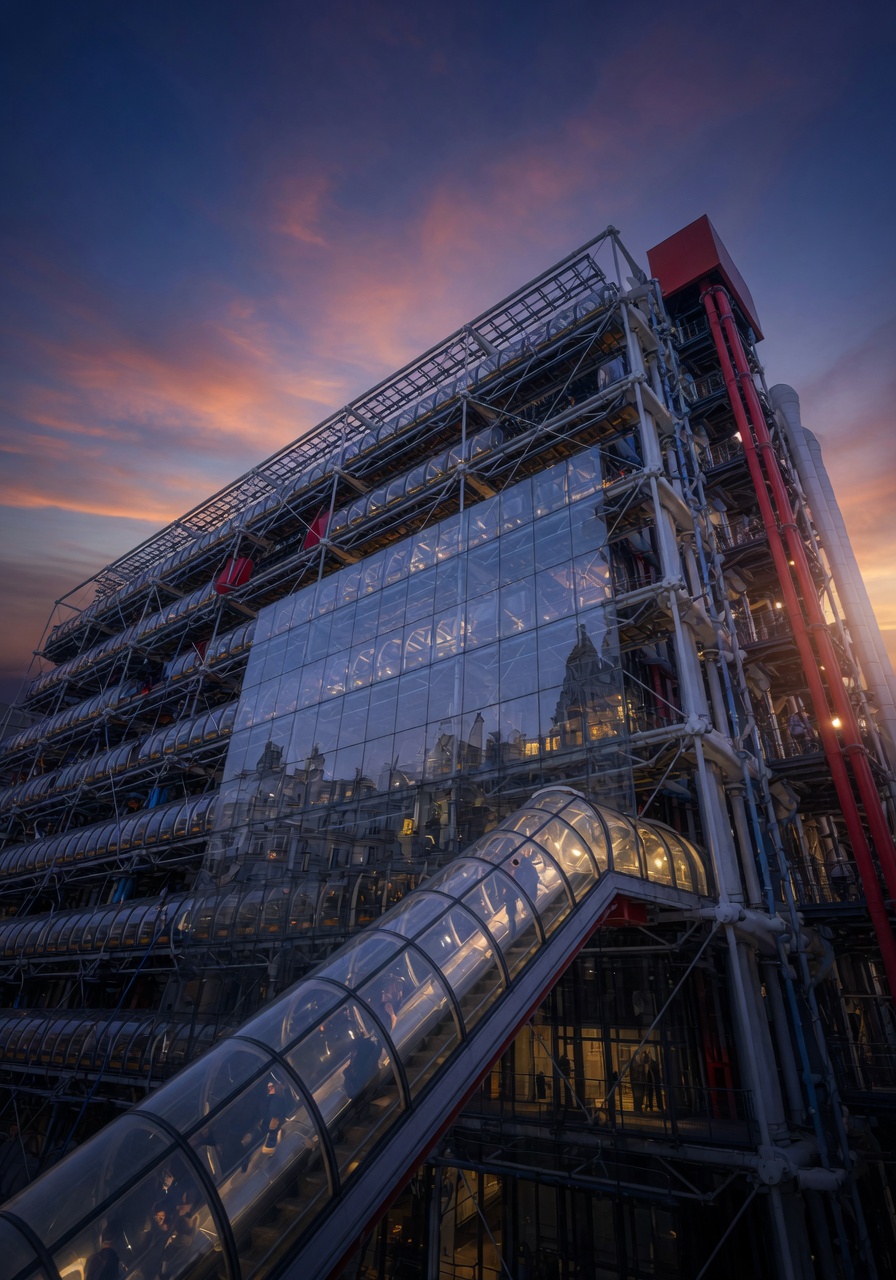
Renzo Piano builds with a clarity that leaves little room for architectural sleight of hand. The Italian architect, best known for co-designing the Centre Pompidou, works from a simple rule: materials should announce exactly what they are. Steel shows its welds, glass transmits light without pretense, and concrete carries its weight in plain view. No veneers or applied finishes soften the message. The result is architecture that reads like a set of instructions rather than a finished illusion.
That approach reached a high point with the Pompidou in 1977. Working alongside Richard Rogers, Piano turned the building inside out. Color-coded pipes and ducts run across the exterior—blue for air handling, green for water, yellow for electrics—creating an exoskeleton that still feels more like an oversized construction toy than a museum. Critics at the time called it a factory in disguise, yet the transparency worked. People could see how the structure operated, and that visibility lowered the barrier between the building and its users.
Piano kept refining the idea across different climates and programs. At Kansai International Airport, completed in 1994, long steel trusses curve overhead like the ribs of a wing, their connections left exposed under vast glass walls. The Whitney Museum in New York stacks raw concrete terraces that register every load and setback, while the California Academy of Sciences uses terra-cotta screens that breathe with the weather rather than mimic it. In each case, the visible parts do real work and look like it.
The lineage runs back through Louis Kahn’s insistence that materials should “speak” and Louis Sullivan’s belief in organic expression. Piano carries that inheritance forward but adds a Mediterranean ease, most visible in the diagrid steel of The Shard in London. The frame stays legible against the sky, registering wind and weight without extra ornament.
The same directness feels newly relevant now. When so many projects rely on simulated textures or overstated sustainability claims, exposed construction offers a practical check. Parts that remain visible tend to get maintained; recyclable steel and glass keep embodied carbon lower; and occupants can read a building’s logic without needing an interpreter. As Piano nears his late eighties, that steady preference for legibility over spectacle continues to push the field toward work that ages honestly rather than chasing the next render.
Comments are closed