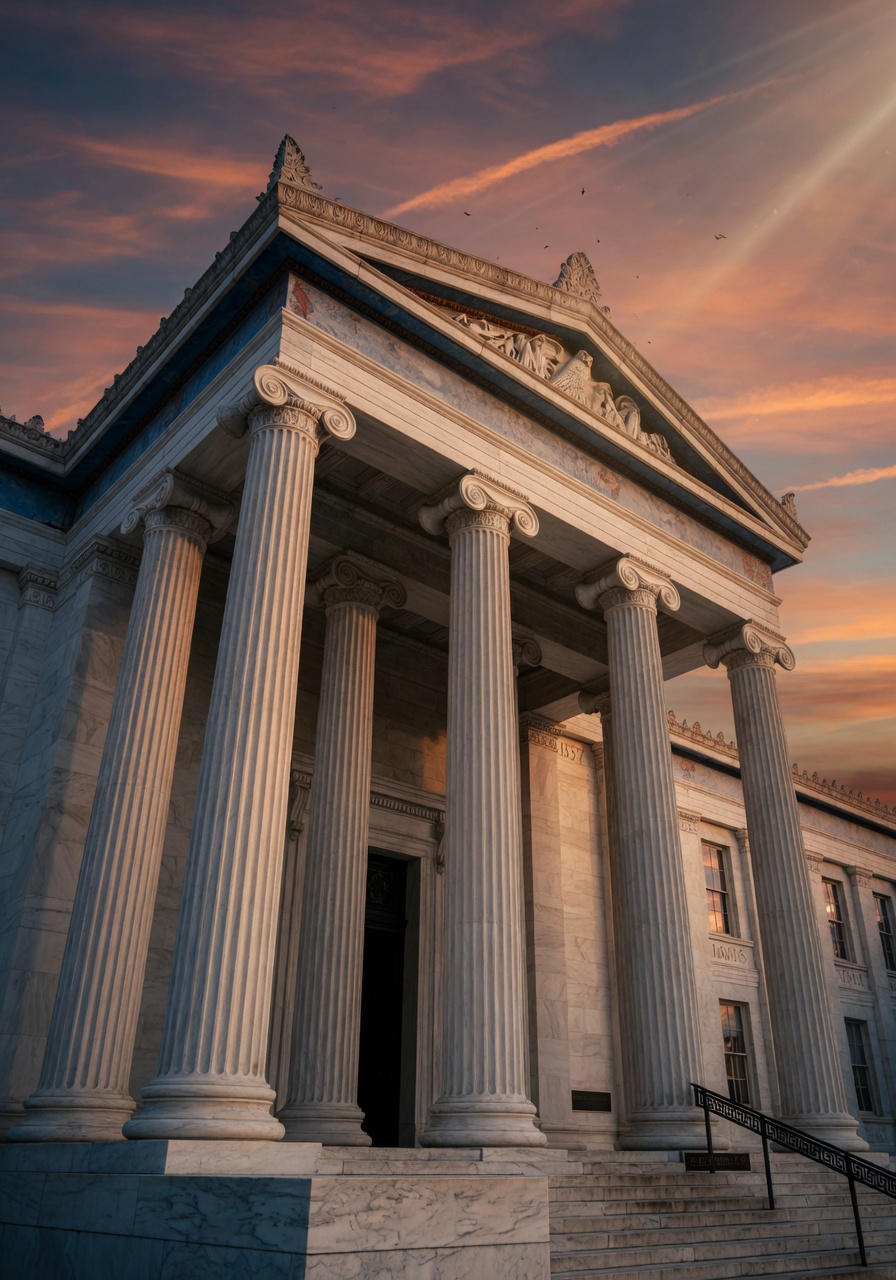
Greek Revival columns have shouldered more than roofs over the years—they’ve carried the weight of democratic aspirations from ancient temples straight into the American landscape. These sturdy forms first gained traction in the young United States during the 1820s, when architects reached back to Athens for visual shorthand that spoke of stability and self-rule. Their clean lines and measured proportions still turn up on everything from county courthouses to front porches, quietly tying today’s structures to ideas that predate the country itself.
The three classic orders remain the backbone of the style. Doric columns keep things spare and strong, with shallow flutes running up a shaft that tapers slightly and ends in a plain, no-nonsense capital—the same look that defines the Parthenon. Ionic versions introduce graceful scroll-like volutes at the top, lending a lighter touch that suits libraries or homes wanting quiet refinement. Corinthian columns go furthest, wrapping the capital in layered acanthus leaves for a richer, almost botanical flourish that works best on public buildings meant to impress. Builders still pay attention to entasis, that gentle outward curve in the shaft meant to correct the eye’s tendency to see straight lines as bowed inward. Height-to-diameter ratios stay consistent too, usually eight to ten times for Doric work, while bases stay minimal so the focus stays on the shaft itself.
The style took off in the States after the Revolution, as leaders like Thomas Jefferson and William Strickland looked to Greece as the original model for republican government. Philadelphia’s Second Bank of the United States, finished in 1819, set the tone with its Doric portico that directly echoed the Parthenon. Similar moves shaped early additions to the U.S. Capitol and crossed the Atlantic to influence London’s British Museum. Rather than simple copying, the choice signaled a deliberate turn away from ornate Baroque forms toward something clearer and more rational, especially as factories and cities grew around them. By the middle of the century the look had spread across statehouses, banks, and plantation homes, turning Greek forms into everyday markers of civic authority.
Today the same columns appear in less expected settings. Fiberglass Ionic versions now front oversized suburban houses chasing instant pedigree, while resorts such as Georgia’s Sanctuary Golf Club use tall Corinthian replicas to frame open spaces. Restoration projects keep historic examples intact—the marble Doric shafts at the Rhode Island State House, for instance, were carefully renewed in the 1990s. Newer versions rely on recycled polymer composites that mimic stone without the environmental cost of quarrying, letting the style continue without draining resources.
What keeps these columns relevant is their ability to suggest permanence in a time of rapid change. They still project reliability, which is why banks and courthouses favor them. Updated materials also fit modern green-building standards, proving classical shapes can meet current demands for efficiency. Whether they frame a modest porch or a state capitol dome, Greek Revival columns continue to connect the present built environment to older ideas of proportion, order, and shared purpose.
Comments are closed