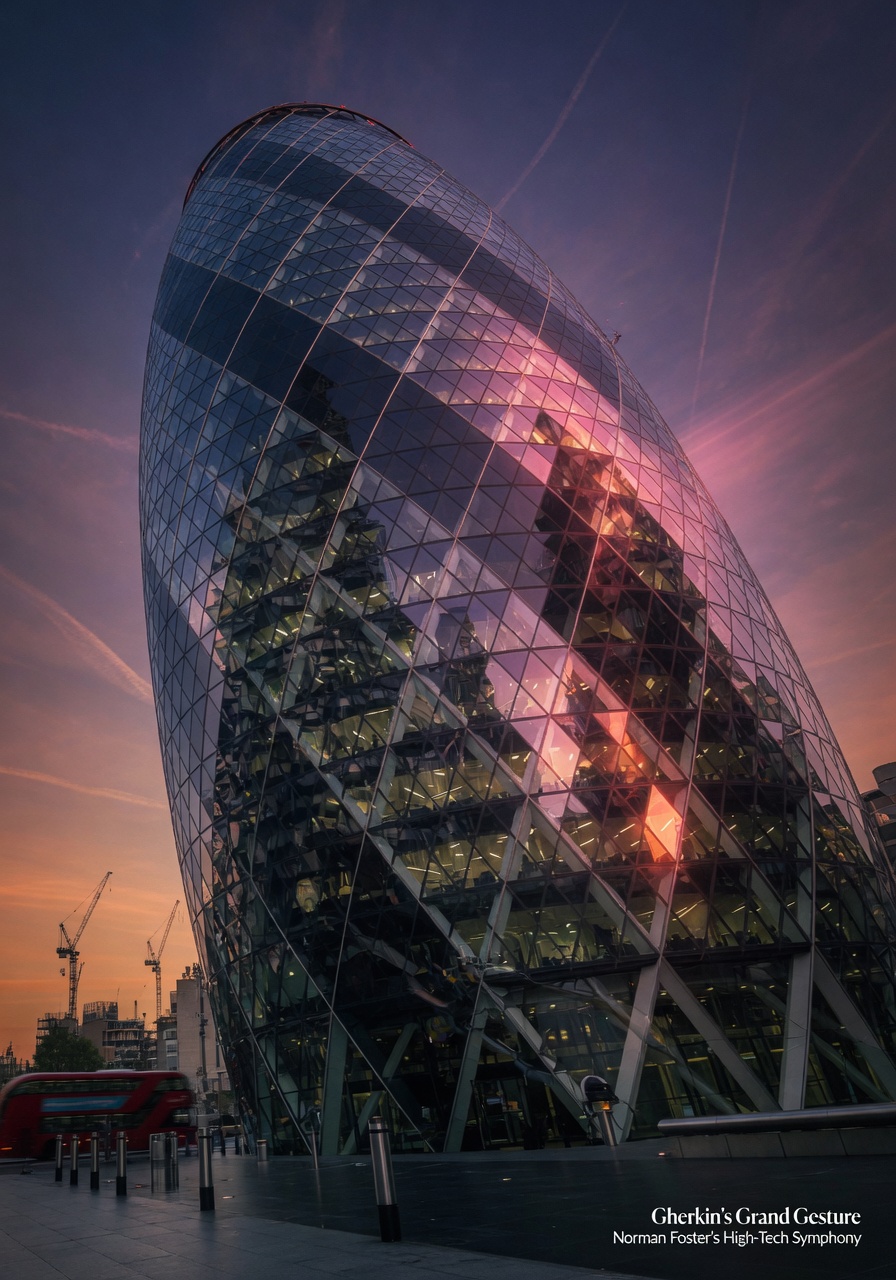
Norman Foster treats architecture as an exercise in revelation rather than concealment. His towers and cultural halls put their inner workings on display—ducts, joints, and load paths become part of the visual language instead of afterthoughts tucked behind walls. The result is a body of work that feels both machine-like and deeply human, shaped by the belief that clarity in construction can also deliver comfort and efficiency.
High-tech design surfaced in the late 1970s as a deliberate counterpoint to the heavy, inward-looking forms of Brutalism. Foster, alongside Richard Rogers and Renzo Piano, drew from the Pompidou Centre’s decision to turn services outward. Where others saw industrial brashness, Foster spotted opportunity for lightness and adaptability. After studies in Manchester and at Yale, he launched Foster Associates in 1967 and began testing ideas of modularity and environmental control. The Sainsbury Centre, completed in 1978, proved the approach could work at scale: a single long volume whose end walls slide open on computer command, letting galleries reconfigure without structural drama.
Certain moves recur across his projects. Diagrid shells reduce steel tonnage while creating fluid surfaces that shed wind loads, as seen in 30 St Mary Axe. Double-skin facades and integrated photovoltaics cut energy demand without sacrificing daylight. At the Hearst Tower, the triangulated addition rises directly from the 1928 base, salvaging most of the original steel rather than starting from scratch. These choices read as practical responses to site constraints and climate data, not stylistic flourishes.
The same logic now shapes larger civic and corporate commissions. Apple Park’s circular glass envelope maximizes natural ventilation and on-site power generation for thousands of daily occupants. Lusail Stadium in Qatar was engineered for post-event disassembly, its seating and cladding designed to migrate to smaller venues once the tournament ended. The Eden Project’s ETFE cushions demonstrate how lightweight skins can shelter entire ecosystems with minimal embodied carbon. In each case, technology serves longevity rather than novelty.
Cities today face tighter carbon budgets and denser populations. Foster’s insistence on measurable performance—lower material use, adaptable floor plates, passive systems—offers a workable template. At eighty-eight he still leads projects that test new materials and digital fabrication methods. The through-line remains consistent: expose what matters, engineer for change, and let the building itself communicate how it works.
Comments are closed