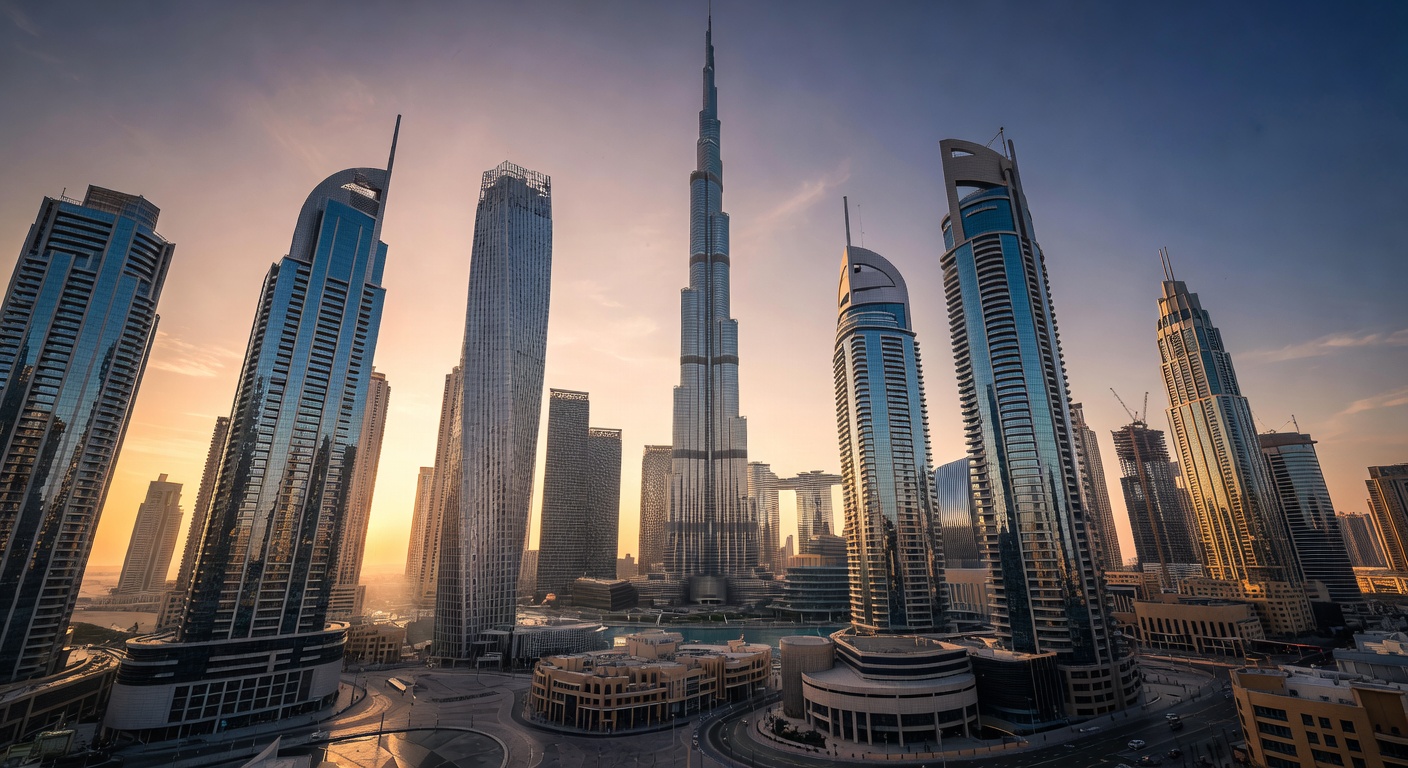
Dubai’s skyline doesn’t just rise—it defies gravity, piercing clouds with audacious spires that redefine human ambition. At the heart of this spectacle are supertall skyscrapers, structures soaring beyond 300 meters, where engineering marvels collide with unbridled vision. These aren’t mere buildings; they’re statements of a city’s relentless drive to conquer the horizon.
The story begins in the late 1990s, when Dubai, a modest trading port dwarfed by oil-rich neighbors, pivoted to tourism and real estate. Sheikh Mohammed bin Rashid Al Maktoum envisioned a metropolis of wonders, betting big on height to symbolize progress. The turning point came in 2004 with the Burj Al Arab, a sail-shaped icon at 321 meters, but it was the Burj Khalifa in 2010 that shattered records. At 828 meters across 160 floors, it’s the world’s tallest, designed by Adrian Smith of Skidmore, Owings & Merrill. Its buttressed core and Y-shaped footprint channel wind forces, allowing it to sway just 1.5 meters in gales— a feat of reinforced concrete piled 50 meters deep into the desert sand.
Modern exemplars push boundaries further. The Marina 101 and 106 towers in Dubai Marina exemplify clustered supertalls, their glass facades reflecting a glittering waterfront. Princess Tower, at 414 meters, held the residential tallest title until eclipsed by others. Now, the skyline boasts over 20 supertalls, with Address Beach Resort’s dual 75-story peaks at 310 meters framing Jumeirah Beach. Key features unite them: sky gardens for wind relief, tuned mass dampers to counter sway, and high-performance glass slashing energy use by 40%. Elevators hit 10 meters per second, whisking residents skyward in under a minute.
What powers this frenzy? Advanced materials like high-strength concrete (up to 100 MPa) and outrigger trusses for stability, born from BIM software simulating thousands of scenarios. Sustainability nods include solar-integrated facades and seawater cooling, vital in 50°C heat.
Why does it matter today? Dubai’s supertalls aren’t vanity projects; they fuel a $100 billion economy, drawing 17 million tourists yearly and housing 3.5 million in vertical density—crucial on limited land. They pioneer resilient design against climate threats like sandstorms and rising seas, influencing global icons from Jeddah’s Kingdom Centre to New York’s Hudson Yards. Yet challenges loom: the 2020 Expo 2020 site birthed District 2020 with sustainable towers, but labor controversies and debt raise questions. Still, as Dubai eyes a 1-km tower, these behemoths signal humanity’s ascent, blending bravado with innovation in a world racing upward.
Comments are closed