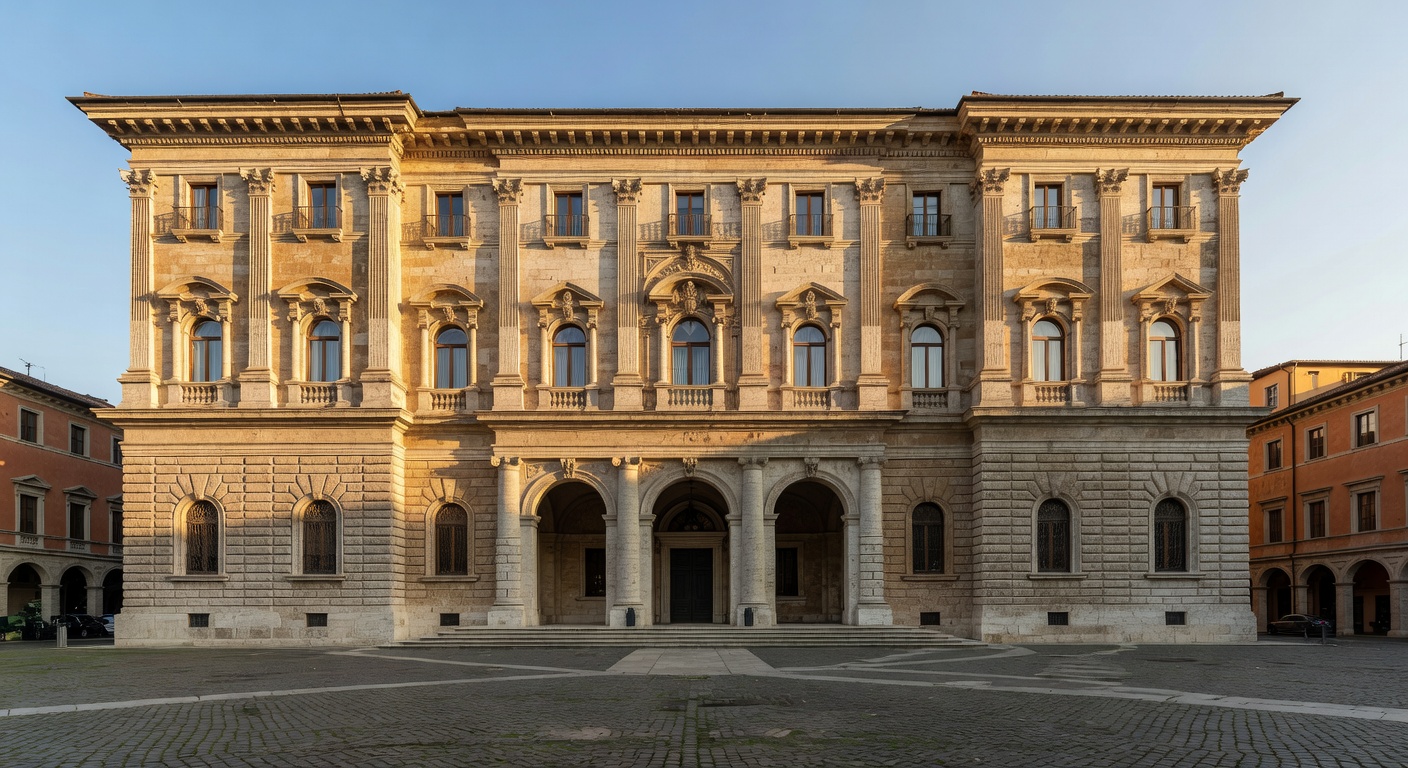
The Renaissance palazzo stands as a testament to Italy’s rebirth of classical ideals, blending fortified strength with artistic splendor. Emerging in the 15th century amid turbulent city-states like Florence and Venice, these urban palaces were homes for the era’s merchant princes and bankers—families like the Medici—who sought to project wealth, security, and cultural supremacy. Unlike medieval castles, palazzi adapted Roman architecture to Renaissance humanism, symbolizing the shift from feudal gloom to enlightened urban living.
At their core, palazzi featured robust stone facades, often rusticated at the ground level with massive, rough-hewn blocks that evoked ancient Roman walls. This “piano nobile” design elevated the main living quarters above street level, accessible via grand staircases, while the basement housed stables and storage. Symmetry ruled: centered doorways flanked by evenly spaced windows, topped by classical cornices and pediments. Inside, courtyards—chiostro—provided light and air, surrounded by arcades supported by slender columns. Frescoed walls, sculpted friezes, and coffered ceilings turned private spaces into galleries of art, with luminaries like Michelangelo and Raphael contributing designs.
Take Palazzo Medici Riccardi in Florence (1444-1460), Michelozzo’s masterpiece for Cosimo de’ Medici. Its austere exterior hides a serene courtyard with serene arches and a garden evoking antiquity. Palazzo Farnese in Rome (1517), designed by Antonio da Sangallo the Younger and completed by Michelangelo, ramps up the grandeur with a monumental cornice that crowns the structure like a classical temple. Venice’s Ca’ d’Oro (1428-1430), though Gothic-influenced, previews Renaissance opulence with its intricate marble tracery and gilded details shimmering over the Grand Canal.
These designs weren’t mere aesthetics; they were political statements. In an age of factional strife, the palazzo’s thick walls and few ground-floor windows deterred rivals, while lavish interiors hosted diplomacy and patronage, fueling the Renaissance itself. Engineers like Brunelleschi innovated with perspective and proportion, drawing from Vitruvius’s treatises rediscovered in the 1400s.
Today, Renaissance palazzo principles echo in modern architecture, proving their timeless appeal. Zaha Hadid’s jagged facades nod to rustication’s texture, while luxury apartments in New York or Dubai mimic the piano nobile for privacy and views. Historic palazzi thrive as museums—Palazzo Vecchio in Florence draws millions—or boutique hotels like Rome’s Palazzo Manfredi, blending heritage with high-end hospitality. They matter because they embody resilience: sturdy yet beautiful, private yet communal. In our fragmented world, the palazzo reminds us that great design harmonizes defense with delight, utility with art—lessons for sustainable, soulful cities ahead.
(Word count: 428)
Comments are closed