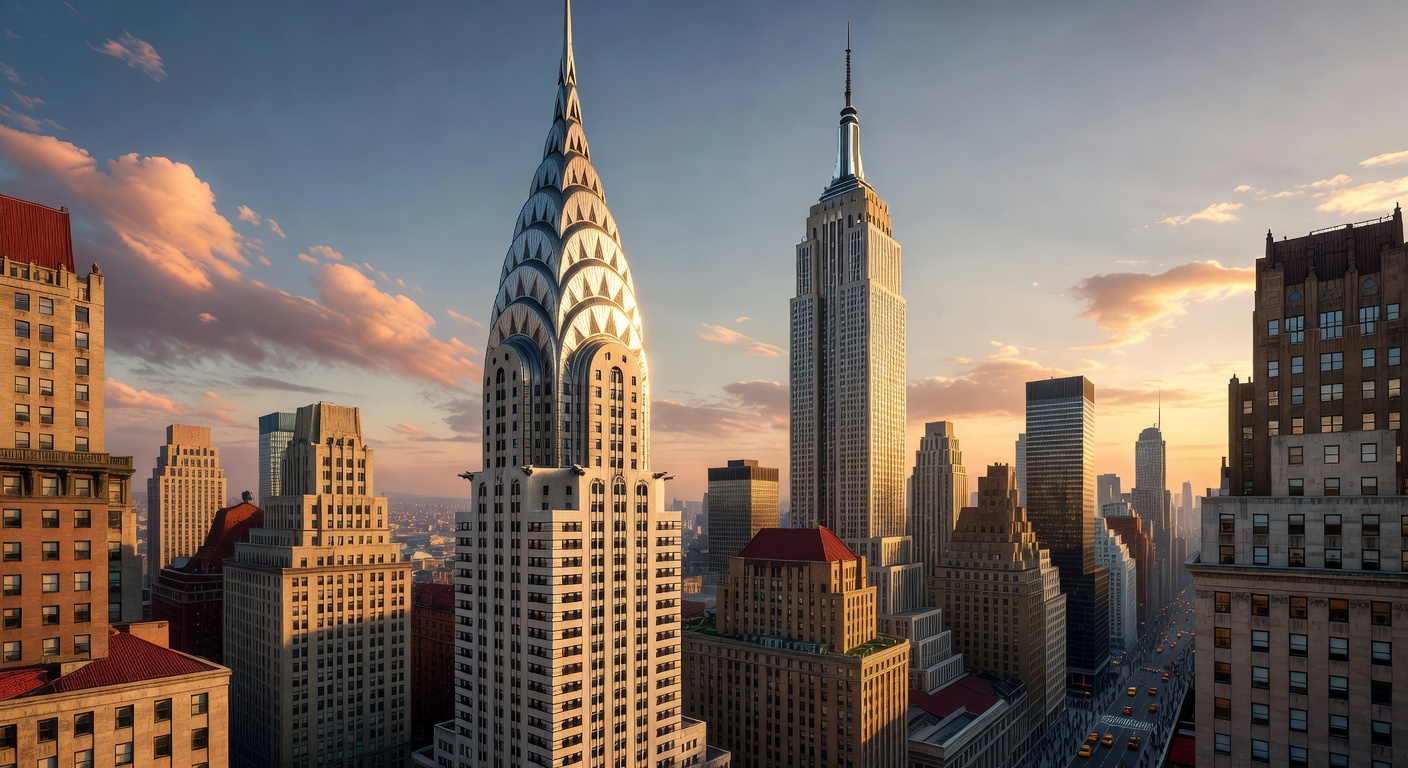
Perched atop Manhattan’s skyline like jeweled crowns, New York’s Art Deco spires define the city’s audacious vertical spirit. These slender pinnacles, often clad in terracotta, stainless steel, or gilded bronze, pierce the clouds with a blend of geometry and glamour. From the Chrysler Building’s iconic stainless-steel sunburst to the Empire State Building’s mooring mast, they embody the 1920s-1930s obsession with height, speed, and modernity. Unlike the squat bulk of earlier skyscrapers, these spires taper elegantly, drawing the eye upward in a vertical ballet of setbacks and finials.
Art Deco’s golden era dawned amid the Roaring Twenties’ economic boom and technological leaps. Architects like William Van Alen and William Lamb channeled the era’s zest for luxury—think ocean liners, luxury cars, and Hollywood glamour—into urban form. The style, born from the 1925 Paris Exposition Internationale des Arts Décoratifs, fused modernism’s clean lines with ornate motifs: ziggurats echoing ancient Babylon, sunbursts symbolizing a new dawn, and eagles for American might. Zoning laws of 1916 mandated setbacks to preserve light and air, birthing the wedding-cake silhouette that spires crowned. The Chrysler Building (1930), Van Alen’s masterpiece, raced to claim the title of world’s tallest at 1,046 feet, its 185-foot spire secretly assembled in five frenzied days to outpace rivals. The Empire State Building (1931) eclipsed it at 1,250 feet (1,454 with antenna), its aluminum-clad spire originally designed as a dirigible dock—a nod to futuristic air travel that never quite took off.
Fast-forward to today, and these spires endure as living relics amid glass-and-steel newcomers. The Chrysler’s vertex, with its layered steel fans, gleams eternally, restored in 1990s renovations that preserved its patina. The Empire State’s spire, floodlit in rotating colors for holidays and causes, remains a global beacon—125 million visitors annually affirm its pull. Modern echoes appear in One World Trade Center’s subtle spire, reaching 1,776 feet as a 9/11 memorial, or the tapered crown of 432 Park Avenue (2015), a minimalist Deco revival by Rafael Viñoly. These updates nod to sustainability: LED lighting slashes energy use, while stainless steel resists corrosion in a changing climate.
Why do these spires matter now? In an age of homogenization, they pulse with human ingenuity and narrative. They symbolize resilience—surviving the Depression, wars, and terror attacks—while inspiring awe in a digital era craving tangible wonder. As New York grapples with supertall density, Art Deco spires remind us that architecture isn’t just shelter; it’s aspiration etched in steel. Climb to an observatory, gaze at their silhouettes against the dusk, and feel the city’s heartbeat: bold, unapologetic, eternally reaching higher.
(Word count: 428)
Comments are closed