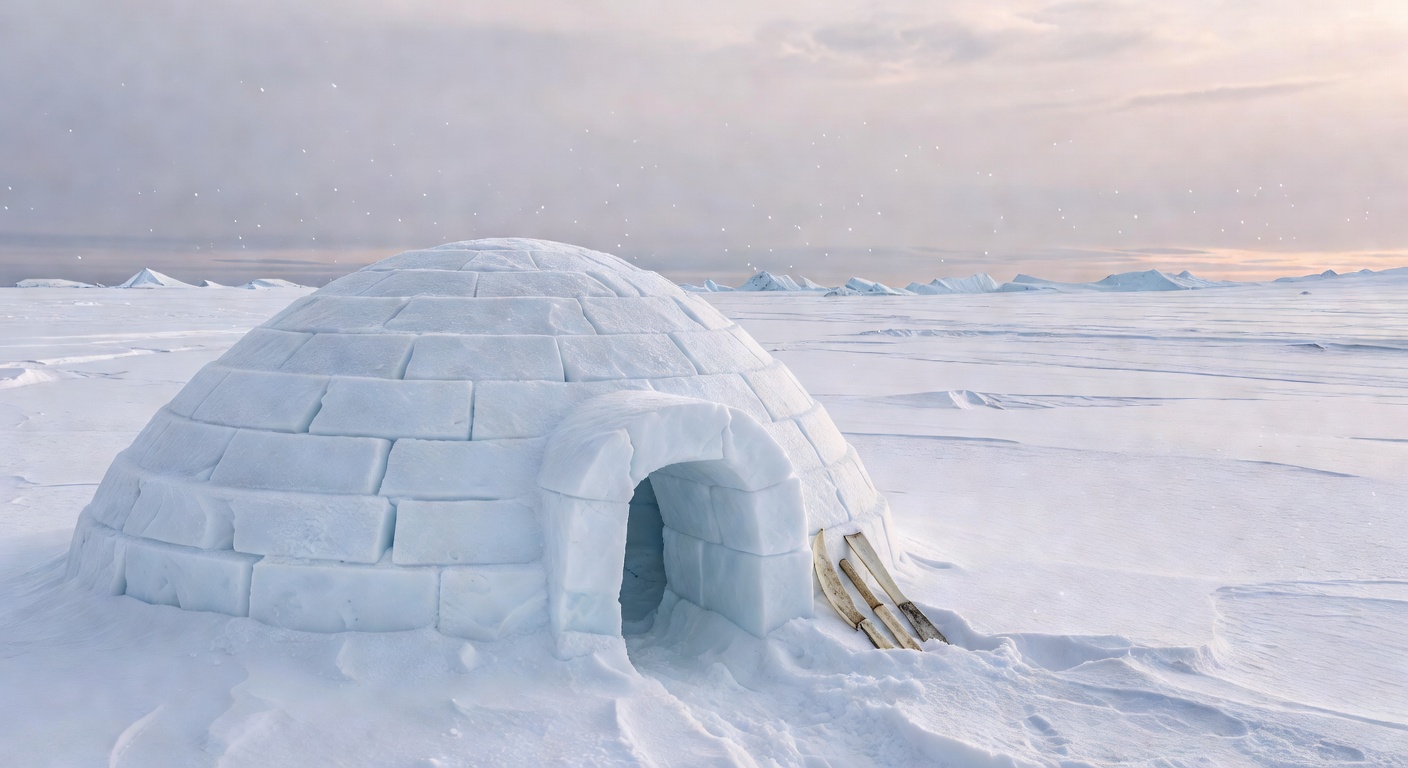
In the vast, frozen expanses of the Canadian Arctic and Greenland, the Inuit people transformed snow into sophisticated shelters that defy modern preconceptions of primitive living. Far from crude huts, igloos represent a pinnacle of environmental engineering, honed over centuries by a culture intimately attuned to ice and wind.
At the heart of igloo construction lies the catenary dome—a self-supporting arch shape mathematically proven to distribute weight with minimal stress. Inuit builders, without blueprints or calculators, intuitively grasped this principle. They began by cutting snow blocks from the upwind side of a drift, selecting dense, wind-packed snow that hardens like concrete under pressure. Each block, roughly 2-3 feet long and weighing 30-50 pounds, is precisely angled and spiraled upward. The first layer forms a low circle, about 7-10 feet in diameter, with blocks leaning inward at 30-40 degrees. Subsequent rings tighten progressively, their outer faces overhanging by a few inches to create the dome’s curve. The final keystone block, inserted from inside, locks everything in place, sealing the structure against collapse.
Key features elevate the igloo beyond mere shape. A short tunnel entrance, elevated slightly, prevents wind-driven snow and cold air from infiltrating the living space—cold sinks into the vestibule, while body heat rises within. Interior benches of packed snow, covered with animal skins, provide insulation and sleeping platforms. A central air vent at the dome’s apex allows smoke from a seal-oil lamp to escape, drawing in fresh oxygen through the tunnel. These elements create a microclimate: inside temperatures can reach 60°F (15°C) even when it’s -40°F (-40°C) outside, thanks to the snow’s low thermal conductivity—thinner walls actually insulate better than thick ones by trapping a breathable air layer.
Historically, igloos served as winter hunting camps, built in hours by small teams using only a snow knife (panik) from bone, ivory, or metal. Archaeological evidence and oral histories from the 19th century, documented by explorers like Knud Rasmussen, reveal igloos as semi-permanent homes during caribou hunts, sometimes housing families for weeks. They dotted Thule culture sites from 1000 AD, adapting to nomadic life in a treeless world where wood was scarce.
Today, igloos inspire modern innovation. Survival experts and architects study their passive heating for energy-efficient designs in cold climates. In 2019, Swiss engineers replicated igloos using 3D-printed snow blocks for disaster relief shelters, proving scalability. Climate researchers deploy igloo-like observatories in Antarctica to monitor ice melt without heavy machinery. Amid global warming threatening Arctic ice, these ancient techniques underscore sustainable building—zero-waste, recyclable, and hyper-local.
The igloo matters now as a lesson in ingenuity: it shows how deep ecological knowledge can yield resilient architecture. In an era of resource strain, the Inuit’s snow domes remind us that the best engineering harmonizes with nature, not against it. Next time you battle a winter chill, tip your hat to these Arctic geniuses.
Comments are closed