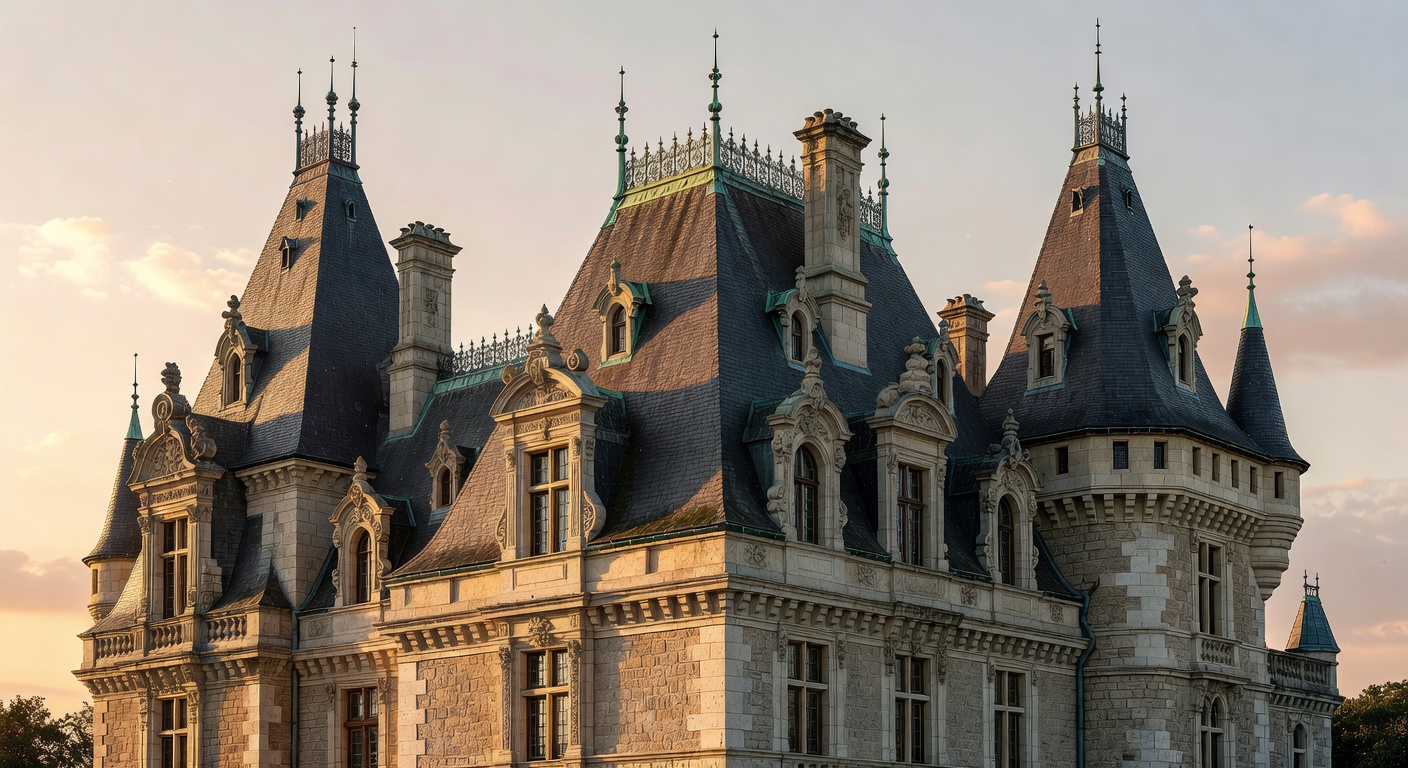
Perched atop some of the world’s most opulent buildings, chateauesque roofs rise like jeweled crowns, blending French Renaissance flair with a dash of Gothic drama. These aren’t just coverings—they’re architectural showstoppers, evoking the fairy-tale chateaus of the Loire Valley while adapting to grander scales. If you’ve ever gazed up at a turreted mansion or a palatial hotel and felt a twinge of royal envy, you’ve likely encountered this style’s signature feature: the steeply pitched mansard roof, reimagined with extravagant embellishments.
The story begins in 16th-century France, where architects drew from medieval castles and Italian villas to craft the chateau aesthetic. King Francis I set the tone at places like Chambord, with its iconic octagonal staircase tower and layered roofs pierced by dormers. But chateauesque as a full style exploded in the 19th century during the French Second Empire under Napoleon III. Architect Victor Daly and others popularized the mansard roof—named after François Mansart, who revived it in the 17th century—characterized by its double slope: a steep lower section for maximum attic space and a gentler upper curve. Adornments like slate tiles in vibrant fish-scale patterns, ornate cresting along ridges, and elaborate dormer windows turned these roofs into canvases of excess.
Key features make chateauesque roofs instantly recognizable. Expect steeply pitched surfaces (often 60-70 degrees) to shed heavy snow while maximizing interior volume. Dormers galore—pedimented, ogee-curved, or bull’s-eye—protrude like watchful eyes, often framed in stone with sculptural details. Towers and turrets punctuate corners, topped with conical spires or lanterns. Materials shine: multicolored slate, copper flashing that patinas to verdigris, and galvanized iron for intricate cresting. Unlike simpler gables, these roofs demand engineering savvy to support their weight and complexity.
Fast-forward to America, where chateauesque hit its stride during the Gilded Age. Richard Morris Hunt imported the style for tycoons like the Vanderbilts at Biltmore Estate in North Carolina (1895), the largest private home in the U.S., with its 250-room sprawl under a sprawling slate roof adorned with 178 turrets. The 1893 Chicago World’s Fair showcased it too, influencing public buildings. Modern echoes persist: the New York City skyline nods to it in the Gilsey House hotel, restored with gleaming mansards. Contemporary architects tweak it for luxury condos, like those in Miami’s Faena District, blending original grandeur with sustainable tech—think solar-integrated slates and insulated underlayers.
Why does this matter today? In an era of flat-roofed minimalism, chateauesque roofs remind us of architecture’s power to inspire awe and storytelling. They champion craftsmanship amid mass production, preserving heritage in historic districts while adapting to green building standards. Urban planners value their verticality, adding skyline drama without sprawling footprints. For homeowners, a chateauesque-inspired roof elevates curb appeal, boosting property values by 10-20% in period revivals, per real estate data. Ultimately, these roofs aren’t relics; they’re a blueprint for blending opulence with functionality, proving that a building’s top can redefine its soul. Next time you spot one, look closer—it’s history wearing a very fancy hat.
Comments are closed