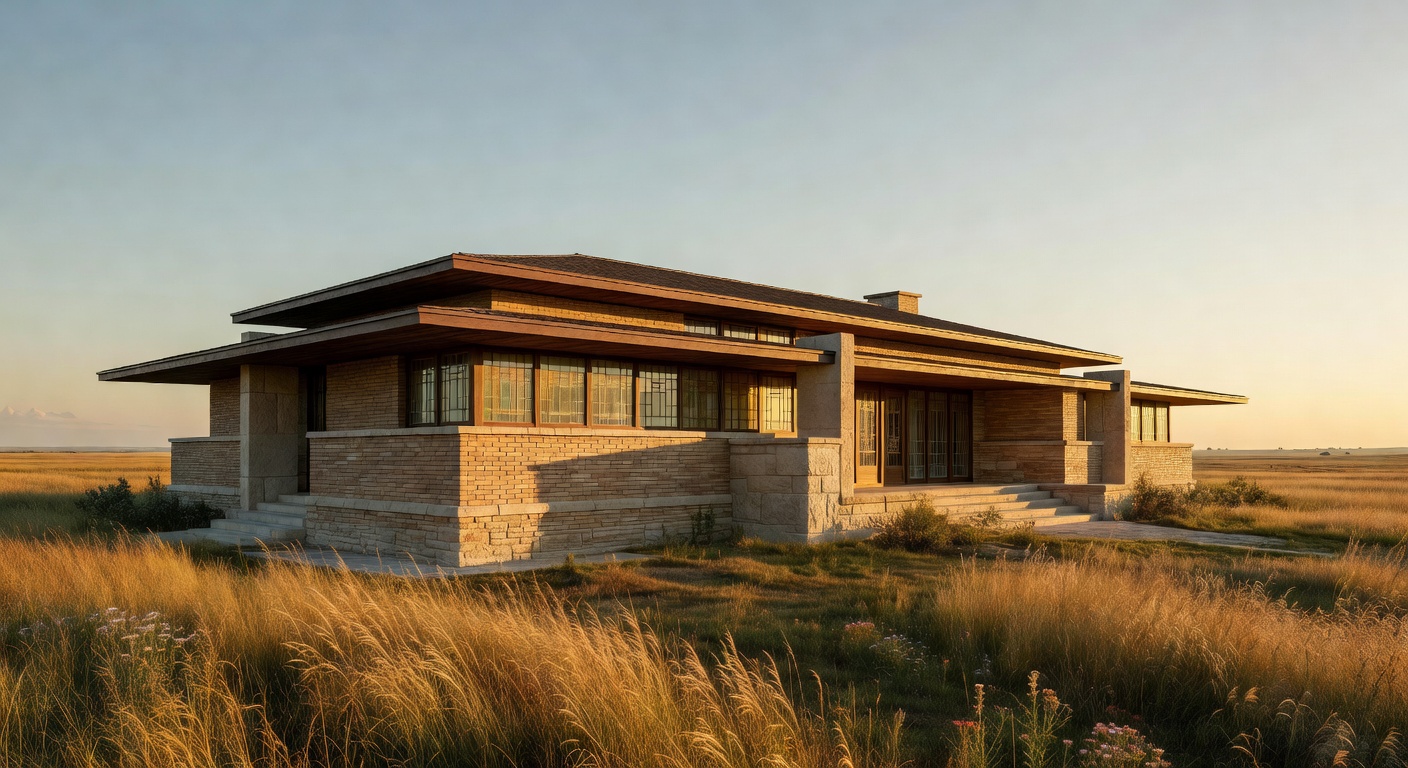
In the flat expanses of the American Midwest, where the land stretches endlessly under vast skies, architecture found a way to echo that horizon. The Prairie School movement, born in the late 19th and early 20th centuries, harnessed horizontal lines as its signature weapon against the vertical pomp of Victorian excess. Led by Frank Lloyd Wright and his contemporaries like Louis Sullivan and Walter Burley Griffin, this style didn’t just build houses—it grounded them in the earth, making buildings feel like natural extensions of the prairie landscape.
At its core, the horizontal line in Prairie School design creates a sense of grounded expansiveness. Low-pitched roofs with wide overhangs stretch outward, mimicking the low horizon of the plains. Continuous horizontal bands of windows and trim unify the facade, drawing the eye across the structure rather than upward. Brickwork often emphasizes level courses, while cantilevered eaves shelter living spaces from the relentless prairie winds. Interiors reinforce this with open floor plans and built-in furniture that flow parallel to the ground, blurring boundaries between indoors and out. Wright’s famous Robie House in Chicago (1909) exemplifies this: its dramatic hip roofs and ribbon windows hug the site, pulling the viewer into a dialogue with the surrounding terrain.
Historically, Prairie School emerged as a rebellion against the ornate, imported European styles dominating Chicago after the Great Fire of 1871. Architects like Wright, influenced by the Arts and Crafts movement and Japanese prints, sought an organic American architecture rooted in local materials—red cedar, limestone, and native plants. It was democratic too, aiming to elevate everyday homes rather than just monuments. By the 1910s, the style spread to suburbs and even Australia via Griffin’s Canberra designs, but World War I and modernism’s rise curtailed its momentum.
Today, Prairie School’s horizontal ethos resonates in sustainable design. Modern architects revive it in eco-friendly homes that prioritize passive solar gain through south-facing bands of windows, reducing energy needs. Take Studio Gang’s Aqua Tower in Chicago (2009), which nods to Wright with its wavy, horizon-like balconies, or the contemporary prairie-style homes in the Midwest using prairie grass roofs and geothermal systems. These lines matter now because they combat urban verticality, fostering mental well-being in an age of towering glass skyscrapers. Studies from environmental psychology suggest horizontal forms evoke calm and openness, countering the stress of dense cities.
Ultimately, Prairie School horizontals remind us that architecture can harmonize with nature rather than dominate it. In a world racing toward the sky, these lines pull us back to earth—inviting us to breathe, expand, and belong. They prove that true innovation often lies in subtraction: less height, more horizon.
(Word count: 428)
Comments are closed