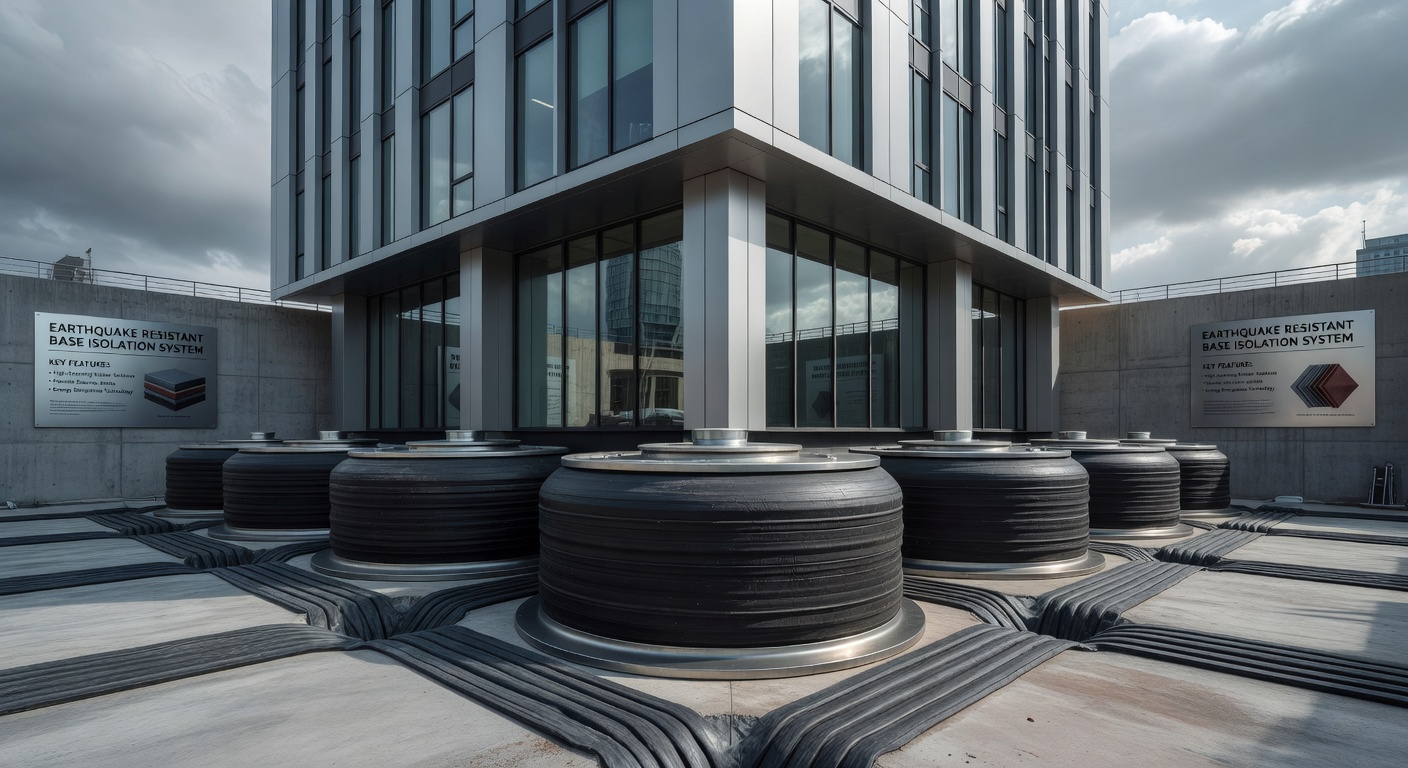
Earthquakes strike without warning, turning solid ground into a treacherous wave. Yet amid the chaos, innovative engineering has found a way to let buildings dance rather than crumble. Enter base isolation, a seismic superhero that decouples structures from the earth’s violent tremors. By placing a flexible “shock absorber” between a building and its foundation, this technique allows the ground to sway while the structure above stays remarkably steady. It’s like giving your skyscraper roller skates—smooth gliding over rough terrain.
At its core, base isolation relies on isolators installed at the base of columns or walls. These come in various forms: lead-rubber bearings, which combine rubber’s elasticity with lead’s damping to absorb energy; friction pendulum bearings, resembling sliding saucers that let buildings rock gently on a curved surface; or high-damping rubber devices that convert shaking into heat. The magic happens through reduced acceleration transmission—studies show isolators can cut building movements by 70-80% during major quakes. Unlike rigid foundations that rigidly transfer every jolt upward, isolation shifts the structure’s natural frequency away from the earthquake’s dominant vibrations, minimizing resonance.
This isn’t futuristic tech; its roots trace back to the 19th century. In 1884, Scottish engineer William Webster patented early isolators for machinery, but real-world application lagged until the 20th century. New Zealand pioneered the shift after devastating quers in the 1960s and 70s, mandating isolation in some codes. Japan, ever quake-prone, embraced it post-1985 Mexico City quake, where soft soil amplified destruction. Today, it’s a global staple.
Modern marvels showcase its prowess. Tokyo’s Roppongi Hills Mori Tower, a 238-meter behemoth completed in 2003, sits on 128 rubber-lead isolators, unscathed by the 2011 Tohoku quake’s aftershocks. In the U.S., the new San Francisco Federal Building (2012) uses friction pendulums, designed to withstand a magnitude 8.0 event. Christchurch’s convention center, rebuilt post-2011 quakes, employs isolators that let it flex 300mm without damage. Even historic preservation benefits: Italy’s Cathedral of St. Peter in Frascati was retrofitted with isolators in the 1990s, safeguarding Renaissance art from seismic threats.
Why does this matter now? Urbanization packs megacities onto fault lines—Tokyo, Istanbul, Los Angeles face overdue big ones. Climate change indirectly ups risks via induced seismicity from fracking or reservoirs. Base isolation slashes retrofit costs over demolition-rebuild (often 30-50% cheaper long-term) and protects lives: in the 1995 Kobe quake, isolated structures fared vastly better, saving hundreds. With global quake losses topping $300 billion yearly (per UN estimates), it’s a smart investment—insurance premiums drop, downtime minimizes, economies rebound faster.
As plate tectonics grind on, base isolation stands as humanity’s elegant retort: not fighting nature’s fury, but flowing with it. Next time the ground heaves, these unsung pads ensure our tallest dreams don’t topple.
Comments are closed